
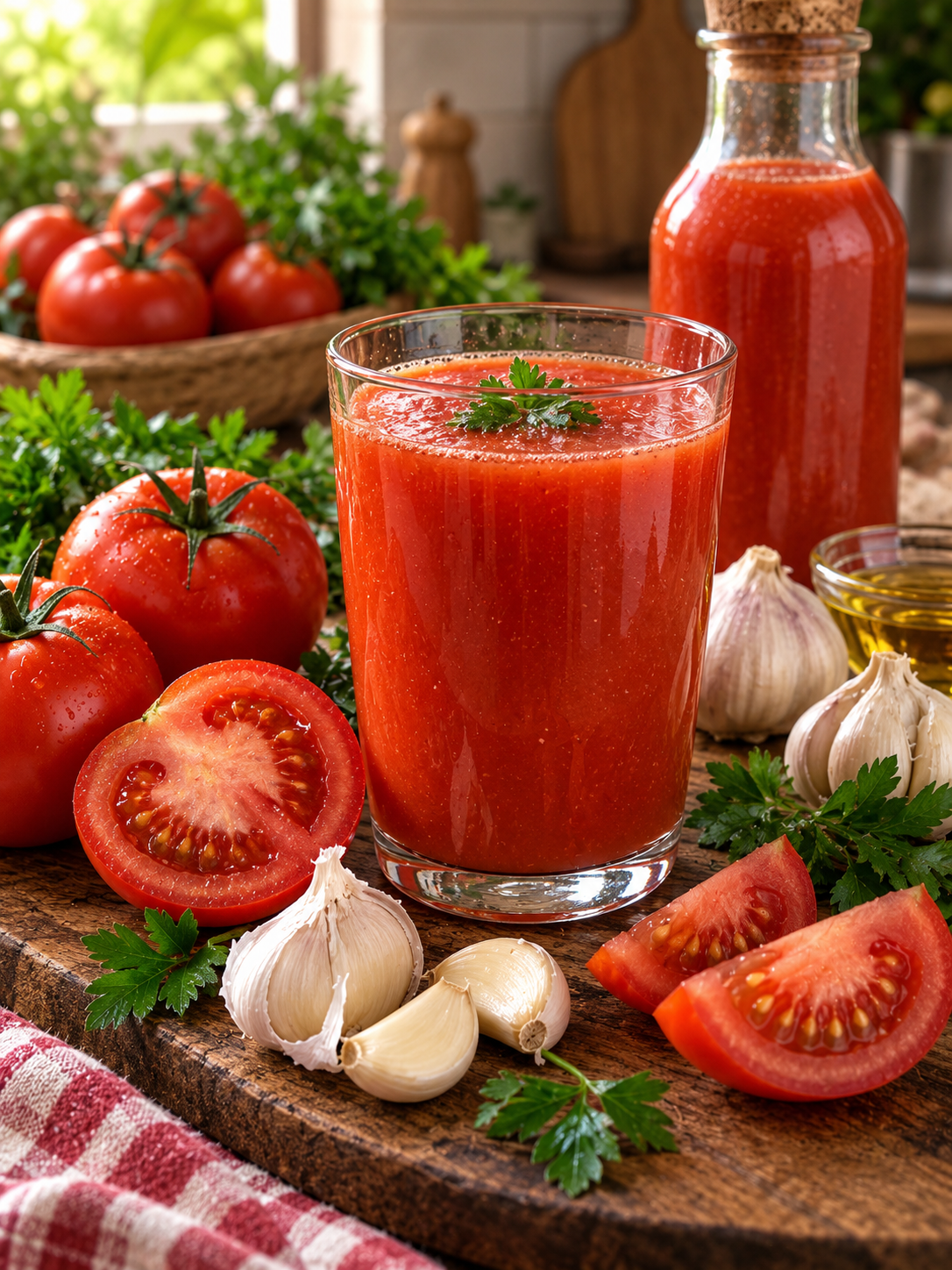
Waking once at night to urinate can be annoying.
Waking three, four, or five times can turn the entire night into a repeated walk from the bed to the bathroom—and back again.
For men over 50, one common reason is benign prostatic hyperplasia (BPH), a noncancerous enlargement of the prostate. As the prostate enlarges, it can press on the urethra and contribute to urgency, frequency, weak stream, and nighttime urination. BPH is the most common prostate problem in men over 50.
That is why simple kitchen remedies such as tomato and garlic water attract so much attention.
Tomatoes contain lycopene. Garlic contains sulfur-containing plant compounds. Both foods can fit into a healthy diet.
But there is an important reality:
There is not enough evidence to say that tomato-garlic water shrinks an enlarged prostate, restores urine flow, or stops nocturia.
NCCIH specifically states that evidence is insufficient to support lycopene for the prevention or treatment of BPH.
So the habit may be worth enjoying as food—but not as a replacement for diagnosis or treatment.
🍅 What Is the Tomato-Garlic Water Habit?
A simple food-level version might use:
1 small ripe tomato
½ to 1 small garlic clove
1 cup water
Blend briefly and drink with or after a meal.
You can also skip the drink entirely and simply add tomato and garlic to meals.
That may actually be easier on the stomach.
Avoid turning it into an extremely concentrated “shot” with several cloves of raw garlic.
More garlic does not mean more prostate benefit.
🧔 Why Does BPH Cause So Many Nighttime Bathroom Trips?
The prostate sits below the bladder and surrounds part of the urethra.
When prostate tissue grows, urine may have more difficulty passing through.
Typical BPH symptoms can include:
Weak stream.
Difficulty starting.
Stop-and-start flow.
Dribbling.
Urgency.
Frequent urination.
Feeling that the bladder has not emptied.
Waking repeatedly at night to urinate.
That last symptom is called nocturia.
But nocturia is important because an enlarged prostate is only one possible cause.
🌙 Not Every “Hallway March” Comes From the Prostate
A man may assume:
“I wake four times because my prostate is swollen.”
Sometimes that’s correct.
But nighttime urination can also be influenced by:
Large evening drinks.
Caffeine.
Alcohol.
Diabetes.
Sleep problems.
Certain medications.
Bladder disorders.
Fluid shifting from swollen legs after lying down.
Heart or kidney problems.
That means the smartest strategy isn’t simply asking:
“Which drink shrinks my prostate?”
It is asking:
“Why am I making so much urine at night, and am I emptying my bladder properly?”
🍅 Why Tomatoes Enter the Prostate Conversation
Tomatoes are rich in lycopene, a carotenoid pigment responsible for their red color.
Lycopene has been investigated in relation to prostate health for years.
That makes tomatoes scientifically interesting.
But the marketing usually travels much further than the evidence.
NCCIH reviewed randomized trials and concluded that there is insufficient evidence to support lycopene for either preventing or treating BPH.
In practical terms:
Eating tomatoes is healthy.
Drinking tomato water is fine for many people.
But tomato does not have a proven prostate-shrinking effect.
🧄 Why Add Garlic?
Garlic is another nutritious kitchen ingredient containing biologically active sulfur compounds.
It can make meals more flavorful and may help people rely less on heavily salted sauces or processed seasonings.
But garlic should not be treated as a BPH medicine.
There is no good clinical evidence that adding raw garlic to tomato water causes enlarged prostate tissue to shrink.
The realistic benefit is dietary.
Not pharmaceutical.
📊 Tomato-Garlic Claims vs. What We Know
| Popular claim | Evidence-based view |
| Tomato-garlic water shrinks the prostate | Not established |
| Lycopene treats BPH | Evidence insufficient |
| Garlic opens urine flow | Not established |
| Tomatoes fit a healthy diet | Yes |
| Garlic can flavor food without much salt | Yes |
| BPH can cause nocturia | Yes |
| Drinking less near bedtime may help | Yes |
| Caffeine and alcohol may worsen symptoms | Yes |
| Complete inability to urinate needs urgent care | Yes |
⏰ Timing May Matter More Than the Drink
Here’s where many homemade prostate drinks backfire.
A man wakes several times every night.
Then at 10 p.m. he drinks a large glass of tomato-garlic water because the internet calls it a “night prostate remedy.”
Now his bladder has even more fluid to process.
NIDDK advises men with mild BPH symptoms that they may benefit from drinking fewer liquids before bedtime.
So if you enjoy tomato-garlic water:
Drink it with lunch.
Or with an early dinner.
Not right before getting into bed.
☕ Coffee Could Be Part of the Problem
Before buying another prostate supplement, look at caffeine.
NIDDK recommends reducing beverages containing caffeine when managing mild BPH symptoms.
For some men, caffeine can aggravate:
Urgency.
Frequency.
Bladder irritation.
Nighttime trips.
Try moving coffee earlier in the day and tracking symptoms for one week.
That simple experiment can tell you more than a viral recipe.
🍺 Alcohol Can Add Another Bathroom Trip
Alcohol can increase urine production and disrupt sleep.
NIDDK also recommends limiting alcohol when it contributes to BPH symptoms.
So imagine this pattern:
Tomato drink at night.
Two beers.
Coffee after dinner.
Then waking repeatedly.
The prostate may be involved—but the nighttime fluid pattern certainly isn’t helping.
💊 Check Cold and Allergy Medicines
This is frequently overlooked.
NIDDK notes that certain cold and allergy medicines can worsen urinary symptoms and should be considered during BPH management.
Some men first notice a major slowdown in urine flow after taking a decongestant.
If symptoms suddenly worsen after a new medication, ask a pharmacist or clinician whether it could be contributing.
🚽 Try Double Voiding
If the bladder feels incompletely emptied, a simple technique may help some men:
Urinate normally.
Wait briefly.
Relax.
Then try to urinate again.
This is commonly called double voiding.
It does not shrink the prostate.
But it may help some people empty the bladder more effectively.
💧 Don’t “Flush” the Prostate With Gallons of Water
There is no need to force large amounts of water in an attempt to wash out prostate enlargement.
The prostate is tissue.
It cannot be flushed away.
Hydration matters, but if someone already has urinary frequency and nocturia, excessive evening fluid can worsen the very symptom they are trying to treat.
🍅 Whole Tomato vs. Tomato Juice
Whole tomato has an advantage:
You actually eat the food.
It provides fiber and fits naturally into meals.
Try:
Tomato with eggs.
Tomato and cucumber salad.
Tomato sauce with vegetables.
Tomato with olive oil and herbs.
A homemade soup.
You do not need to juice several tomatoes each day for “prostate detox.”
🧄 Raw Garlic vs. Cooked Garlic
Raw garlic can be harsh.
Some people develop:
Heartburn.
Stomach burning.
Nausea.
Gas.
Reflux.
If raw garlic bothers you, cooked garlic is perfectly reasonable as a culinary ingredient.
There is no evidence that forcing down painful raw-garlic shots gives superior BPH results.
🌿 What About Other Natural Prostate Remedies?
Several herbs have been studied.
But none deserves miracle status.
NCCIH says some limited evidence suggests stinging nettle and Pygeum africanum may improve certain BPH symptoms, but studies are generally small, short, and use different preparations and doses.
That makes them areas of interest—not guaranteed treatments.
🌴 What About Saw Palmetto?
Saw palmetto is probably the most heavily advertised prostate supplement.
Yet NCCIH’s current summary says a 2023 review of 27 studies found that saw palmetto taken alone provides little or no benefit for BPH symptoms.
That is useful context.
An herb can be famous for a condition without being strongly supported by evidence.
🍅 Is Lycopene Better Than Saw Palmetto?
There is no good evidence to declare one a reliable BPH treatment.
For lycopene specifically, NCCIH says evidence is insufficient to support its use for preventing or treating BPH.
Tomatoes remain excellent foods.
They simply shouldn’t be marketed as prescription substitutes.
💊 What Actually Treats an Enlarged Prostate?
Treatment depends on symptom severity.
For mild symptoms, lifestyle changes and monitoring may be enough.
For more troublesome symptoms, medications are available.
NIDDK notes that drugs such as finasteride and dutasteride can stop prostate growth or actually shrink the prostate in some men.
Other medicines can relax the muscles around the prostate and bladder outlet to improve urine flow.
And when obstruction is significant, minimally invasive procedures or surgery may be appropriate.
Those are very different interventions from tomato water.
📉 Symptom Improvement Does Not Always Mean Prostate Shrinkage
This distinction matters.
A man’s stream might improve because:
Bladder irritation decreased.
He changed evening fluids.
Medication relaxed smooth muscle.
He reduced caffeine.
He emptied his bladder more effectively.
That doesn’t necessarily mean the prostate became smaller.
Likewise, feeling slightly better after a tomato drink would not prove that the tomato shrank prostate tissue.
🧬 Bigger Prostate Doesn’t Always Mean Worse Symptoms
Prostate size and symptom severity don’t perfectly match.
A man with a larger prostate may have modest symptoms.
Another man with less enlargement may have significant urinary obstruction.
That is one reason proper evaluation is more useful than guessing based on symptoms alone.
🧔 BPH Is Not Prostate Cancer
BPH is benign, meaning noncancerous.
But urinary symptoms shouldn’t automatically be self-diagnosed.
Other prostate and urinary conditions can produce similar symptoms.
Persistent or worsening symptoms deserve evaluation.
🧪 What Might Be Checked?
Depending on the situation, a clinician may review:
Urinary symptoms.
Medication use.
Medical history.
Urine testing.
Prostate examination.
PSA when appropriate.
Urinary flow.
Residual urine remaining after urination.
Other tests if necessary.
The goal is not merely to confirm that someone is urinating frequently.
It is to determine why.
🚫 10 Mistakes Men Over 50 Make With “Prostate Drinks”
1. Drinking them immediately before bed.
More fluid may worsen nocturia.
2. Assuming tomato juice shrinks prostate tissue.
Evidence for lycopene in BPH remains insufficient.
3. Adding huge amounts of raw garlic.
More isn’t necessarily beneficial.
4. Ignoring caffeine.
Reducing it may improve urinary symptoms in some men.
5. Ignoring alcohol.
It may worsen nighttime urination.
6. Assuming every nighttime trip is caused by BPH.
7. Taking several prostate supplements together.
8. Stopping prescribed medication because a natural drink seems safer.
9. Ignoring increasingly weak urine flow.
10. Waiting at home when urination stops completely.
🌙 A Better Evening Routine for Nocturia
Instead of looking for a miracle bedtime beverage, try changing the evening pattern.
Have most of your fluids earlier.
Avoid drinking a large amount immediately before sleep.
Move caffeine earlier.
Reduce evening alcohol.
Use the bathroom before bed.
Take enough time to empty fully.
Review medicines that may worsen urination.
NIDDK specifically lists reducing late fluids, caffeine, alcohol, and reviewing medicines among lifestyle approaches for mild BPH symptoms.
📅 A Simple 7-Day Prostate Diary
For one week, record:
What time you stop drinking large quantities of fluid.
How much caffeine you consume.
Any alcohol.
How many times you wake to urinate.
Whether your stream is weak.
Whether you have urgency.
Whether you feel completely empty afterward.
This can reveal patterns that one random glass of tomato water never will.
🦵 Swollen Legs Can Also Affect Nighttime Urination
Another overlooked issue is daytime leg swelling.
When someone lies down, some accumulated fluid may return to circulation and eventually reach the kidneys, increasing nighttime urine production.
That means frequent nighttime urination is not always purely a prostate issue.
If you have persistent ankle or leg swelling, mention it during your medical evaluation rather than simply increasing prostate supplements.
⚠️ Garlic and Medication Considerations
Culinary amounts of garlic are usually very different from concentrated garlic supplements.
If someone is considering high-dose garlic supplements—especially while taking multiple medications—it is sensible to discuss this with a healthcare professional.
The same principle applies to any concentrated “prostate formula.”
Food and supplement doses are not equivalent.
🚨 When “Hallway Marches” Need Medical Attention
Urinary symptoms deserve prompt evaluation if you notice:
Blood in the urine.
Pain or burning with urination.
Fever or chills.
Severe pelvic or lower abdominal pain.
Repeated urinary infections.
Rapidly worsening stream.
Increasing inability to empty the bladder.
And one symptom requires particular urgency:
If you cannot urinate at all, seek medical care immediately.
BPH can obstruct urine flow, and acute urinary retention is not something to treat with tomato water.
❓ Frequently Asked Questions
Is tomato good for prostate health?
Tomatoes are nutritious and provide lycopene. However, NCCIH says there is insufficient evidence to support lycopene for preventing or treating BPH.
Does tomato-garlic water shrink the prostate?
There is no reliable evidence that this homemade drink shrinks an enlarged prostate.
Can garlic improve urine flow?
Garlic has not been established as a treatment for BPH-related obstruction.
Should I drink tomato water before bed?
Probably not if nocturia is your main problem. NIDDK recommends drinking fewer liquids before sleep when appropriate.
Why do I wake up three or four times to urinate?
BPH may contribute, but caffeine, alcohol, evening fluids, medications, diabetes, bladder disorders, sleep problems, and other medical conditions can also contribute.
Does lycopene treat BPH?
Current evidence is insufficient to support it for BPH prevention or treatment.
Does saw palmetto work better than tomato?
Current NCCIH information indicates saw palmetto used alone provides little or no benefit for BPH symptoms, while lycopene evidence is also insufficient.
Can BPH be treated medically?
Yes. Depending on severity, options include lifestyle changes, medicines, minimally invasive procedures, and surgery.
Can medication actually shrink the prostate?
Some medicines, including finasteride and dutasteride, can stop prostate growth or shrink it in some men.
Is an enlarged prostate cancer?
No. BPH is noncancerous.
⭐ The Bottom Line
Tomato and garlic can absolutely belong in a healthy diet after 50.
Tomatoes provide lycopene.
Garlic adds flavor and useful plant compounds.
Together they can make an enjoyable savory drink or, even better, simply become part of meals.
But current evidence does not show that tomato-garlic water shrinks an enlarged prostate, opens the urinary tract, or ends nighttime bathroom trips. NCCIH specifically concludes that evidence is insufficient to support lycopene for BPH treatment or prevention.
For men whose nights have become repeated “hallway marches,” the most useful first steps may be surprisingly simple: move fluids earlier, reduce caffeine and alcohol when they aggravate symptoms, review medications that can affect urination, and get persistent symptoms properly evaluated.
And if the prostate truly is causing troublesome obstruction, effective medical treatments exist.
So enjoy the tomato.
Cook with garlic.
Use the habit as part of a healthier routine.
But don’t confuse a nutritious kitchen drink with a proven treatment for BPH.