
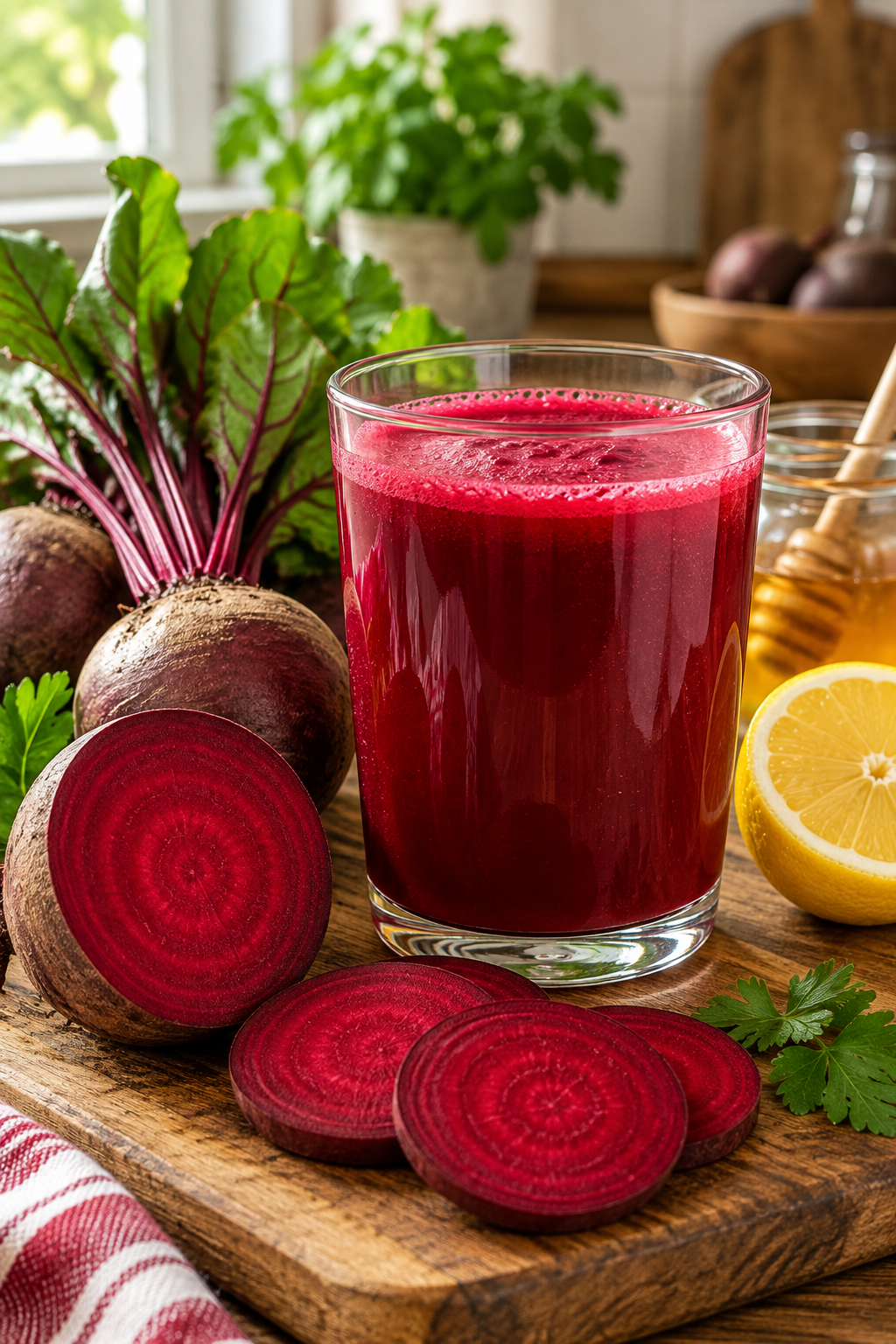
Beetroot juice has become one of the most talked-about “circulation drinks” for adults over 60. The reason is not just internet hype: beets are naturally rich in dietary nitrate, which the body can convert into nitric oxide, a molecule involved in blood-vessel relaxation and blood flow.
That makes beetroot scientifically interesting for blood pressure, vascular function, and exercise tolerance.
But there is an important limit:
Beetroot juice does not “unclog” leg arteries, dissolve plaque, cure peripheral artery disease, or make swollen legs disappear.
Research suggests it may modestly support circulation-related measures in some people, but results are mixed and it should be viewed as a food-based adjunct—not a treatment for vascular disease.
🥤 A Simple Beetroot Juice
A modest home version can be made with:
½ small beet
½–1 cup water
Optional:
A squeeze of lemon.
Blend until smooth and strain only if you prefer a thinner drink.
If you buy bottled beet juice, check the label for added sugar.
For someone trying it for the first time, a small serving makes more sense than immediately drinking several cups.
Clinical studies have often used standardized nitrate-rich beetroot products, so a homemade drink cannot be assumed to provide the same nitrate dose.
🩸 Why Beets May Affect Circulation
Beetroot contains inorganic nitrate.
After consumption, nitrate can be converted to nitrite and then to nitric oxide.
Nitric oxide helps regulate vascular tone and can promote vasodilation—the widening of blood vessels.
A systematic review in older adults found that dietary nitrate sometimes improved blood pressure, blood flow, or exercise performance, although results were inconsistent across studies.
So the realistic claim is:
Beetroot may support certain aspects of vascular function.
Not:
“Beet juice cleans blocked arteries.”
❤️ What Does the Blood-Pressure Research Show?
This is where beetroot has some of its strongest human evidence.
A 2024 meta-analysis of 11 randomized trials involving 349 adults with hypertension found that beetroot juice reduced clinic systolic blood pressure by about 5 mmHg on average, while effects on diastolic and 24-hour blood pressure were not significant. The authors rated the certainty of evidence as low and advised cautious interpretation.
An earlier meta-analysis of seven trials involving 218 people with hypertension reported a similar average reduction in systolic pressure—about 5 mmHg.
That is meaningful.
But it does not mean everyone experiences the same change.
👴 What About People Over 60 Specifically?
Small studies have investigated older adults directly.
One randomized crossover trial in healthy older adults used 140 mL of nitrate-rich beetroot juice and found increases in circulating nitrate/nitrite and reductions in blood pressure within several hours.
Another study comparing younger and older adults found that nitrate-rich beetroot juice increased nitrite levels and lowered blood pressure in both groups, with some responses appearing stronger in the older participants.
But not every study is positive.
A 2024 randomized trial in adults ages 56–71 with treated hypertension found that four weeks of nitrate-rich beetroot juice increased nitrate and nitrite levels but did not improve vascular function or blood pressure compared with placebo.
That is why beetroot should not be presented as guaranteed therapy.
🦵 Can Beetroot Help Tired or Heavy Legs?
Possibly in some circumstances.
If leg fatigue is partly related to reduced exercise capacity or impaired blood flow, dietary nitrate has attracted interest.
Researchers have specifically studied beetroot in people with peripheral artery disease (PAD), a condition in which atherosclerotic plaque reduces blood flow to the legs.
One randomized trial involving 11 patients with PAD found that nitrate-rich beetroot juice improved endothelial function and increased maximal walking distance by about 93 meters compared with placebo.
Another randomized trial in patients with PAD also evaluated nitrate-rich vegetables and beetroot juice for walking tolerance and vascular responses.
Earlier small research likewise suggested improved exercise tolerance after dietary nitrate in PAD.
These studies are interesting.
But they were small.
They do not prove beet juice treats PAD by itself.
🚫 Beetroot Does Not Remove Plaque
This distinction matters.
PAD is usually caused by atherosclerosis.
That means plaque has accumulated in arteries supplying the legs.
Beetroot may temporarily influence vascular function through nitric oxide.
It does not physically scrape plaque out of an artery.
If someone has:
Calf pain when walking.
Foot wounds that heal slowly.
Cold feet.
Reduced pulses.
Skin-color changes.
Or pain in the feet even at rest,
they need proper vascular evaluation rather than another glass of juice.
📊 Beetroot Claims vs. What Research Supports
| Claim | Evidence-based view |
| Beetroot supports nitric oxide production | Yes |
| Beetroot may modestly lower systolic BP | Yes, in some studies |
| Beet juice may improve exercise capacity in PAD | Preliminary evidence |
| Beetroot cleans blocked leg arteries | No |
| Beet juice dissolves arterial plaque | No |
| Beetroot cures poor circulation | No |
| Beetroot can replace BP medication | No |
| Beetroot may lower BP too much in some people | Possible |
| Beets can turn urine or stool red | Yes |
🦶 What About Leg Swelling?
This is where beetroot is often promoted incorrectly.
Swollen ankles and legs—edema—can occur for many reasons.
Examples include:
Vein problems.
Heart failure.
Kidney disease.
Liver disease.
Blood clots.
Medication side effects.
Long periods of sitting.
Lymphedema.
Beetroot juice has not been established as a treatment for edema.
And drinking more fluid is not automatically helpful when the body is already retaining fluid.
If swelling is new, worsening, significant, or unexplained, it deserves evaluation.
🚨 One-Sided Leg Swelling Is Different
If one leg suddenly becomes:
Swollen.
Painful.
Warm.
Red.
or noticeably larger than the other,
especially with sudden shortness of breath or chest pain, seek urgent medical attention.
That pattern can be associated with a blood clot.
Do not spend several days trying beetroot juice first.
💊 Blood-Pressure Medication: Important Caution
Because beetroot nitrate can lower blood pressure in some people, caution makes sense if you already take antihypertensive medication.
This is particularly relevant if you already experience:
Low readings.
Lightheadedness.
Dizziness on standing.
Fainting.
Falls.
A clinical review from Cleveland Clinic similarly advises people with low blood pressure or those taking blood-pressure medication to discuss large amounts of beet juice with their healthcare provider.
For an older adult, a “healthy” blood-pressure drop is not useful if it causes a fall.
🧍 Why Dizziness After 60 Matters
Older adults are more vulnerable to injuries from falls.
If beetroot lowers your pressure on top of:
Blood-pressure medication.
Diuretics.
Dehydration.
Hot weather.
Or illness,
you may notice dizziness when standing.
That does not mean beetroot is poisonous.
It means the total effect on blood pressure matters more than whether the source is “natural.”
🪥 One Surprising Detail: Mouth Bacteria Matter
Part of the nitrate-to-nitrite conversion begins in the mouth.
Certain oral bacteria help convert nitrate into nitrite before further conversion to nitric oxide.
This means the nitrate pathway involves more than simply swallowing beet juice.
Research into this pathway has also raised questions about whether frequent use of strong antibacterial mouthwash may reduce nitrate conversion.
It is an interesting example of how complex the effect actually is.
The drink itself is only one part of the process.
🥬 Beets Aren’t the Only Nitrate-Rich Food
You do not need beet juice to obtain dietary nitrate.
Other nitrate-rich vegetables can include:
Arugula.
Spinach.
Lettuce.
Celery.
Other leafy greens.
A vegetable-rich dietary pattern may be more useful long term than relying on one concentrated “circulation shot.”
🧃 Whole Beet vs. Beet Juice
Whole beets provide fiber.
Juice allows you to consume a larger amount quickly.
Neither is automatically superior.
For everyday nutrition, roasted or cooked beet can be an easy choice:
Add it to salad.
Mix it with vegetables.
Serve it with lentils.
Add it to a grain bowl.
Juice is more convenient when someone specifically wants a nitrate-rich beverage, but portions can become large quickly.
🪨 Kidney-Stone Caution
Beets contain oxalate.
For most people, that is not a reason to avoid them.
But people who have had certain calcium-oxalate kidney stones may be advised to limit high-oxalate foods.
Cleveland Clinic notes that people with a history of certain kidney stones may need to moderate beet intake depending on their medical advice.
This is especially relevant if someone starts consuming concentrated beet juice every day.
A normal serving of beetroot and several large glasses of concentrated beet juice are not the same exposure.
🩺 What About Kidney Disease?
Kidney disease changes dietary decisions.
Depending on kidney function, potassium levels, fluid recommendations, and stone history, a concentrated vegetable juice may or may not fit the plan.
Do not assume:
“Natural circulation drink = automatically kidney-friendly.”
If you have CKD, ask whether beetroot juice fits your individual potassium, fluid, and oxalate needs.
🔴 Don’t Panic if Your Urine Turns Red
This is one of beetroot’s most memorable side effects.
Some people develop beeturia, meaning their urine becomes pink or red after consuming beets.
It can also change stool color.
This happens because of beet pigments and is usually harmless.
However, do not automatically assume every episode of red urine is caused by beets.
⚠️ Red Urine Without Recent Beets Needs Attention
Blood in urine can occur with conditions such as:
Urinary infection.
Kidney stones.
Prostate problems.
Bladder or kidney disease.
And other causes.
If urine remains red when you haven’t recently consumed beets—or discoloration persists—get medical advice rather than assuming beeturia. Cleveland Clinic similarly recommends evaluation when red urine cannot reasonably be explained by recent beet consumption.
🧪 Can Beetroot Lower Cholesterol?
This claim is frequently bundled with circulation content.
But beetroot’s stronger research story relates to nitrate, nitric oxide, blood pressure, and vascular function, not dramatic LDL reduction.
Do not use beet juice as a replacement for:
Statins.
Other lipid-lowering treatment.
Exercise.
Smoking cessation.
Or a heart-healthy diet.
Those have far stronger evidence for cardiovascular risk reduction when medically appropriate.
❤️ Blood Pressure Is Not the Same as Blocked Arteries
Someone can have normal blood pressure and still have arterial plaque.
Someone can also have hypertension without severe leg artery obstruction.
Lowering blood pressure modestly with beet juice does not prove arteries have become “clean.”
These are different physiological issues.
🚶 Walking Is One of the Most Important Leg Habits
If circulation and leg function are the goal, don’t focus exclusively on drinks.
Regular physical activity supports:
Muscle function.
Walking endurance.
Cardiovascular health.
Blood-pressure management.
Blood-glucose control.
Mobility.
For diagnosed PAD, structured walking exercise can be particularly important as part of medical management.
Beet juice should never become a reason to stop moving.
👟 Leg Pain While Walking Deserves Attention
A classic PAD pattern is:
Calf, thigh, or buttock pain during walking.
Relief after resting.
Pain returns at a similar walking distance.
This is called claudication.
If this pattern is happening repeatedly, especially after 60 or in someone with diabetes or a smoking history, ask for medical evaluation.
The goal is to identify vascular disease early—not simply mask symptoms with a drink.
🚫 10 Beetroot Mistakes After 60
1. Calling it an artery cleaner.
Beetroot does not dissolve plaque.
2. Drinking enormous amounts immediately.
Start modestly.
3. Expecting swollen ankles to disappear.
Edema has many causes.
4. Ignoring low blood pressure.
Beetroot can reduce BP in some people.
5. Replacing blood-pressure medication with juice.
6. Assuming leg pain is simply poor circulation.
It may require diagnosis.
7. Ignoring kidney-stone history.
Beets contain oxalate.
8. Panicking over harmless beeturia.
Beets can temporarily turn urine red.
9. Assuming all red urine is beeturia.
Unexplained blood-colored urine requires evaluation.
10. Forgetting that research uses standardized preparations.
A homemade glass may contain a very different nitrate amount.
🕒 When Should You Drink It?
There is no medically established “perfect hour.”
Some exercise studies give nitrate-rich beetroot juice a few hours before activity because nitrate metabolism takes time.
For ordinary food use, morning or lunchtime is practical.
If beet juice makes you urinate more simply because you’re drinking extra fluid, drinking a large serving immediately before bed may be inconvenient.
🥤 A Practical Small Serving
For someone without a medical reason to restrict it, a conservative homemade starting point could be:
¼–½ cup beetroot juice diluted with water.
You do not need a giant pitcher.
Published studies have used very different products and nitrate doses, so there is no universal home-treatment dose.
If your goal is simply healthy eating, whole beets may be easier.
🩺 Track Blood Pressure Instead of Guessing
If you take beet juice specifically because you have hypertension, don’t rely on how you feel.
Check your actual blood pressure.
Record:
Morning reading.
Evening reading.
Medication timing.
Symptoms such as dizziness.
Beetroot use.
Then discuss persistent high—or unusually low—readings with your healthcare professional.
A colorful drink should not replace measurements.
🚨 When Leg Symptoms Need Prompt Care
Seek medical evaluation for:
New or worsening walking-related calf pain.
A foot that becomes unusually cold or pale.
A wound on the foot or toe that will not heal.
Pain in the foot while resting.
Sudden one-sided leg swelling.
Marked redness or warmth.
New numbness or weakness.
And seek emergency care for severe leg symptoms accompanied by chest pain, shortness of breath, or sudden major color/temperature changes.
Those situations need diagnosis—not a circulation juice.
❓ Frequently Asked Questions
Is beetroot juice good for circulation after 60?
It may support nitric-oxide production and vascular function. Some studies in older adults have reported improvements in blood pressure or blood flow, while others have found no significant benefit.
Does beetroot juice lower blood pressure?
Meta-analyses suggest it may modestly lower systolic blood pressure in adults with hypertension, with an average reduction of roughly 5 mmHg in some analyses. Effects on diastolic and 24-hour BP are less consistent.
Can beet juice unclog arteries?
No. There is no evidence that beetroot juice removes established arterial plaque.
Can beetroot help leg pain from poor circulation?
Small studies in people with PAD suggest dietary nitrate may improve walking capacity and endothelial function, but evidence remains preliminary and beetroot does not replace PAD treatment.
Does beet juice cure peripheral artery disease?
No.
Can beet juice reduce swollen legs?
It is not an established treatment for edema. Swelling may come from vein, heart, kidney, liver, medication, or clot-related problems and should be evaluated when persistent or significant.
Can beetroot make urine red?
Yes. Beeturia is a generally harmless pink or red discoloration after beet consumption.
Should I worry if my urine stays red?
If you haven’t recently eaten beets, the discoloration persists, or you have pain or other urinary symptoms, get medical advice because blood in urine has other causes.
Is beetroot safe with blood-pressure medicine?
Food-level portions may be fine for many people, but beetroot can lower blood pressure. If you already have low BP, take several BP medicines, or experience dizziness, discuss regular concentrated beet juice with your healthcare professional.
Is beetroot safe with kidney stones?
People with certain oxalate kidney stones may need to limit high-oxalate foods, including beets.
⭐ The Bottom Line
Beetroot juice is one of the more scientifically interesting kitchen drinks promoted for circulation because its nitrate can contribute to nitric-oxide production and blood-vessel relaxation.
Human studies suggest it may modestly reduce systolic blood pressure in some adults with hypertension. Small studies also suggest nitrate-rich beetroot may improve certain measures of walking performance and vascular function in people with peripheral artery disease.
But the evidence does not support saying that beetroot juice:
Unclogs leg arteries.
Dissolves plaque.
Cures poor circulation.
Eliminates swelling.
Or replaces blood-pressure or vascular medication.
After 60, a small amount of beetroot juice can be part of a healthy diet when it fits your medical needs. But if you have low blood pressure, take blood-pressure medication, have a history of oxalate kidney stones, or have significant kidney disease, regular concentrated juice deserves extra caution.
And if your legs are becoming painful while walking, persistently swollen, cold, discolored, or slow to heal, don’t keep searching for stronger juice.
Those symptoms deserve a circulation check—not a detox.