
Getting up several times during the night to urinate.
Waiting longer for the urine stream to start.
A weaker stream.
Dribbling.
Urgency.
Or the frustrating feeling that the bladder hasn’t completely emptied.
That’s why pumpkin and pumpkin seeds have become popular ingredients in homemade “prostate drinks.”
Unlike many viral prostate remedies, pumpkin seeds are actually interesting because they have been studied in humans for lower urinary tract symptoms associated with benign prostatic hyperplasia (BPH).
But there’s an important distinction:
Pumpkin and pumpkin seeds are nutritious foods, and some studies suggest pumpkin-seed preparations may modestly improve urinary symptoms. They have not been proven to rapidly shrink an enlarged prostate, cure BPH, or restore normal urine flow overnight.
BPH is the most common prostate problem in men over 50, and NIDDK estimates it affects roughly 29%–33% of men age 65 and older.
So let’s separate what pumpkin may realistically offer from what social-media posts often promise.
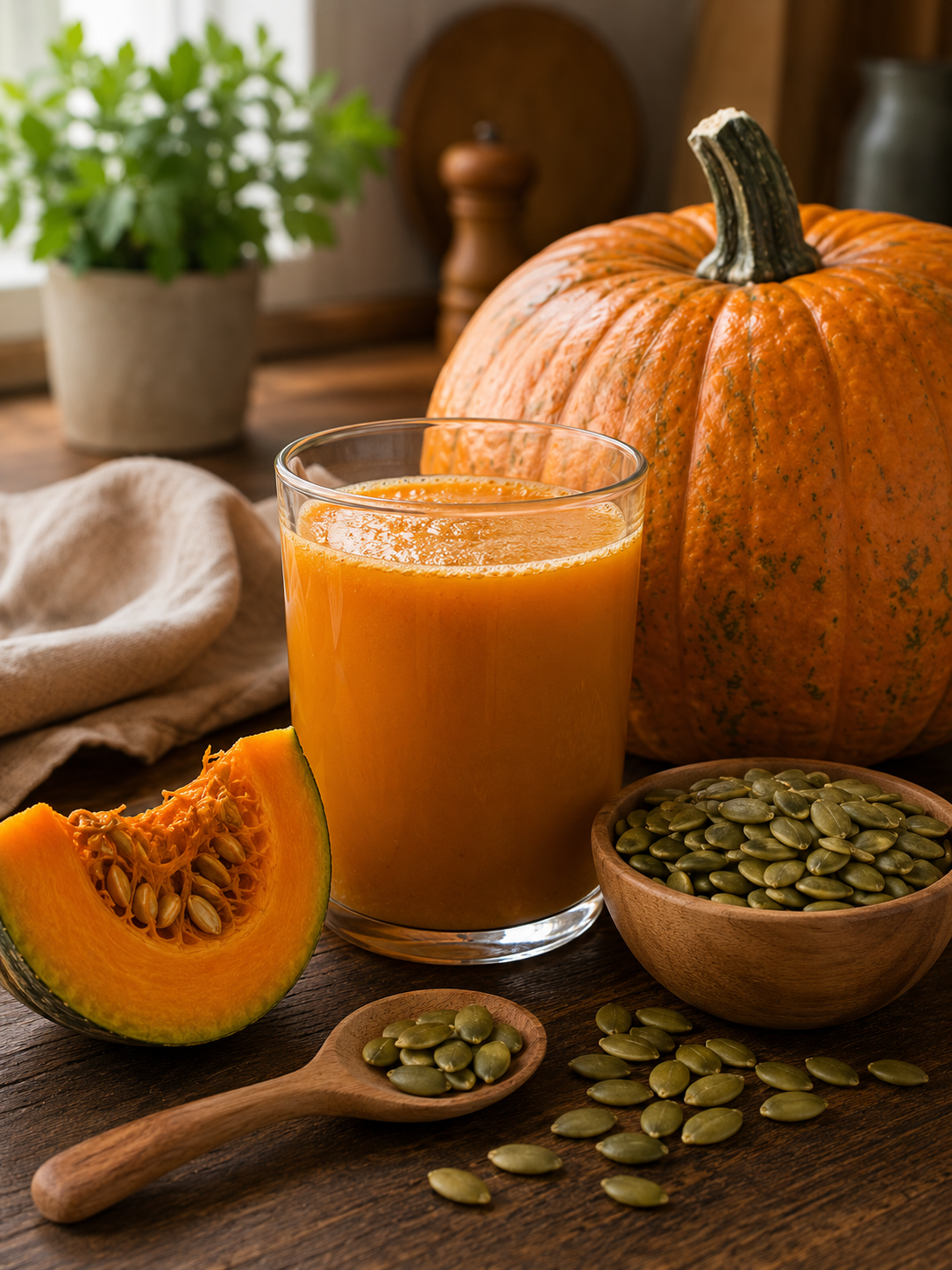
🎃 What Is the Pumpkin & Pumpkin Seed Drink?
A simple food-based version can be made without expensive supplements.
Simple Pumpkin Seed Drink
Use:
1 tablespoon unsalted pumpkin seeds
½ cup cooked plain pumpkin
1 cup water or an appropriate unsweetened milk
Optional:
A pinch of cinnamon.
Blend until smooth.
Avoid loading it with:
Sugar.
Honey.
Sweetened condensed milk.
Large amounts of syrup.
This should be viewed as a nutritious beverage—not a prostate medication.
And there’s another important detail:
Most clinical studies have investigated pumpkin seeds, pumpkin seed oil, or standardized extracts—not this homemade drink.
So we cannot assume that a kitchen smoothie produces the same effects or delivers the same dose.
🧔 Why Does the Prostate Become a Problem After 60?
The prostate sits below the bladder and surrounds part of the urethra.
With BPH, the prostate grows larger even though the enlargement is not cancerous.
As it enlarges, it can squeeze the urethra and make the bladder work harder to push urine through.
NIDDK lists common BPH symptoms including difficulty starting urination, weak or interrupted flow, dribbling, urgency, frequency, nocturia, and difficulty emptying the bladder.
And BPH becomes increasingly common with age.
That’s why prostate-related drinks attract such a large audience after 60.
🌱 Why Pumpkin Seeds Became Interesting to Researchers
Pumpkin seeds contain:
Plant sterols.
Unsaturated fats.
Protein.
Magnesium.
Zinc.
Other naturally occurring plant compounds.
Researchers have investigated whether preparations made from Cucurbita pepo—pumpkin—could influence lower urinary tract symptoms.
The results are interesting.
But they aren’t miraculous.
🔬 The Large Pumpkin Seed Study Worth Knowing About
One of the most useful studies involved 1,431 men between ages 50 and 80 with lower urinary tract symptoms associated with BPH.
Participants received:
Pumpkin seeds.
Pumpkin seed extract.
Or placebo.
The whole pumpkin-seed group consumed 5 grams twice daily and was followed for 12 months.
At the end of the study, 58.5% of men in the pumpkin-seed group met the study’s symptom-response threshold compared with 47.3% receiving placebo.
However, the researchers concluded that the findings needed confirmation before pumpkin seeds could be firmly recommended as a treatment for moderate urinary symptoms. Interestingly, the pumpkin-seed extract did not significantly outperform placebo on the study’s primary response measure.
That is a much more realistic conclusion than:
“Eat pumpkin seeds and shrink your prostate tonight.”
📊 Pumpkin Claims vs. What Research Actually Shows
| Claim | What the evidence suggests |
| Pumpkin seeds cure BPH | No |
| Pumpkin shrinks the prostate overnight | No |
| Pumpkin seeds may improve some urinary symptoms | Possibly |
| Improvement occurs within hours | Not established |
| Whole pumpkin seeds have been studied in men | Yes |
| Pumpkin seed oil has also been studied | Yes |
| Pumpkin replaces prostate medication | No |
| Pumpkin prevents prostate cancer | Not established |
| BPH is prostate cancer | No |
| Complete inability to urinate needs urgent care | Yes |
🫗 What About Pumpkin Seed Oil?
Pumpkin seed oil has also been investigated.
A randomized clinical trial involving 73 men with BPH age 50 or older compared pumpkin seed oil with tamsulosin, a prescription alpha blocker.
Participants receiving pumpkin seed oil took 360 mg twice daily.
After three months, symptom scores and quality of life improved in both groups.
But the improvement in symptom scores was greater with tamsulosin at both one and three months.
This gives us another useful reality check.
Pumpkin seed oil may be worth researching.
But it should not be marketed as:
“Nature’s stronger version of prostate medication.”
⏰ Notice How Long the Studies Took
This point is extremely important.
The large pumpkin-seed study lasted:
12 months.
The pumpkin-seed-oil study assessed results over:
1–3 months.
Another small pilot study involving a standardized pumpkin-seed extract reported improvements primarily after 8–12 weeks.
Compare that with viral claims:
“Drink before bed and stop nighttime urination tonight.”
“Restore urine flow in 30 minutes.”
“Shrink your prostate in three days.”
That’s not what the research shows.
🎃 What About Pumpkin Flesh?
Pumpkin itself is nutritious.
It provides:
Carotenoids.
Fiber.
Vitamins.
Minerals.
Carbohydrates.
But research on urinary symptoms has focused much more heavily on pumpkin seeds and their preparations than ordinary pumpkin flesh.
So adding pumpkin to the drink can make it nutritious and flavorful.
It doesn’t transform it into BPH therapy.
🌱 Should You Grind the Pumpkin Seeds?
You can.
Grinding makes them easier to blend.
Use:
Raw or roasted unsalted pumpkin seeds.
Avoid assuming that raw seeds are medically superior.
There isn’t good evidence that roasting automatically destroys their potential prostate benefits.
The bigger concern for an everyday snack is often what has been added.
Heavily salted pumpkin seeds can contribute substantial sodium.
🧂 Choose Unsalted Seeds
This matters after 60 because prostate symptoms often coexist with:
High blood pressure.
Diabetes.
Cardiovascular disease.
Kidney disease.
NIDDK notes that conditions including cardiovascular disease, type 2 diabetes, obesity, chronic kidney disease, and erectile dysfunction are associated with greater likelihood of BPH.
So turning pumpkin seeds into a heavily salted snack doesn’t make much sense.
Choose plain or lightly seasoned versions.
🥄 How Much Pumpkin Seed Should You Eat?
There is no universally established “prostate dose” for ordinary pumpkin seeds.
The large GRANU trial studied 5 grams twice daily, but that doesn’t establish an ideal treatment dose for everyone.
For ordinary food use, a small handful can easily fit into meals.
Try them on:
Oatmeal.
Yogurt.
Salads.
Vegetables.
Soups.
Or simply eat them as a snack.
You don’t need to consume cups of seeds every day.
They are nutrient-dense and calorie-dense.
🌙 Can Pumpkin Seeds Stop Nighttime Urination?
This is where expectations need to stay realistic.
Nighttime urination—nocturia—may occur with BPH.
But BPH isn’t the only cause.
Nocturia can also be influenced by:
Large evening drinks.
Caffeine.
Alcohol.
Diabetes.
Overactive bladder.
Sleep disorders.
Sleep apnea.
Leg swelling.
Certain medications.
Heart or kidney problems.
So if someone wakes four times each night, assuming:
“My prostate needs pumpkin seeds”
may miss the real problem.
🥤 The Biggest Mistake: Drinking the Pumpkin Drink Before Bed
This is almost comical when you think about it.
Someone wants to stop nighttime urination.
So at 10 p.m., they drink:
A huge 20-ounce “prostate smoothie.”
Then they wonder why they’re urinating again at midnight.
NIDDK recommends that men with mild BPH symptoms consider drinking fewer liquids before bedtime and reducing caffeine and alcohol.
So if you enjoy the pumpkin drink:
Have it earlier in the day.
Not immediately before sleep.
☕ Caffeine May Matter More Than Another Herb
Coffee isn’t automatically forbidden.
But caffeine may aggravate urinary frequency or urgency in some men.
NIDDK recommends reducing caffeinated beverages when they worsen BPH symptoms.
Try moving coffee to earlier in the day.
Then observe whether nighttime bathroom trips change.
That experiment costs nothing.
🍺 Alcohol Can Be Another Trigger
Alcohol can increase urine production and interfere with sleep.
Reducing evening alcohol may help some men with nocturia.
Again, NIDDK includes reducing alcohol among lifestyle strategies that may help BPH symptoms.
A pumpkin smoothie cannot compensate for several large alcoholic drinks before bedtime.
🚽 Empty the Bladder Completely
Another simple strategy is to take your time when urinating.
Don’t rush.
Relax.
Empty the bladder as completely as possible.
Some men also find double voiding useful:
Urinate.
Wait briefly.
Relax.
Then try again.
This doesn’t shrink the prostate.
But it can sometimes help with the sensation of incomplete emptying.
💊 Watch Cold and Allergy Medicines
This surprises many people.
Certain over-the-counter cold medicines may worsen urinary symptoms.
NIDDK specifically mentions medications such as:
Decongestants.
Antihistamines.
as possible contributors to worsening BPH symptoms.
So someone may blame their pumpkin seeds for “stopping working” when the actual change was a new cold medication.
🧪 Prostate Size Doesn’t Tell the Whole Story
Another misconception is:
“Bigger prostate = worse symptoms.”
Not necessarily.
NIDDK notes that some men with significantly enlarged prostates have relatively few urinary symptoms, while a smaller enlargement can cause substantial obstruction in another man.
Symptoms depend on more than prostate volume.
That is why evaluation matters.
🍅 What About Tomatoes and Lycopene?
Tomatoes are nutritious and provide lycopene.
They fit well into a healthy diet.
But NCCIH reports that there isn’t sufficient evidence supporting lycopene for preventing or treating BPH.
So enjoy:
Tomatoes.
Tomato sauce.
Watermelon.
Other lycopene-containing foods.
Just don’t advertise them as prostate-shrinking medicines.
🌿 What About Saw Palmetto?
Saw palmetto is probably the most famous prostate supplement.
But botanical prostate research is inconsistent.
NCCIH emphasizes that evidence for complementary approaches to BPH is generally limited, and trials frequently use different preparations and doses.
This is another reason you shouldn’t automatically combine pumpkin seed oil with:
Saw palmetto.
Nettle.
Pygeum.
Zinc.
Selenium.
And five other supplements.
More ingredients do not automatically mean better results.
💊 What Actually Treats BPH?
Treatment depends on how severe symptoms are and whether complications are developing.
NIDDK lists options including:
Watchful waiting and lifestyle changes
for mild symptoms.
Alpha blockers
which relax muscles around the prostate and bladder neck to improve urine flow.
5-alpha-reductase inhibitors
which can stop prostate growth or shrink the prostate in appropriate men.
PDE-5 inhibitors
which can improve some urinary symptoms.
And when necessary:
Minimally invasive procedures or surgery.
Those treatments have a very different evidence base from pumpkin smoothies.
🚫 Don’t Stop Tamsulosin for Pumpkin Seed Oil
This deserves its own section.
The small randomized trial comparing pumpkin seed oil and tamsulosin found improvements in both groups—but symptom-score improvement was greater with tamsulosin.
So the study does not support:
“Pumpkin is better than tamsulosin.”
And it certainly doesn’t justify stopping prescribed medication without discussing it with your clinician.
🧔 BPH Does Not Mean Prostate Cancer
BPH is benign.
It is not cancer.
NIDDK defines BPH as prostate enlargement that is not caused by cancer.
But urinary symptoms can overlap with:
BPH.
Prostatitis.
Urinary infections.
Bladder problems.
And sometimes prostate cancer.
That’s why persistent symptoms should be evaluated rather than self-diagnosed from social media.
🧪 What Might a Doctor Check?
Depending on your symptoms, evaluation may involve:
Medical history.
Medication review.
Physical examination.
Urinalysis.
PSA testing when appropriate.
Urinary-flow measurements.
Post-void residual urine.
Ultrasound.
Other urinary tract testing.
NIDDK notes that evaluation is individualized according to symptoms and clinical findings.
You don’t automatically need every test.
But you do need the correct diagnosis.
⚠️ Pumpkin Seed Risks & Considerations
Pumpkin seeds are ordinary foods and are generally well tolerated.
But a few things matter.
Calories
Seeds are energy-dense.
Large amounts can add substantial calories.
Sodium
Salted seeds may contain far more sodium than expected.
Digestive discomfort
Large servings can cause bloating or gastrointestinal discomfort in some people.
Allergies
Pumpkin-seed allergy is uncommon but possible.
Supplements are different
Pumpkin-seed oil capsules and standardized extracts are more concentrated than ordinary food.
If you take multiple medications or have significant medical conditions, discuss concentrated supplements with your healthcare professional.
📊 Food vs. Supplement vs. Medication
| Option | What to expect |
| Cooked pumpkin | Nutritious food |
| Whole pumpkin seeds | Some interesting BPH/LUTS research |
| Homemade pumpkin drink | Nutritious beverage; not clinically proven BPH treatment |
| Pumpkin seed oil | Limited clinical evidence |
| Concentrated extract | Evidence depends on exact preparation |
| Tamsulosin | Established prescription BPH therapy |
| 5-ARI medication | Can reduce prostate growth/size in appropriate men |
| Procedures/surgery | Can relieve significant obstruction |
🚫 10 Pumpkin & Prostate Mistakes After 60
1. Expecting overnight results.
Clinical studies evaluated pumpkin preparations over months, not hours.
2. Drinking a huge smoothie immediately before bed.
Extra fluid may worsen nocturia.
3. Assuming pumpkin shrinks the prostate.
That hasn’t been established.
4. Replacing medication with pumpkin seed oil.
Food and prescribed BPH therapy are not equivalent.
5. Eating heavily salted pumpkin seeds.
Choose unsalted versions when possible.
6. Assuming every nighttime bathroom trip is BPH.
Nocturia has multiple possible causes.
7. Ignoring caffeine and alcohol.
Both may worsen symptoms in some men.
8. Taking multiple prostate supplements together.
That makes benefits, doses, side effects, and interactions harder to evaluate.
9. Ignoring a progressively weaker stream.
BPH can lead to urinary retention and other complications.
10. Treating complete urinary retention with home remedies.
This requires immediate medical attention.
📅 A Better 7-Day Prostate Wellness Experiment
Rather than expecting pumpkin to shrink the prostate in seven days, use one week to understand your urinary habits.
Day 1: Record how often you urinate during the day and night.
Day 2: Move most fluids earlier in the day.
Day 3: Reduce late caffeine.
Day 4: Avoid or reduce evening alcohol.
Day 5: Add a small serving of unsalted pumpkin seeds to a healthy meal.
Day 6: Pay attention to whether your bladder feels completely empty after urination.
Day 7: Review your symptoms.
Look specifically at:
Nighttime trips.
Urgency.
Weak stream.
Difficulty starting.
Dribbling.
Incomplete emptying.
This information is far more useful than simply saying:
“My prostate feels swollen.”
🚨 One Prostate Symptom That Cannot Wait
If you suddenly cannot urinate at all, seek medical care immediately.
NIDDK identifies complete inability to urinate as a reason to get medical help right away.
Do not:
Drink more pumpkin juice.
Take another supplement.
Force gallons of water.
Wait overnight.
Urinary retention can require urgent treatment.
⚠️ Other Symptoms That Need Medical Evaluation
Contact a healthcare professional promptly if urinary symptoms occur with:
Blood in the urine.
Fever and chills.
Painful urination.
Significant lower-abdominal pain.
Repeated urinary infections.
Rapidly worsening urine flow.
NIDDK notes that BPH can lead to complications including urinary retention, UTIs, bladder stones, and kidney disease.
❓ Frequently Asked Questions
Are pumpkin seeds good for prostate health after 60?
They are nutritious, and human research suggests whole pumpkin seeds may modestly improve some lower urinary tract symptoms associated with BPH. The evidence isn’t strong enough to consider them a cure or replacement for established treatment.
Can pumpkin seeds shrink an enlarged prostate?
There isn’t convincing evidence that eating pumpkin seeds reliably shrinks an enlarged prostate.
Can pumpkin seed oil improve urine flow?
A small randomized trial found improvements in BPH symptom scores among men taking pumpkin seed oil over three months, although tamsulosin produced greater symptom-score improvement.
How quickly do pumpkin seeds work?
Research showing potential benefits generally looked at weeks or months—not hours.
Should I drink pumpkin seed water before bed?
If nocturia is your problem, drinking a large beverage before bedtime can be counterproductive. NIDDK recommends reducing liquids before sleep when appropriate.
Are raw pumpkin seeds better than roasted seeds?
There isn’t strong clinical evidence showing that raw seeds are uniquely effective for BPH. Unsalted seeds are a practical choice.
Can pumpkin prevent prostate cancer?
Pumpkin seeds should not be promoted as a proven prostate-cancer prevention strategy.
Is pumpkin seed oil better than tamsulosin?
The available small randomized trial does not support that conclusion; tamsulosin produced greater reductions in symptom scores.
Does BPH mean prostate cancer?
No. BPH is a noncancerous enlargement of the prostate.
When should I worry about a weak urine stream?
Persistent or worsening weak flow, difficulty emptying the bladder, blood in urine, recurrent infections, pain, or other new urinary symptoms deserve medical evaluation. If you cannot urinate at all, seek immediate medical help.
⭐ The Bottom Line
Pumpkin and pumpkin seeds are much more interesting than many viral prostate remedies because pumpkin-seed preparations have actually been studied in men with BPH-related urinary symptoms.
A large randomized study involving 1,431 men found a higher symptom-response rate with whole pumpkin seeds than placebo after 12 months, although the researchers emphasized that the finding required further confirmation.
A smaller randomized trial also found improvement with pumpkin seed oil over three months—but tamsulosin produced greater symptom-score improvement.
That’s encouraging enough to consider pumpkin seeds a nutritious food with potential prostate-wellness benefits.
But it is not evidence that pumpkin:
Shrinks the prostate overnight.
Stops nocturia immediately.
Opens a blocked urinary tract.
Prevents prostate cancer.
Or replaces BPH medication.
For mild BPH symptoms, practical habits such as reducing late-evening fluids, limiting caffeine and alcohol when they worsen symptoms, staying active, and emptying the bladder fully can also help. When symptoms become troublesome, effective medications and procedures are available.
So enjoy pumpkin.
Add unsalted pumpkin seeds to your meals.
And if you like the drink, have a modest serving earlier in the day.
But after 60, the best prostate strategy isn’t searching for one miracle seed.
It’s combining sensible nutrition with attention to urinary symptoms—and getting the right evaluation before a manageable prostate problem becomes urinary retention or another complication.