
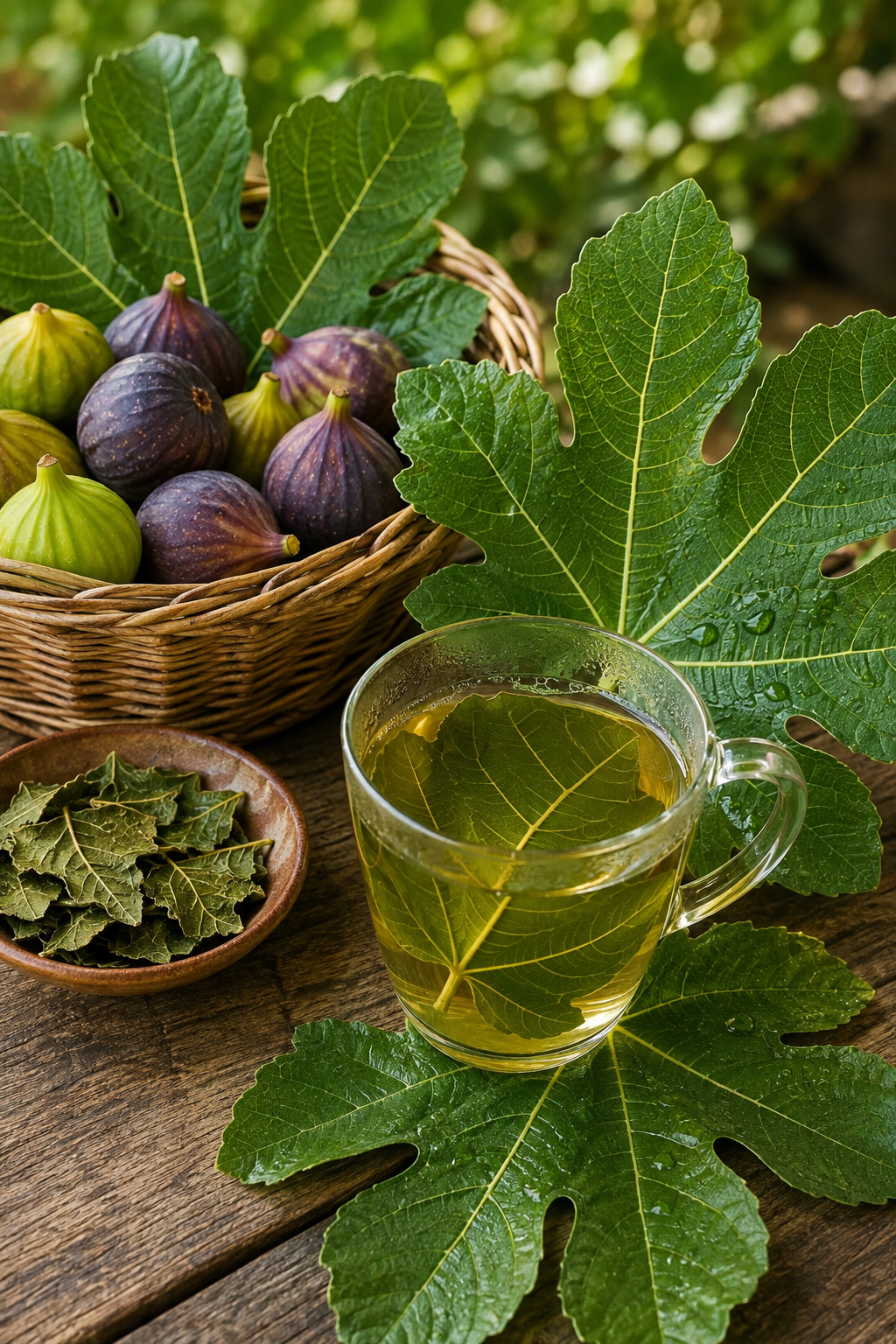
For generations, fig trees have provided more than their naturally sweet fruit. In several traditional practices, the leaves of the common fig tree (Ficus carica) have also been dried or simmered in water to make an herbal infusion.
Today, fig-leaf tea is appearing again in home-remedy discussions, often surrounded by impressive claims involving blood sugar, cholesterol, inflammation, weight loss, skin health, and even serious diseases.
There is a genuinely interesting scientific story behind fig leaves—but it is much more nuanced than most viral posts suggest.
Researchers have identified numerous plant compounds in fig leaves, particularly polyphenols, and laboratory and animal research has explored several possible biological effects. Human evidence, however, remains limited. A scientific review of Ficus carica leaves concluded that the plant has a long history of traditional use and contains numerous potentially active compounds, while also emphasizing that important research gaps remain.
So fig leaves are worth exploring.
They just shouldn’t be turned into a miracle medicine.
🌿 What Exactly Are Fig Leaves?
Fig leaves come from the common fig tree, Ficus carica.
They’re the large, deeply lobed leaves surrounding the familiar fig fruit.
The fruit and leaves shouldn’t be treated as interchangeable. They have different chemical compositions, and most of the research discussed here specifically concerns fig leaves or fig-leaf extracts, not eating fresh figs.
Fig leaves contain numerous phytochemicals, including polyphenolic compounds. Scientists continue studying these substances for possible metabolic, antioxidant, anti-inflammatory and other biological activities.
But detecting an interesting chemical in a plant doesn’t automatically establish a health benefit in humans.
That distinction becomes important throughout this article.
🍵 Traditional Fig-Leaf Tea
A traditional preparation is generally very simple.
Fresh or dried leaves are infused or simmered in water and the liquid is consumed as tea.
However, there is no universally established medical dose for homemade fig-leaf tea.
That’s why a conservative kitchen preparation is more appropriate than creating an extremely concentrated herbal decoction.
A Simple Home Preparation
For someone who has confirmed that fig-leaf tea is appropriate for them, a mild traditional preparation might use:
1 small, properly identified fig leaf
2 cups water
Wash the leaf thoroughly.
Bring the water to a boil.
Add the leaf and reduce the heat.
Simmer gently for approximately 10 minutes.
Remove the leaf and allow the tea to cool before drinking.
Avoid adding large quantities of sugar or honey if blood-glucose management is one of your goals.
Most importantly, don’t assume that making the tea stronger makes it healthier.
🩸 The Most Interesting Claim: Blood Sugar
This is where fig leaves have attracted legitimate scientific interest.
A small clinical trial published in 1998 investigated a fig-leaf decoction in people with type 1 diabetes.
Only 10 participants were included.
Participants continued their usual diabetes diet and insulin treatment while researchers compared fig-leaf decoction with unsweetened commercial tea.
The researchers observed lower post-meal glucose during the fig-leaf period.
That sounds promising.
But there are major limitations.
The study was:
Very small.
Conducted decades ago.
Performed in younger adults rather than people over 60.
And it studied fig-leaf tea alongside insulin, not instead of insulin.
Therefore, the study does NOT demonstrate that fig-leaf tea:
Cures diabetes.
Reverses insulin resistance.
Eliminates the need for medication.
Or safely lowers blood sugar in everyone.
⚠️ Why the Blood-Sugar Finding Creates a Safety Issue
Suppose fig leaves really can lower glucose under certain circumstances.
That doesn’t only represent a potential benefit.
It could also create a potential problem for someone already taking glucose-lowering medication.
NCCIH warns that herbal products used alongside conventional diabetes medications may cause unwanted effects and recommends telling healthcare professionals about supplements being used. Overall, reliable evidence supporting herbal supplements for controlling diabetes remains insufficient.
This is particularly relevant after 60, when someone may already be taking several medications.
If you use:
Insulin.
Sulfonylureas.
Or other glucose-lowering medications.
Don’t begin using concentrated fig-leaf preparations as a diabetes treatment without discussing them with your healthcare professional.
And never reduce prescribed medication simply because your glucose reading changed after drinking an herbal tea.
🔬 What Does Newer Research Show?
Research into fig leaves continues.
For example, a recent study investigated aqueous fig-leaf extract in diabetic mice and reported glucose-lowering activity under experimental conditions. But the investigators did not find sustained HbA1c reduction, and importantly, this was an animal experiment rather than a clinical trial demonstrating effectiveness in people.
This is a classic example of why headlines can become misleading.
A study might correctly say:
“Fig-leaf extract affected glucose in diabetic mice.”
Social media transforms that into:
“One fig leaf reverses diabetes.”
Those aren’t equivalent statements.
📊 Fig-Leaf Claims vs. What We Actually Know
| Popular claim | What the evidence currently supports |
| Fig leaves cure diabetes | No |
| Fig-leaf tea may influence blood glucose | Preliminary evidence |
| Fig leaves replace insulin | No |
| Fig leaves contain biologically active compounds | Yes |
| Fig leaves instantly lower cholesterol | Not established |
| Fig leaves detox the kidneys | Not established |
| Fig leaves cure cancer | No |
| Fig leaves melt belly fat | Not established |
| Fig-leaf tea has been studied in humans | Yes, but human evidence is limited |
| Fig-tree sap can irritate/burn skin after sunlight exposure | Yes |
That last point is especially important.
☀️ The Fig-Leaf Risk Most People Don’t Know About
Fig leaves have a surprisingly important skin-safety issue.
The sap from fig trees contains photosensitizing substances called furocoumarins, including psoralen-related compounds.
When fig sap gets on the skin and that skin is subsequently exposed to sunlight, it can produce phytophotodermatitis.
This can cause:
Redness.
Burning.
Pain.
Swelling.
Blistering.
And later pigmentation.
Published case reports have documented significant blistering following contact with fig trees and subsequent sunlight exposure.
🧤 Handle Fresh Fig Leaves Carefully
If you’re harvesting leaves directly from a tree, especially when cutting stems or branches:
Consider wearing gloves.
Avoid getting the milky sap on exposed skin.
Wash exposed areas thoroughly.
And be particularly careful about subsequent sunlight exposure.
Research has identified photoactive compounds such as psoralen and bergapten in fig leaf and shoot sap, with higher concentrations reported in leaf sap than shoot sap.
This isn’t merely theoretical.
There are documented cases severe enough to require medical treatment.
🔥 Fig Leaves Should NOT Be Used as a Skin Soak
This traditional remedy can be dangerous.
Five published cases described people who soaked their feet in a fig-leaf decoction for skin problems.
After sunlight exposure, they developed burning, redness, swelling and blisters consistent with phytophotodermatitis.
Another report described severe widespread phytophotodermatitis after exposure to a fig tree that required treatment in a burn unit.
Therefore:
Drinking a mild traditional infusion and applying concentrated fig leaves or sap directly to the skin are completely different exposures.
Do not rub fig sap onto:
Warts.
Age spots.
Dark spots.
Wrinkles.
Eczema.
Joint pain.
Or other skin problems.
Especially before going into sunlight.
🧴 What About Fig Leaves for Eczema?
There is some early research worth mentioning.
A small double-blind randomized preliminary trial investigated fig-leaf tea in people with mild atopic dermatitis.
Researchers reported improvement in eczema severity among participants drinking fig-leaf tea, and no concerning safety changes were identified during the study.
Interesting?
Absolutely.
Proof that fig-leaf tea cures eczema?
No.
It was a preliminary study involving a small number of participants.
Larger independent studies would be necessary before recommending fig-leaf tea as an established eczema treatment.
❤️ What About Cholesterol?
Laboratory, animal and phytochemical research has generated interest in possible effects of fig leaves on lipid metabolism.
But that doesn’t establish fig-leaf tea as a treatment for high LDL cholesterol or cardiovascular disease.
Someone with high cholesterol should not replace:
Prescribed statins.
Blood-pressure management.
Physical activity.
A heart-healthy dietary pattern.
Diabetes management.
Smoking cessation.
Or other medically appropriate strategies
with fig-leaf tea.
You can investigate a traditional food without asking it to perform the job of medication.
⚖️ Can Fig-Leaf Tea Cause Weight Loss?
There isn’t convincing human evidence showing that drinking homemade fig-leaf tea produces substantial fat loss.
Tea may indirectly help if an unsweetened cup replaces:
Soda.
Sweet tea.
Sugar-heavy coffee.
Juice.
Or another calorie-heavy beverage.
But that’s a beverage substitution effect.
It doesn’t mean fig leaves are “melting belly fat.”
🧬 What About Cancer Claims?
Fig-leaf compounds have been studied in laboratory settings, including experiments involving cancer cells. For example, one laboratory study evaluated phototoxic and antiproliferative effects of fig-tree components on human melanoma cells.
But laboratory cancer-cell experiments do not demonstrate that drinking fig-leaf tea prevents or treats cancer in humans.
This distinction is essential.
A compound can damage cultured cells at a particular concentration without ever reaching that concentration safely inside a human tumor.
Therefore:
Fig-leaf tea should never replace cancer diagnosis or treatment.
🫘 Does Fig-Leaf Tea “Clean the Kidneys”?
There is no established evidence that homemade fig-leaf tea detoxifies the kidneys or lowers creatinine.
Your kidneys already perform filtration continuously.
If kidney tests are abnormal, important questions include:
What is the creatinine?
What is the eGFR?
Is albumin present in the urine?
What is the potassium level?
Is blood pressure controlled?
Is diabetes present?
An herbal tea should never be used to postpone evaluation of abnormal kidney results.
🫀 Does It Clean the Arteries?
No evidence demonstrates that fig-leaf tea removes established arterial plaque.
Atherosclerosis is far more complicated than something that can be “washed away” with tea.
Reducing cardiovascular risk involves managing factors such as:
LDL cholesterol.
Blood pressure.
Blood glucose.
Smoking.
Physical activity.
Nutrition.
Body weight when appropriate.
And medication when indicated.
🌿 Tea vs. Extract vs. Sap: Don’t Confuse Them
This is one of the most important sections of the article.
Fig-leaf tea
Water infused with leaves.
Fig-leaf extract
A concentrated preparation that may contain much larger amounts of certain plant compounds.
Fig-tree sap/latex
The milky material released from leaves, stems or branches.
These products are not interchangeable.
A study involving an extract does not prove that homemade tea provides the same dose.
And the potentially irritating sap should definitely not be treated as ordinary tea.
🍵 Fresh Leaves vs. Dried Leaves
Traditional preparations may use either.
But there isn’t enough high-quality human research to declare one universally superior.
Dried leaves can have a practical advantage:
You don’t have to cut a fresh branch immediately before preparing tea and expose yourself to as much fresh sap.
Whatever you use, make sure the plant is correctly identified.
Never consume an unidentified leaf simply because it resembles a fig leaf.
🚫 8 Fig-Leaf Mistakes to Avoid
1. Assuming “natural” means risk-free.
Plants contain biologically active chemicals.
2. Using tea instead of diabetes medication.
The limited human study examined fig-leaf decoction alongside conventional diabetes management.
3. Making extremely concentrated tea.
More isn’t automatically better.
4. Rubbing fresh fig sap on the skin.
Fig sap can produce significant phototoxic reactions after sunlight exposure.
5. Using fig leaves as a sun-exposed skin treatment.
Serious blistering reactions have been documented.
6. Expecting overnight blood-sugar control.
Preliminary research isn’t proof of a rapid home treatment.
7. Believing laboratory studies prove human benefits.
Cell and animal research are earlier stages of evidence.
8. Combining several medicinal herbs at once.
If glucose drops or another reaction occurs, identifying the responsible ingredient becomes much harder.
👴 Why People Over 60 Should Be Especially Careful
After 60, many people take multiple medications for conditions such as:
Diabetes.
High blood pressure.
High cholesterol.
Heart disease.
Blood clot prevention.
Kidney problems.
Arthritis.
Or sleep problems.
Adding medicinal-strength herbal products can complicate treatment.
This doesn’t mean every cup of herbal tea is dangerous.
It means that frequent or concentrated medicinal use deserves more attention than occasionally drinking an ordinary beverage.
For someone taking glucose-lowering medication, fig leaves deserve particular caution because preliminary human research suggests they may influence glucose.
📝 A Smarter Way to Try a Traditional Herbal Tea
If your healthcare professional has no concerns about fig-leaf tea for you, keep the experiment simple.
Start with a mild preparation.
Don’t combine it with five other medicinal herbs.
Don’t add large quantities of sugar.
Don’t alter prescribed medications.
And pay attention to how you feel.
If you monitor blood glucose, continue monitoring it according to your usual medical plan.
Traditional remedies become considerably safer when they’re approached as optional additions rather than replacements for medical care.
🚨 Stop and Get Advice If You Notice
After drinking an herbal preparation, seek medical advice for concerning symptoms such as:
Severe dizziness.
Fainting.
Unusually low blood-glucose readings.
Persistent vomiting or diarrhea.
Swelling of the lips or tongue.
Difficulty breathing.
Or another significant reaction.
And after handling fig leaves or sap, significant burning, blistering or swelling—particularly following sunlight exposure—deserves medical attention.
❓ Frequently Asked Questions
Can you make tea from fig leaves?
Fig-leaf decoctions and teas have a history of traditional use and have also been investigated scientifically.
Can fig-leaf tea lower blood sugar?
A very small clinical trial involving 10 people with type 1 diabetes reported lower post-meal glucose during fig-leaf decoction use. However, this is far too little evidence to establish fig-leaf tea as a diabetes treatment.
Can fig leaves replace diabetes medicine?
No. The clinical study involved participants who continued their conventional diabetes management, including insulin.
Can fig-leaf tea cure diabetes?
No reliable evidence establishes fig-leaf tea as a diabetes cure. NCCIH notes that evidence for herbal supplements in diabetes management remains insufficient overall.
Is fig-leaf tea good for cholesterol?
There is scientific interest in fig-leaf compounds and metabolism, but convincing clinical evidence showing that homemade tea treats high cholesterol is lacking.
Does fig-leaf tea cure cancer?
No. Laboratory research involving fig compounds and cancer cells cannot be translated into a claim that drinking fig-leaf tea treats cancer.
Are fig leaves dangerous to touch?
Ordinary brief contact isn’t guaranteed to cause a reaction, but fig sap contains phototoxic compounds. Sap exposure followed by sunlight has caused significant phytophotodermatitis, including blistering.
Can I put fig leaves directly on my skin?
That isn’t a good DIY strategy. Published reports document significant phototoxic skin injuries involving fig leaves and fig-tree sap.
Is stronger fig-leaf tea better?
There is no established evidence that making increasingly concentrated homemade preparations provides greater benefits, and stronger exposure may increase unwanted effects.
Should people over 60 drink it every day?
There isn’t enough evidence to recommend daily medicinal use for every older adult. Medication use, diabetes, kidney or liver function, and other medical conditions can change the risk-benefit calculation.
⭐ The Bottom Line
Fig leaves are an interesting example of a traditional remedy that deserves curiosity without exaggeration.
There is preliminary human evidence suggesting fig-leaf decoction may influence blood glucose, but the most frequently cited clinical trial involved only 10 people and was performed alongside conventional diabetes treatment.
Other potential benefits remain areas of ongoing research rather than established treatments.
And fig leaves come with an unusual caution that shouldn’t be ignored:
Fresh fig-tree sap can react with sunlight and cause phytophotodermatitis, including painful redness, swelling and blisters.
So if you have a fig tree at home, appreciate it.
Enjoy the fruit.
Explore the history of the leaves.
And, when medically appropriate, a mild traditional infusion may be something worth discussing.
But don’t turn an interesting plant into a promise it cannot support.
Fig-leaf tea is not a cure for diabetes, kidney disease, blocked arteries, cancer, or other serious conditions—and it should never replace prescribed treatment.
The most useful approach after 60 is simple:
Enjoy traditional foods thoughtfully, understand what the research actually shows, and treat powerful health claims with the same care you would give any medicine.