
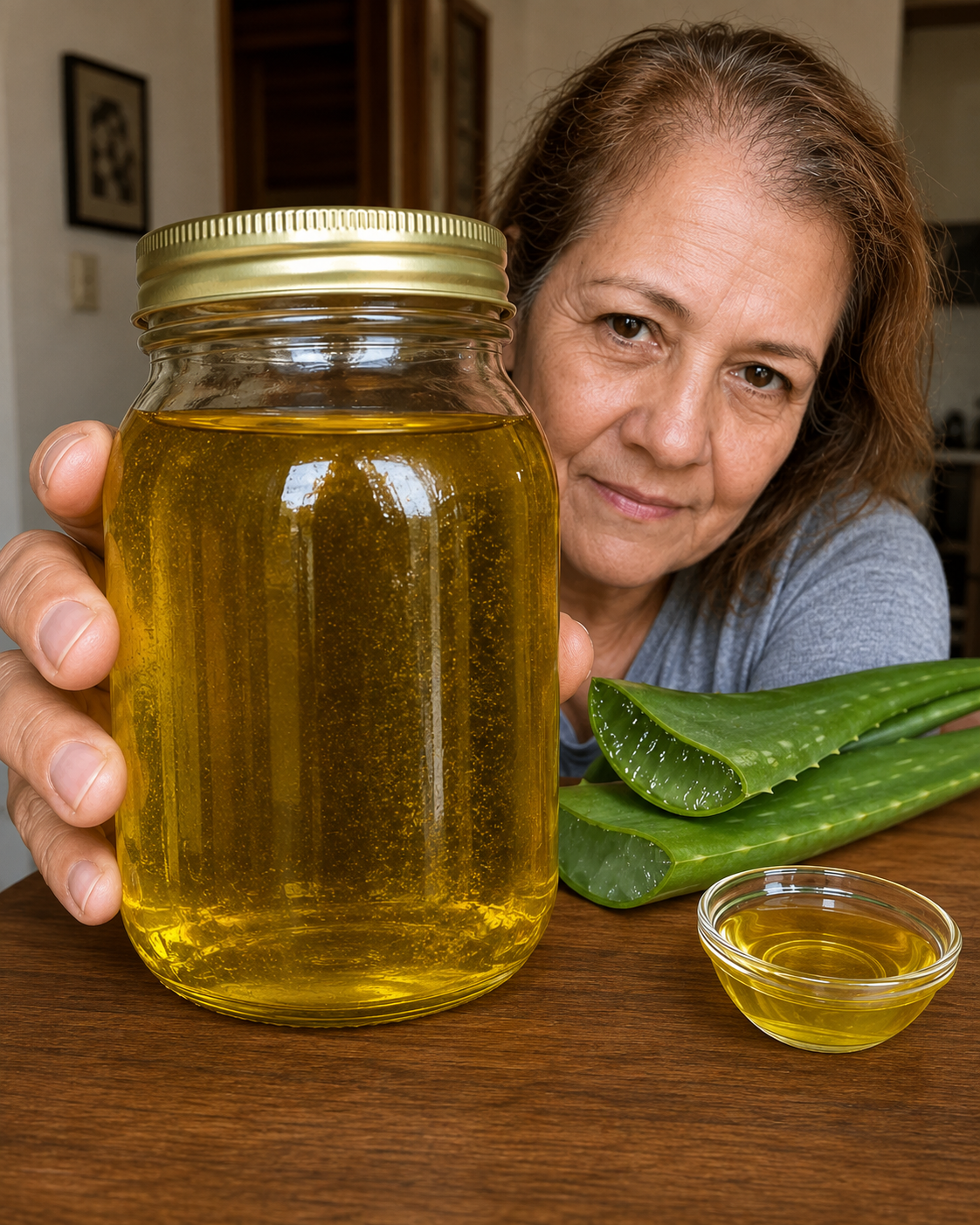
Finding more hair in the shower, noticing a widening part, or seeing the scalp become increasingly visible can be unsettling—especially after age 50.
That’s why a simple remedy like aloe vera oil sounds so appealing.
Social-media posts often claim that massaging aloe into the scalp can “reset” dormant follicles, restore circulation, stop shedding, and make thinning hair grow back.
Aloe vera certainly has legitimate uses for skin, and topical aloe gel is generally well tolerated. But current evidence does not establish aloe as a treatment that resets hair follicles or reliably reverses age-related or hereditary hair loss. The National Center for Complementary and Integrative Health notes evidence for several topical skin uses of aloe, but hair regrowth isn’t an established benefit. (NCCIH)
That doesn’t make aloe useless.
For some people, a gentle aloe-based scalp treatment may feel cooling or moisturizing. The bigger issue is that hair loss after 50 has many possible causes, and identifying the cause matters far more than finding the perfect oil.
Important: Sudden, patchy, painful, scar-like, or rapidly progressing hair loss deserves professional evaluation. Earlier diagnosis can improve the chance of successfully treating certain types of hair loss. (American Academy of Dermatology)
🌿 First: Aloe Vera Gel Isn’t Actually an Oil
This causes a lot of confusion.
The inside of an aloe leaf contains a water-rich gel, not oil.
Products marketed as “aloe vera oil” generally contain aloe incorporated or infused into a carrier oil such as:
- Coconut oil
- Jojoba oil
- Olive oil
- Sunflower oil
- Other cosmetic oils
That means two bottles labeled “aloe oil” may contain completely different formulations.
And homemade aloe gel mixed with oil is different again.
When evaluating claims, it’s important to know exactly which product is being discussed.
👩 Why Does Hair Often Change After 50?
Hair naturally changes with age.
Hair growth can slow, follicles can produce thinner hairs, and some follicles eventually stop producing visible hair. The American Academy of Dermatology also notes that hereditary hair loss is extremely common and can become particularly noticeable later in life. (American Academy of Dermatology)
But age itself isn’t the only possibility.
Hair loss can result from many different conditions.
Potential causes include:
- Female or male pattern hair loss
- Significant physical or emotional stress
- Illness or high fever
- Certain medications
- Tight hairstyles
- Scalp disorders
- Alopecia areata
- Nutritional deficiencies
- Thyroid problems
- Hormonal changes
The appearance and timing of the loss provide important clues.
👩🦳 Female Pattern Hair Loss After 50
For women, one particularly important possibility is female pattern hair loss.
It commonly begins during midlife—in the 40s, 50s, or 60s.
Typical signs include:
- A widening part
- Thinning across the top of the scalp
- A smaller ponytail
- Gradually decreasing hair density
Without treatment, the thinning can progressively worsen. (American Academy of Dermatology)
This isn’t something an aloe mask has been shown to reverse.
But evidence-based treatment options are available.
👨 What About Men?
Men commonly develop androgenetic—or male pattern—hair loss.
It may appear as:
- Receding temples
- A receding hairline
- Thinning at the crown
- Progressive baldness on top
By age 50, pattern hair loss is extremely common among men. (American Academy of Dermatology)
Again, aloe isn’t known to reverse the underlying follicle miniaturization responsible for this condition.
🔬 What Does Aloe Vera Actually Do?
Aloe vera contains numerous compounds, including polysaccharides and other plant constituents.
Topical aloe has been investigated primarily for skin-related conditions.
Research suggests possible usefulness in areas such as certain burns and some skin conditions, although evidence varies substantially by condition. (NCCIH)
That has encouraged people to extend the idea to scalp health.
The logic usually sounds like:
Aloe helps skin → the scalp is skin → aloe must regrow hair.
Unfortunately, that final step hasn’t been established.
Something that soothes skin doesn’t necessarily stimulate a miniaturized hair follicle to begin producing thick terminal hairs again.
🧬 Does Aloe “Reset” Hair Follicles?
There is currently no recognized biological “scalp reset” created by aloe oil.
Hair follicles cycle through different phases.
Anagen
The active growth phase.
Catagen
A short transition phase.
Telogen
A resting phase.
Exogen
The phase during which the hair sheds.
Many factors can influence these cycles.
But applying aloe doesn’t simply restart every dormant follicle.
And in hereditary pattern hair loss, follicles gradually become smaller.
That’s a different biological process from having a dry scalp.
📊 Aloe Hair Claims vs. Reality
| Viral Claim | More Accurate Answer |
| Aloe resets dormant follicles | Not established |
| Aloe can feel soothing on skin | Yes |
| Aloe permanently stops hair loss | Not proven |
| Aloe can sometimes irritate skin | Yes |
| Hair loss after 50 has many causes | Yes |
| Pattern hair loss can be treated | Yes |
| Earlier diagnosis may improve outcomes | Yes |
| One oil works for every type of hair loss | No |
Aloe doesn’t need exaggerated claims to be used as a cosmetic ingredient.
💧 Can Aloe Help a Dry Scalp?
Potentially, depending on the cause.
A properly formulated aloe product may feel soothing and hydrating.
But dry, flaky scalp isn’t always simply “dry skin.”
Flaking can be associated with conditions such as:
- Seborrheic dermatitis
- Psoriasis
- Contact dermatitis
- Other inflammatory scalp disorders
Adding several oils may actually make some scalp conditions harder to manage.
If your scalp is persistently:
- Red
- Extremely itchy
- Painful
- Thickly scaled
- Crusted
get the condition identified rather than repeatedly applying DIY masks.
🧴 A Conservative Aloe Scalp Treatment
If you’re not allergic to aloe and simply want to experiment with it for scalp comfort rather than hair regrowth, keep the routine simple.
You Will Need
- 1 tablespoon commercially prepared plain aloe vera gel
- 1 teaspoon jojoba or another tolerated cosmetic carrier oil
Step 1
Mix a small amount immediately before use.
Step 2
Patch-test it on a small area first.
Step 3
Apply lightly to the scalp rather than saturating your entire head.
Step 4
Massage gently with your fingertips for a few minutes.
Don’t scratch with your nails.
Step 5
Leave it on for approximately 15–30 minutes.
Step 6
Wash it out gently.
There’s no proven advantage to sleeping with the mixture on your scalp overnight.
⚠️ Make It Fresh—Don’t Store Homemade Aloe Oil
This is especially important if you’re mixing aloe gel with oil.
Aloe gel contains water.
Once you create a water-containing homemade cosmetic mixture without an appropriate preservative system, you shouldn’t assume it remains safe for weeks.
Make only what you intend to use.
Don’t prepare a huge jar and leave it in the bathroom for a month.
Commercial cosmetic products are formulated with preservation and stability considerations that homemade mixtures don’t necessarily have.
🚫 Don’t Add 10 “Hair Growth” Ingredients
A common mistake is turning a simple aloe treatment into:
Aloe + onion + rosemary + garlic + cloves + ginger + castor oil + lemon + cinnamon.
This doesn’t make the formula eight times stronger.
It makes it much harder to determine what’s causing a reaction.
Some concentrated botanical ingredients can irritate the scalp.
Inflamed, irritated skin isn’t a good foundation for healthy hair care.
🍋 Skip Lemon Juice
Lemon juice isn’t necessary for hair growth.
Its acidity can irritate sensitive scalp skin.
If your goal is to protect fragile hair after 50, repeatedly irritating the scalp makes little sense.
🧅 What About Onion Juice?
Onion juice has become another popular hair-loss remedy.
Some limited research has investigated it in specific circumstances, but that doesn’t establish onion juice as a universal treatment for age-related thinning or androgenetic alopecia.
Raw onion juice can also irritate the scalp.
Don’t assume burning means:
“The follicles are waking up.”
Burning usually means your skin is being irritated.
🌿 What About Rosemary Oil?
Rosemary oil is frequently promoted alongside aloe.
There is some research interest in rosemary preparations for hair growth, but the evidence remains much smaller than social-media marketing suggests.
Essential oils can also irritate skin and should not be casually applied undiluted.
A 2026 clinical review of adjunctive treatments for androgenetic alopecia concluded that while some alternative approaches show modest promise, many still lack adequate data and stronger trials are needed. (PubMed)
🫒 What About Castor Oil?
Castor oil can coat hair and make strands feel lubricated.
That cosmetic effect can make hair appear shinier or more substantial.
But coating the hair shaft isn’t the same as increasing the number of functioning follicles.
There isn’t good evidence that castor oil reverses pattern baldness.
✋ Scalp Massage: Helpful or Hype?
Gentle scalp massage can feel relaxing.
It can also help distribute shampoo or a cosmetic scalp product.
But don’t turn massage into aggressive rubbing.
Hair that is already fragile can break from:
- Pulling
- Scratching
- Rough brushing
- Excessive tension
You don’t need to make the scalp red to “increase circulation.”
A follicle affected by hereditary hair loss isn’t simply suffering because your fingers haven’t massaged it enough.
💊 What Actually Has Better Evidence?
For certain forms of pattern hair loss, minoxidil has substantially stronger evidence than aloe.
The American Academy of Dermatology states that topical minoxidil can stimulate hair growth and help prevent further hair loss in appropriate patients. (American Academy of Dermatology)
But it isn’t an instant solution.
Results generally take time.
For female pattern hair loss, the AAD notes that it can take approximately 6–12 months of continuous use to determine how well minoxidil is working. (American Academy of Dermatology)
And treatment has to match the diagnosis.
That’s why seeing a dermatologist can be more valuable than trying five oils sequentially.
⏳ Why Hair Regrowth Takes Months
Hair grows slowly.
That’s one reason advertisements promising:
“New growth in seven days!”
should immediately raise skepticism.
Even treatments that genuinely influence follicles need time before changes become visually noticeable.
You may need months to determine whether a treatment is:
- Slowing shedding
- Maintaining density
- Producing regrowth
A one-week before-and-after photograph doesn’t reliably demonstrate follicular regeneration.
🧪 Could You Be Missing a Nutrient?
Sometimes nutrition contributes to hair loss.
Depending on someone’s symptoms and history, a healthcare professional may consider issues involving:
- Iron
- Protein intake
- Certain vitamins or minerals
But taking every “hair vitamin” isn’t the solution.
The AAD specifically cautions that excessive intake of certain nutrients can actually worsen hair loss. (American Academy of Dermatology)
Testing for a suspected deficiency is more sensible than blindly taking megadoses.
💊 Be Careful With Biotin
Biotin is marketed almost everywhere for hair.
True biotin deficiency can cause hair-related problems.
But deficiency is uncommon in otherwise healthy people eating a normal diet.
High-dose biotin supplements can also interfere with certain laboratory tests.
Don’t assume that 10,000% of the daily value will make hair grow 100 times faster.
Biology doesn’t work that way.
🍳 Protein Matters
Hair is made primarily from keratin, a protein.
Severely inadequate protein intake can contribute to hair problems.
This becomes particularly relevant for adults who:
- Follow very restrictive diets
- Have poor appetite
- Lose substantial weight rapidly
- Have difficulty eating enough
Useful protein sources can include:
- Eggs
- Fish
- Poultry
- Yogurt
- Beans
- Lentils
- Tofu
- Other appropriate protein-rich foods
You don’t need an expensive “hair protein powder” if your normal diet already provides adequate nutrition.
⚖️ Rapid Weight Loss Can Trigger Shedding
A dramatic diet can produce a dramatic number on the scale.
It can also be followed months later by noticeable hair shedding in some people.
Major physiological stress can shift more follicles into a resting phase, producing a type of shedding known as telogen effluvium.
If your hair loss began after:
- Significant illness
- Surgery
- High fever
- Rapid weight loss
- Major stress
tell your healthcare professional.
Timing can be an important clue.
👩🦳 Menopause and Hair Changes
For many women, noticeable hair changes occur around menopause.
Hormonal changes can influence:
- Hair density
- Hair diameter
- Scalp oil production
- Hair texture
But don’t automatically label all postmenopausal hair loss as “hormones.”
Female pattern hair loss and other conditions can occur during the same period.
A dermatologist can examine the pattern and scalp to narrow down the cause.
🚿 Your Hair-Care Routine Matters Too
When hair is thinning, protecting the remaining strands becomes important.
The AAD recommends gentle hair care for people experiencing hair loss. (American Academy of Dermatology)
Consider reducing:
- Excessive heat
- Repeated chemical processing
- Aggressive brushing
- Tight braids
- Tight ponytails
- Extensions that pull on hair
Use conditioner after shampooing when appropriate.
Fragile hair needs less trauma, not more stimulation.
🚫 7 Hair-Loss Mistakes After 50
1. Waiting Years Before Investigating It
Some treatments work better when started earlier. (American Academy of Dermatology)
2. Assuming Aloe Can Fix Every Cause
It can’t.
3. Taking Random Hair Supplements
More nutrients aren’t automatically better.
4. Applying Undiluted Essential Oils
They can irritate the scalp.
5. Treating Burning as a Good Sign
A burning scalp isn’t proof that follicles are being activated.
6. Using Tight Hairstyles to Hide Thinning
Chronic tension can contribute to additional hair loss.
7. Changing Treatments Every Week
Hair growth is slow.
Even effective treatments generally require months to evaluate.
🔍 Look at the Pattern of Your Hair Loss
Before buying another oil, look carefully at what’s happening.
Widening center part
Can occur with female pattern hair loss.
Receding temples or crown thinning
Can suggest male pattern hair loss.
Round bald patches
May occur with alopecia areata or other conditions.
Sudden shedding everywhere
Can occur with telogen effluvium.
Hair breaking at different lengths
May point toward hair-shaft damage rather than follicles stopping growth.
Hair loss with redness, pain, scaling, or scarring
Needs professional evaluation.
The pattern provides far more information than the number of hairs found in the shower on one particular day.
🚨 When to See a Dermatologist
Arrange an evaluation if you notice:
- Rapidly worsening thinning
- Smooth bald patches
- Loss of eyebrows or eyelashes
- Scalp pain
- Significant itching or burning
- Pus or crusting
- Scarring
- Significant scaling
- Hair loss associated with other unexplained symptoms
Hair loss has many causes, and the AAD emphasizes that determining the actual cause is central to getting useful results. (American Academy of Dermatology)
Don’t spend a year treating an undiagnosed scalp condition with oils.
🌙 A Simple Hair Routine After 50
You don’t need a 12-step routine.
Step 1 — Clean gently
Wash according to your scalp’s needs.
Step 2 — Condition the hair
Focus especially on dry lengths and ends.
Step 3 — Reduce unnecessary damage
Limit excessive heat and tension.
Step 4 — Eat adequately
Get sufficient calories, protein, and micronutrients.
Step 5 — Investigate progressive loss
If your part continues widening or your density is clearly declining, get a diagnosis.
Step 6 — Use evidence-based treatment when appropriate
Discuss options such as minoxidil and other diagnosis-specific treatments with your dermatologist.
Aloe can remain an optional cosmetic scalp treatment—not the centerpiece of your hair-loss strategy.
❓ Frequently Asked Questions
Does aloe vera regrow thinning hair?
There isn’t sufficient clinical evidence showing that aloe reliably regrows hair in common forms of age-related or hereditary hair loss.
Can aloe stop hair shedding?
Not reliably. The correct treatment depends on why the shedding is occurring.
Is aloe oil better than aloe gel?
They’re different products. Aloe gel is water-based, while “aloe oil” generally combines aloe with a carrier oil.
Can I leave aloe on my scalp overnight?
There’s no established hair-growth advantage to doing so. Longer exposure may also increase irritation in susceptible people.
Can aloe clog hair follicles?
The answer depends largely on the formulation and accompanying oils. Heavy products may leave buildup on some scalps.
Does scalp massage regrow hair?
Massage may feel relaxing, but it shouldn’t be considered a replacement for evidence-based treatment of pattern hair loss.
What’s the best treatment for female pattern hair loss?
Topical minoxidil is a commonly recommended evidence-based treatment, but a dermatologist should confirm the cause of thinning and determine which treatment is appropriate. (American Academy of Dermatology)
How long does minoxidil take?
Visible results take time. The AAD notes that many people need approximately 6–12 months to evaluate results. (American Academy of Dermatology)
Should I take hair vitamins after 50?
Only when appropriate. Excessive amounts of certain nutrients can actually worsen hair loss. (American Academy of Dermatology)
Can hair grow back after 50?
Sometimes, yes. It depends heavily on the cause, how advanced the condition is, and whether follicles remain capable of producing hair. Earlier diagnosis and treatment can improve the chances of success in several forms of hair loss. (American Academy of Dermatology)
⭐ The Bottom Line
Aloe vera can be a pleasant scalp-care ingredient, particularly when used in a gentle, properly formulated product.
But there’s no good evidence that aloe oil “resets” the scalp, wakes every dormant follicle, or rapidly reverses hair loss after 50.
Hair thinning at this age can have many causes—including pattern hair loss, illness-related shedding, scalp disease, medication effects, nutritional problems, and age-related changes. (American Academy of Dermatology)
That’s why identifying the cause is more important than choosing an oil.
If you enjoy aloe, use it conservatively for scalp comfort. Topical aloe gel is generally well tolerated, although burning, itching, rash, and eczema have occasionally been reported. (NCCIH)
For actual hair regrowth, treatments such as minoxidil have considerably stronger evidence for appropriate types of hair loss, although results take months rather than days. (American Academy of Dermatology)
And if your hair is thinning progressively, don’t wait until most of the density is gone before investigating it.
The most useful “scalp reset” isn’t a miracle oil—it’s finding out why the hair is falling out and treating that cause early.