
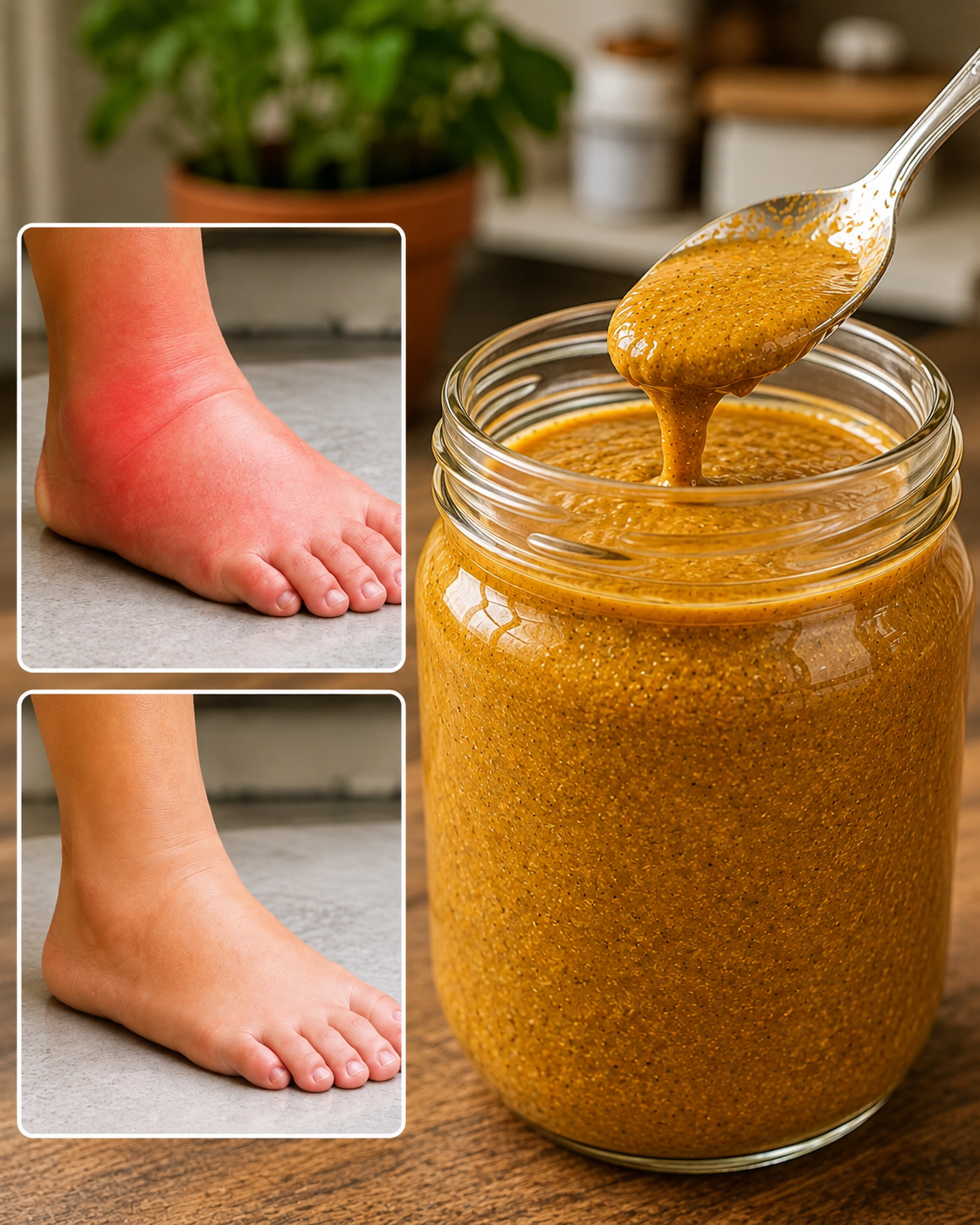
At 47, waking up with stiff knees, aching joints, or feet that look more swollen by the end of the day can make a “natural anti-inflammatory drink” sound very appealing.
Online recipes often promise that combinations of ginger, turmeric, lemon, and other kitchen ingredients can quietly “crush arthritis,” eliminate knee pain, and drain swollen feet.
There is some legitimate science behind certain plant compounds—particularly ginger and turmeric/curcumin—but the dramatic promise needs correcting.
No homemade drink has been proven to cure arthritis, rebuild worn knee cartilage, or reliably remove unexplained swelling from the feet.
More importantly, arthritis and swollen feet aren’t necessarily the same problem.
Persistent foot or ankle swelling can sometimes be related to medications, vein problems, prolonged sitting, or excess sodium—but it can also occur with heart, kidney, liver, or circulation problems. (MedlinePlus)
So a warm spice drink can be an enjoyable addition to your routine, but it shouldn’t become a substitute for figuring out why your joints hurt or why your feet are swelling.
Important: Natural does not automatically mean safe or effective. Herbal products and concentrated supplements can cause side effects and interact with medications. (NCCIH)
🦵 First: What Kind of Arthritis Are We Talking About?
“Arthritis” isn’t one disease.
There are many forms.
One of the most common is osteoarthritis (OA).
Osteoarthritis involves changes to cartilage and other tissues within a joint and frequently affects the:
- Knees
- Hips
- Hands
- Spine
Typical symptoms can include:
- Joint pain
- Stiffness
- Reduced range of motion
- Swelling around the joint
- Difficulty with activities
But knee pain doesn’t automatically mean osteoarthritis.
Pain can also originate from tendons, ligaments, bursae, injuries, gout, inflammatory arthritis, and other conditions.
That’s why treating every painful knee with the same homemade drink isn’t a reliable strategy.
🫚 The Popular Drink: Ginger, Turmeric & Lemon
If you enjoy natural food-based drinks, here’s a simple version that doesn’t require concentrated supplement doses.
Gentle Ginger-Turmeric Drink
Ingredients
- 1 cup hot water
- 2–3 thin slices fresh ginger
- ¼ teaspoon culinary turmeric
- Small squeeze of lemon
- Optional small pinch of black pepper
- Optional ½ teaspoon honey
Directions
Place the ginger and turmeric in a cup.
Add hot water and steep for about 5–10 minutes.
Allow it to cool to a comfortable drinking temperature.
Add lemon.
If desired, add a small amount of honey.
Drink it because you enjoy it—not because you expect it to rebuild your knee overnight.
🌿 What Might This Drink Actually Do?
Let’s separate each ingredient.
Ginger
Ginger contains biologically active compounds, including gingerols and shogaols.
Researchers have investigated ginger for several possible health effects, including pain and inflammatory pathways.
Some people may find ginger-containing foods or beverages comfortable as part of their diet.
But ginger isn’t a replacement for arthritis treatment.
🟡 Turmeric
Turmeric contains compounds known as curcuminoids, the most famous being curcumin.
Curcumin has received enormous research attention because it can influence inflammatory signaling in experimental studies.
Some clinical studies of curcumin preparations have also explored joint symptoms.
However, turmeric powder in your kitchen and a standardized concentrated curcumin supplement aren’t the same thing.
And even concentrated curcumin shouldn’t be described as curing arthritis.
🍋 Lemon
Lemon contributes:
- Flavor
- Vitamin C
- Small amounts of other plant compounds
Vitamin C is necessary for normal collagen formation.
But adding lemon to water doesn’t regenerate damaged knee cartilage.
The drink can be refreshing without needing a miracle explanation.
⚫ Why Do Recipes Add Black Pepper?
Black pepper contains piperine.
Piperine can affect how the body handles certain compounds and has been used in some curcumin supplements to increase curcumin exposure.
This is often presented online as:
“Black pepper makes turmeric 20 times stronger.”
But increased absorption isn’t automatically desirable.
Concentrated piperine may also raise medication-interaction concerns.
A pinch of black pepper in food isn’t equivalent to taking a concentrated piperine supplement.
🍯 What About Honey?
Honey can improve the taste of the drink.
That’s its most practical purpose here.
But honey is still a source of sugar.
Adding several tablespoons doesn’t make an arthritis drink more therapeutic.
For people monitoring blood glucose, those carbohydrates matter.
📊 Viral Drink Claims vs. Reality
| Viral Claim | More Accurate Answer |
| Ginger cures arthritis | No |
| Turmeric contains biologically active compounds | Yes |
| The drink rebuilds knee cartilage | Not established |
| Lemon drains swollen feet | No |
| Losing excess weight may reduce stress on arthritic knees | Yes |
| Exercise can improve OA pain and function | Yes |
| Swollen feet can have causes unrelated to arthritis | Yes |
| Herbal supplements may interact with medication | Yes |
For osteoarthritis specifically, established management emphasizes measures such as appropriate exercise; for people with overweight or obesity, weight management can also reduce stress on weight-bearing joints and improve symptoms. (niams.nih.gov)
🦴 Can Turmeric Rebuild Knee Cartilage?
This is where many advertisements become misleading.
There isn’t convincing evidence that drinking turmeric regenerates worn cartilage.
If a treatment reduces someone’s perception of discomfort, that’s not proof that cartilage grew back.
Those are two completely different outcomes.
For knee osteoarthritis, treatment generally focuses on:
- Reducing pain
- Improving function
- Maintaining mobility
- Strengthening supporting muscles
- Managing body weight when appropriate
Exercise can reduce joint pain and stiffness while improving strength and endurance. (niams.nih.gov)
🚶 Movement May Matter More Than the Drink
Pain often makes people afraid to move.
But completely avoiding activity can lead to weaker muscles.
Weak muscles provide less support around the knee.
For many people with osteoarthritis, appropriate activities can include:
- Walking
- Cycling
- Swimming
- Water exercise
- Range-of-motion exercises
- Strengthening exercises
The correct program depends on your health and the severity of your symptoms.
Start gradually.
A physical therapist can help identify exercises that strengthen the muscles around the knee without unnecessarily aggravating symptoms. (niams.nih.gov)
⚖️ Why Body Weight Can Affect Knee Pain
Your knees are weight-bearing joints.
For someone carrying excess body weight, weight reduction can decrease stress placed on those joints.
This doesn’t mean every person with knee pain needs to lose weight.
But when overweight or obesity is present, weight management is one of the evidence-based strategies used for knee osteoarthritis. (niams.nih.gov)
That’s far more meaningful than expecting a detox beverage to repair the joint.
🦶 Now Let’s Talk About Swollen Feet
This part of the viral claim deserves the most caution.
Swollen feet and ankles can result from fluid accumulating in the tissues.
Potential contributors include:
- Long periods of standing
- Long periods of sitting
- High sodium intake
- Certain medications
- Vein problems
- Pregnancy
- Injury
But swelling can sometimes be associated with more significant medical conditions involving the heart, kidneys, or liver. (MedlinePlus)
That’s why repeatedly drinking turmeric water while ignoring persistent swelling isn’t a good plan.
🧂 Could Salt Be Contributing?
Sodium can contribute to fluid retention in susceptible people.
A useful experiment isn’t necessarily adding another herbal drink.
It may be examining how much sodium you’re already consuming.
Common sources include:
- Processed meats
- Fast food
- Packaged soups
- Salty snacks
- Restaurant meals
- Some sauces
- Highly processed frozen foods
MedlinePlus notes that reducing dietary salt may help decrease fluid buildup in some situations. (MedlinePlus)
But don’t start an extreme sodium or fluid restriction unless you’ve been advised to do so.
🛋️ Sitting All Day Can Matter
If your feet are relatively normal in the morning but gradually swell after spending hours sitting or standing, gravity and circulation may be contributing.
Movement of the leg muscles helps move fluid and blood upward.
For appropriate individuals, useful habits may include:
- Taking regular walking breaks
- Moving the ankles
- Avoiding hours of uninterrupted sitting
- Elevating the legs when resting
Leg elevation and movement are among measures that may help some forms of uncomplicated leg swelling. (MedlinePlus)
But these strategies don’t replace evaluation of unexplained or worsening edema.
💊 Your Medication Could Be Relevant
Some medications can contribute to ankle or foot swelling.
If swelling began after:
- Starting a new medication
- Increasing a dose
- Changing treatment
tell your healthcare professional.
Do not stop the medication yourself.
MedlinePlus specifically advises against discontinuing a medicine you suspect is causing swelling without first discussing it with your healthcare provider. (MedlinePlus)
🌿 What About Arthritis Supplements?
People with joint pain are often sold combinations containing:
- Turmeric
- Glucosamine
- Chondroitin
- MSM
- Fish oil
- Boswellia
- Multiple herbal extracts
Evidence varies widely among these products.
For example, NCCIH notes that glucosamine and chondroitin studies generally haven’t shown much meaningful improvement in osteoarthritis pain or function, and evidence for several other nutritional approaches remains limited or inconclusive. (NCCIH)
Don’t assume a bottle containing eight “natural” ingredients is eight times more effective.
It may simply be eight times more complicated.
⚠️ “Natural” Doesn’t Mean Interaction-Free
This becomes increasingly important for anyone taking daily medication.
Herbal and dietary supplements can potentially:
- Increase medication effects
- Decrease medication effects
- Cause their own side effects
NCCIH emphasizes that some herbal products interact with prescription and over-the-counter medicines, and evidence about many possible herb-drug interactions remains incomplete. (NCCIH)
Tell your healthcare professional about everything you take—including products that don’t look like medicine.
🚫 7 Mistakes to Avoid
1. Calling the Drink an Arthritis Cure
Arthritis is not “crushed” by ginger water.
2. Assuming Knee Pain Means Arthritis
Several conditions can cause knee pain.
3. Assuming Swollen Feet Come From the Knees
Foot swelling may have an entirely different cause.
4. Taking Huge Curcumin Doses
Concentrated supplements aren’t equivalent to culinary turmeric.
5. Stopping Pain Medication
Never discontinue prescribed treatment simply because you’ve started a natural remedy.
6. Resting the Knee Forever
Appropriate movement and strengthening are important parts of osteoarthritis management. (niams.nih.gov)
7. Ignoring Persistent Swelling
This is particularly important if swelling is worsening or associated with other symptoms.
🥗 A Better Daily “Anti-Inflammatory” Strategy
Rather than depending on one drink, build meals around minimally processed foods.
Try emphasizing:
Vegetables
Leafy greens, broccoli, peppers, tomatoes, carrots, and other colorful vegetables.
Whole fruits
Berries, apples, oranges, and other fruits appropriate for your health needs.
Protein
Fish, poultry, beans, lentils, eggs, or other appropriate sources.
Healthy fats
Olive oil, nuts, seeds, avocado, and omega-3-rich fish.
Whole grains
Oats, barley, brown rice, or other minimally processed grains where appropriate.
Turmeric and ginger can simply be seasonings within this larger dietary pattern.
🌅 A Simple Morning Routine for Achy Knees
Instead of starting with an aggressive “detox,” consider:
1. Gentle movement
Move the knee through a comfortable range of motion.
2. Eat a balanced breakfast
Include protein and minimally processed foods.
3. Take prescribed medications correctly
Don’t replace them with the drink.
4. Walk or perform appropriate activity
Avoid remaining completely sedentary.
5. Monitor swelling
Notice whether it affects:
- Both feet
- One foot only
- The ankle
- The calf
and whether it improves overnight.
That information can help your healthcare professional identify the cause.
🌙 A Simple Evening Routine
If your feet become mildly swollen after a long day and your clinician has ruled out serious causes, you may find it useful to:
- Take a gentle walk
- Avoid prolonged sitting
- Elevate your legs comfortably
- Pay attention to sodium intake
- Follow any compression advice given by your clinician
Don’t begin compression stockings for significant unexplained swelling without making sure they’re appropriate for your circulation and health situation.
🚨 When Swollen Feet Need Urgent Attention
Swelling becomes much more concerning when it occurs with other symptoms.
Seek urgent medical attention if swelling is accompanied by:
- Chest pain
- Shortness of breath
- Difficulty breathing
MedlinePlus recommends emergency care for swelling accompanied by chest pain or shortness of breath. (MedlinePlus)
Prompt evaluation is also important for significant new one-sided swelling, particularly when accompanied by:
- Calf pain
- Warmth
- Redness
- Tenderness
A blood clot is one possible cause and shouldn’t be treated with turmeric tea.
🩺 When Knee Pain Should Be Evaluated
Consider medical evaluation if knee pain:
- Persists for weeks
- Progressively worsens
- Significantly limits walking
- Causes repeated instability
- Is associated with substantial swelling
- Follows a significant injury
- Is accompanied by redness or warmth
- Occurs with fever
A proper diagnosis makes treatment far more targeted.
❓ Frequently Asked Questions
Can ginger and turmeric cure arthritis?
No. They contain compounds being studied for biological effects, but they don’t cure arthritis.
Can turmeric remove knee inflammation?
Curcumin has been investigated for effects on inflammatory pathways and joint symptoms, but it shouldn’t be treated as a guaranteed or immediate solution.
Can this drink rebuild cartilage?
There is no good evidence that a ginger-turmeric-lemon drink regenerates damaged knee cartilage.
Can lemon water reduce swollen feet?
Lemon water isn’t a treatment for edema. Persistent swelling requires understanding its cause.
Can I drink turmeric and ginger every day?
Culinary amounts may fit into many people’s diets, but concentrated or medicinal amounts deserve more caution, especially if you take medication.
Is black pepper necessary with turmeric?
No. You don’t need to maximize curcumin absorption every time you consume turmeric.
What actually helps knee osteoarthritis?
Appropriate exercise, strengthening, weight management when relevant, symptom-control strategies, physical therapy, and medication when appropriate are among established approaches. (niams.nih.gov)
Why are both my feet swollen at night?
Prolonged standing or sitting, medications, venous problems, sodium intake, and several medical conditions can contribute. Persistent or worsening swelling deserves evaluation. (MedlinePlus)
Why is only one leg swollen?
New one-sided swelling requires more attention because injury, infection, or a blood clot can be among the possible causes.
Are natural arthritis supplements safer than medication?
Not automatically. Natural products can have side effects, interact with medications, and vary in evidence and quality. (NCCIH)
⭐ The Bottom Line
A warm drink made with ginger, turmeric, lemon, and a small amount of black pepper can be an enjoyable part of a healthy diet.
Ginger and curcumin contain biologically active compounds that researchers continue to study.
But the drink does not reliably:
crush arthritis, rebuild knee cartilage, eliminate knee pain, or drain swollen feet.
For knee osteoarthritis, appropriate movement, strengthening, physical therapy, and weight management when relevant have much stronger roles in established care. (niams.nih.gov)
And swollen feet deserve separate attention.
If swelling is persistent, worsening, or unexplained, find the cause rather than repeatedly treating it with a homemade drink.
Most importantly, new leg swelling combined with chest pain or shortness of breath requires urgent medical care. (MedlinePlus)
Use natural foods to support your health.
Don’t let the word “natural” convince you that a symptom no longer needs a diagnosis. (NCCIH)