
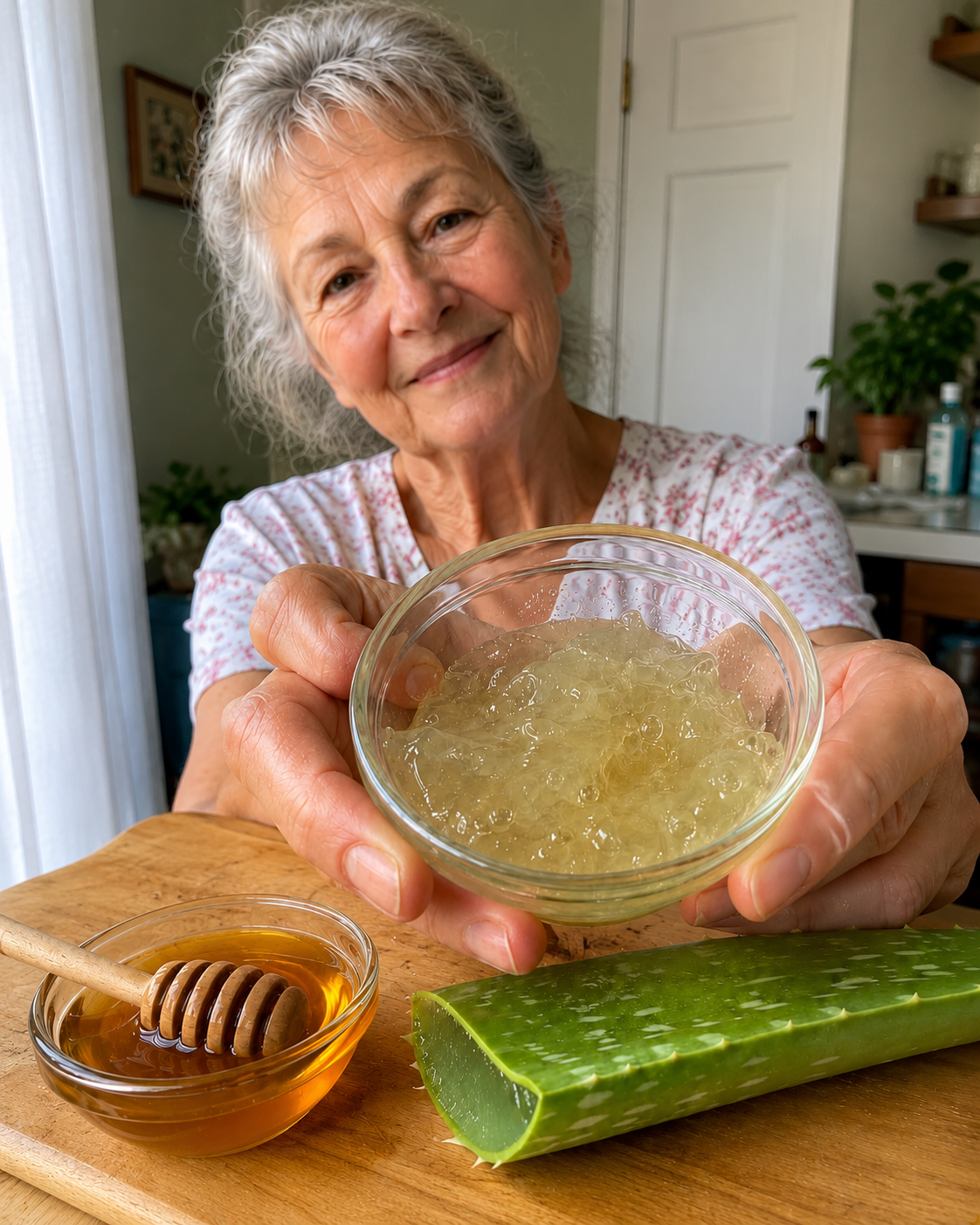
A two-ingredient skincare recipe sounds almost too simple:
Aloe vera + glycerin.
It’s the kind of mixture that can easily become a family beauty secret—especially when someone in her 70s still has soft, smooth-looking skin.
Aloe vera is widely used in topical skincare, while glycerin is a well-established humectant used in moisturizers to help the outer layer of skin retain water.
Together, they may temporarily make dry skin look:
- Smoother
- Softer
- Plumper
- More hydrated
- Less dull
That can create some of the dewy appearance now popularly called “glass skin.”
But there’s an important distinction.
This mixture does not erase deep wrinkles, rebuild decades of lost collagen overnight, tighten sagging skin, or reverse biological aging.
What it may do is much simpler—and genuinely useful:
Improve hydration.
And for mature skin, hydration can make a surprisingly noticeable cosmetic difference.
Important: Homemade skincare can cause irritation or contamination. Patch-test first, avoid using fresh aloe directly from the plant if you’re unsure how to prepare it safely, and don’t store homemade water-based mixtures for long periods without a proper preservative system.
🌿 Why Mature Skin Often Looks Drier
Skin changes considerably with age.
After 50—and particularly after menopause—many people notice that their skin becomes:
- Drier
- Thinner
- More fragile
- Less elastic
- More sensitive
Oil production can decline, while the skin barrier may become less efficient at holding onto water.
This matters because dehydrated skin makes fine lines look more pronounced.
Imagine a dry leaf compared with a hydrated one.
The underlying biology isn’t identical, of course, but the visual principle helps explain why moisturizing can produce such a noticeable change.
Hydrated skin reflects light differently and often appears smoother.
That’s where this simple mixture becomes interesting.
💧 Ingredient #1: Aloe Vera Gel
Aloe vera gel comes from the inner portion of the aloe leaf.
It’s primarily water but also contains various polysaccharides and other naturally occurring plant compounds.
Topical aloe has a long history of use in skincare.
People often describe it as:
- Cooling
- Lightweight
- Soothing
- Hydrating
But aloe isn’t a proven wrinkle eraser.
The biggest mistake is turning a reasonable skincare ingredient into a miracle anti-aging treatment.
✨ Ingredient #2: Glycerin
Glycerin may actually be the less glamorous but more important ingredient in this recipe.
It’s a humectant.
Humectants help increase water content in the outer layer of skin.
That’s why glycerin appears in countless commercial:
- Moisturizers
- Lotions
- Creams
- Serums
- Cleansers
When dry skin becomes better hydrated, fine surface lines can temporarily appear softer.
That doesn’t mean the wrinkle has structurally disappeared.
It means the skin surface is better hydrated.
🔬 Why Hydration Can Look Like “Anti-Aging”
This is one of the most important skincare concepts to understand.
Imagine someone has dry, dehydrated skin around the cheeks and eyes.
The surface looks:
- Rough
- Dull
- Crepey
- Heavily lined
Then they apply an effective moisturizer.
After hydration improves, the same skin may appear:
- Smoother
- Brighter
- Plumper
- More reflective
Take before-and-after photographs under flattering lighting and the change can look dramatic.
But hydration hasn’t suddenly rebuilt years of collagen loss.
Temporary plumping ≠ permanent wrinkle reversal.
Both can be valuable.
They’re simply different things.
📊 Viral Claim vs. Reality
| Viral Claim | More Accurate Answer |
| Aloe erases wrinkles | Not established |
| Glycerin can improve skin hydration | Yes |
| Hydrated skin can look smoother | Yes |
| The mixture rebuilds collagen overnight | No |
| Aloe permanently tightens sagging skin | Not proven |
| Mature skin often benefits from moisturization | Yes |
| Two ingredients can replace sunscreen | No |
| “Glass skin” is a medical condition | No—it’s a cosmetic description |
You don’t need an exaggerated claim for a moisturizer to be useful.
🥣 The 2-Ingredient Aloe Mix
If you want to experiment, commercially prepared plain aloe vera gel is more predictable than cutting open a fresh leaf.
You Will Need
- 1 tablespoon plain aloe vera gel
- A few drops of cosmetic-grade glycerin
That’s it.
Step 1
Place the aloe gel in a clean container.
Step 2
Add only a small amount of glycerin.
Step 3
Mix thoroughly.
Step 4
Apply a thin layer to slightly damp, clean skin.
Step 5
Follow with your normal moisturizer if your skin still feels dry.
You don’t need a thick, sticky layer.
⚠️ More Glycerin Isn’t Better
A common DIY mistake is thinking:
“If three drops hydrate my skin, one tablespoon must work even better.”
Not necessarily.
Too much glycerin can make the mixture:
- Extremely sticky
- Uncomfortable
- Difficult to layer with other products
Commercial skincare products use carefully designed formulations rather than simply maximizing one ingredient.
Start small.
🌙 Is It Better at Night?
You can use moisturizing products whenever they fit your routine.
Nighttime can be convenient because you’re not layering makeup over them.
A simple evening routine might look like:
1. Gentle cleanser
Remove makeup, sunscreen, and daily buildup.
2. Aloe-glycerin mixture
Apply a thin layer if your skin tolerates it.
3. Moisturizer
Use a fragrance-free moisturizer to help support the skin barrier.
That’s enough.
You don’t need seven additional DIY ingredients.
🌞 What About the Morning?
If you use the mixture during the day, there’s one step far more important for long-term skin aging:
Sunscreen.
A morning routine can be as simple as:
- Gentle cleansing
- Moisturizer
- Broad-spectrum SPF 30+ sunscreen
Aloe doesn’t replace sunscreen.
Glycerin doesn’t replace sunscreen.
No anti-aging serum replaces sunscreen.
☀️ Why Sunscreen Matters More Than This Recipe
UV radiation is one of the major external drivers of premature skin aging.
Long-term exposure contributes to:
- Wrinkles
- Uneven pigmentation
- Loss of elasticity
- Rough texture
- Visible sun damage
You could use an excellent moisturizer every night and still undermine your skincare routine with excessive unprotected UV exposure.
If maintaining healthy-looking skin at 72 is the goal, sun protection deserves a permanent place in the routine.
🍃 Fresh Aloe vs. Store-Bought Aloe Gel
Cutting an aloe leaf from a plant feels more natural.
But “fresh” isn’t automatically safer.
Aloe leaves contain different layers and substances.
The yellowish latex located near the outer leaf is different from the clear inner gel and can be irritating.
A commercially prepared product designed for topical use provides a more standardized option.
Choose a simple formula and avoid unnecessary fragrance if you have sensitive skin.
🧊 Why You Shouldn’t Store a DIY Jar for Weeks
This is one of the most important safety points.
Aloe gel contains water.
Once you’re dealing with water-containing skincare, microbial contamination becomes a concern.
Commercial skincare manufacturers use:
- Preservatives
- Controlled manufacturing
- Stability testing
- Packaging designed to reduce contamination
Your kitchen doesn’t provide the same conditions.
Better approach:
Mix only a tiny amount for immediate use.
Don’t make a large jar and store it in the bathroom for weeks.
If you want a product that lasts, buy a properly formulated moisturizer containing aloe and/or glycerin.
🍋 Don’t Add Lemon Juice
A lot of viral “glass skin” recipes eventually become:
Aloe + glycerin + lemon.
Skip the lemon.
Raw lemon juice is acidic and can irritate facial skin.
It isn’t necessary for hydration.
And irritating mature skin can make it look:
- Redder
- Drier
- Rougher
- More lined
The goal is supporting the skin barrier—not attacking it.
🧂 Don’t Add Baking Soda Either
Another common recipe adds baking soda to “deep clean” the skin.
That’s unnecessary.
Healthy skin maintains a mildly acidic surface environment.
Repeated exposure to alkaline ingredients can disrupt normal barrier function.
Your face isn’t a kitchen counter.
It doesn’t need to be scrubbed or chemically stripped clean.
🌿 What About Essential Oils?
Lavender, tea tree, peppermint, rosemary, and other essential oils are often added to DIY skincare.
For this recipe, they’re unnecessary.
Essential oils contain concentrated aromatic compounds and can cause:
- Irritation
- Burning
- Allergic contact dermatitis
Mature skin may already be more sensitive.
Keep the recipe simple.
👵 Why Skin at 72 Needs a Different Strategy
Skin in the 70s usually benefits more from barrier protection than aggressive exfoliation.
A mature-skin routine should prioritize:
- Gentle cleansing
- Hydration
- Moisturization
- Sun protection
- Evidence-based treatment when desired
Repeatedly stripping the skin with:
- Scrubs
- Strong acids
- Lemon
- Alcohol-heavy toners
- Harsh soaps
can worsen dryness.
And dryness makes fine lines more visible.
🧴 Ingredients Worth Looking for in a Mature-Skin Moisturizer
If aloe and glycerin aren’t enough, consider a properly formulated moisturizer containing ingredients such as:
Glycerin
Helps support hydration.
Ceramides
Help support the skin barrier.
Hyaluronic acid
A humectant commonly used for hydration.
Squalane
Can help soften dry skin.
Petrolatum
An effective occlusive ingredient that can reduce water loss, especially on very dry areas.
You don’t need every ingredient in one product.
Choose something comfortable enough to use consistently.
🌙 What About Retinol?
If the goal goes beyond hydration and includes improving signs of photoaging, retinoids have much stronger evidence than aloe.
Retinoids can help improve:
- Fine lines
- Skin texture
- Certain pigmentation changes
But they can also irritate dry mature skin.
Start cautiously.
A common approach is to begin with infrequent application and gradually increase according to tolerance.
People with very sensitive skin or dermatological conditions may benefit from professional guidance.
🚫 7 “Glass Skin” Mistakes After 50
1. Trying to Remove Every Wrinkle
Wrinkles are a normal feature of aging skin.
Healthy skin doesn’t have to be wrinkle-free.
2. Using Too Much Glycerin
More isn’t automatically more hydrating.
3. Adding Lemon
It increases irritation risk without being necessary.
4. Scrubbing Every Day
Over-exfoliation can compromise the skin barrier.
5. Skipping Moisturizer
Aloe alone may not provide enough barrier support for dry mature skin.
6. Ignoring Sunscreen
Preventing additional UV damage is crucial.
7. Storing Homemade Aloe Mixtures for Weeks
Water-containing DIY products aren’t automatically shelf-stable.
🥗 Does Diet Create “Glass Skin”?
No single food guarantees perfect skin.
But overall nutrition supports normal skin biology.
A balanced diet should provide adequate:
- Protein
- Essential fatty acids
- Vitamin C
- Zinc
- Vitamin A precursors
- Other micronutrients
Useful foods include:
- Vegetables
- Whole fruits
- Fish
- Eggs
- Beans
- Nuts
- Seeds
Extreme detox diets aren’t necessary.
And drinking gallons of water won’t permanently erase wrinkles if you’re already adequately hydrated.
💧 Does Drinking More Water Remove Wrinkles?
Hydration is important for health.
But once you’re adequately hydrated, drinking excessive amounts of water doesn’t fill wrinkles from the inside like cosmetic filler.
Drink according to thirst and individual medical needs.
People with certain kidney or heart conditions may even have specific fluid recommendations.
More water isn’t always better.
📸 Why “72-Year-Old Skin” Photos Can Be Misleading
Age alone tells you very little about how someone’s skin will look.
Skin appearance depends on:
- Genetics
- Lifetime sun exposure
- Smoking history
- Hormonal changes
- Skincare habits
- Environment
- Facial anatomy
And photographs add another layer.
Lighting, makeup, filters, facial expression, camera processing, and editing can dramatically change how wrinkles appear.
A photograph doesn’t prove that one DIY recipe caused someone’s skin appearance.
🚨 When a Skin Change Needs a Dermatologist
Don’t assume every new mark after 50 is simply aging.
Have a healthcare professional evaluate a spot that:
- Changes significantly
- Repeatedly bleeds
- Doesn’t heal
- Develops an irregular border
- Changes noticeably in color
- Grows rapidly
- Becomes persistently painful or itchy
No aloe mixture should be used to delay evaluation of a suspicious skin lesion.
❓ Frequently Asked Questions
Can aloe and glycerin make skin look smoother?
They may improve hydration, which can temporarily make dry skin look smoother and plumper.
Does aloe remove wrinkles?
There isn’t good evidence that aloe permanently removes established wrinkles.
Does glycerin tighten skin?
Glycerin primarily acts as a humectant. Better hydration may make the skin appear smoother, but it doesn’t surgically tighten sagging skin.
Can a 70-year-old use aloe vera?
Many older adults can tolerate topical aloe products, but irritation or allergy is possible. Patch-testing a new product is sensible.
Can I use aloe and glycerin every night?
If your skin tolerates the ingredients, they may fit into a moisturizing routine. A properly formulated commercial moisturizer is usually more predictable for long-term use.
Can I leave the mixture overnight?
A thin amount of a tolerated topical product may be left on according to how your skin responds, but there’s no need to apply a thick layer.
Should I use fresh aloe directly from the plant?
Commercially prepared topical aloe gel is easier to use consistently and avoids some of the preparation issues associated with fresh leaves.
Does aloe increase collagen?
There isn’t strong evidence that a simple homemade aloe application significantly rebuilds age-related collagen loss in human facial skin.
What’s the best skincare product after 70?
There isn’t one universal product. Gentle moisturizer and broad-spectrum sunscreen are excellent foundations.
What works better for wrinkles than aloe?
Sun protection and appropriately used evidence-based ingredients such as retinoids have considerably stronger support for photoaging.
⭐ The Bottom Line
A simple aloe vera and glycerin mixture doesn’t need to be a miracle treatment to have value.
Both can contribute to hydration, and hydrated mature skin often looks:
softer, smoother, plumper, and more luminous.
That may help create the dewy appearance people describe as “glass skin.”
But the mixture doesn’t turn 72-year-old skin into 25-year-old skin.
It doesn’t erase deep wrinkles.
It doesn’t permanently tighten sagging skin.
And it doesn’t rebuild decades of collagen overnight.
If you want to try it, keep the formula simple:
Plain aloe gel + a few drops of cosmetic-grade glycerin.
Patch-test first, make only a tiny amount, avoid lemon and essential oils, and don’t store homemade water-based mixtures for weeks.
Then build the routine around what matters most for mature skin:
Gentle cleansing, consistent moisturization, broad-spectrum SPF 30+ sun protection, and evidence-based treatments when appropriate.
The secret isn’t forcing mature skin to look young.
It’s keeping mature skin hydrated, protected, comfortable, and healthy.