
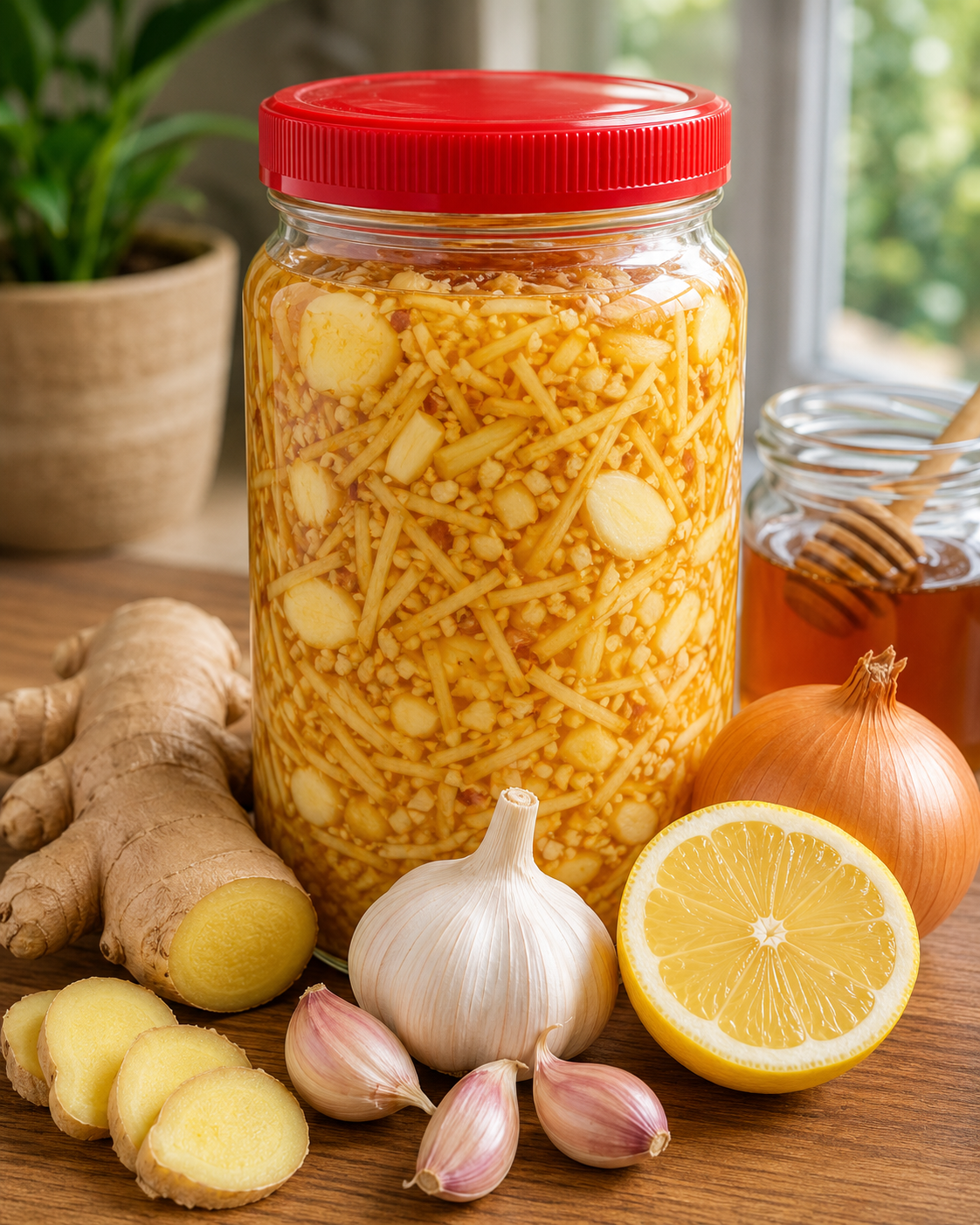
Ginger, onion, garlic, lemon, and honey are five ordinary kitchen ingredients that have been used in traditional home preparations for generations.
Combine them in a jar, and you’ll often see the mixture described online as a powerful natural syrup capable of clearing the lungs, eliminating mucus, stopping coughs, boosting immunity, killing infections, and “detoxing” the body.
The reality is less dramatic—but still useful.
Of these ingredients, honey has the clearest evidence for helping soothe an acute cough, while ginger and warm liquids may feel comforting for an irritated throat. Lemon adds flavor and vitamin C, and garlic and onion contain interesting sulfur-containing plant compounds.
What the mixture cannot reliably do is cure pneumonia, eliminate a bacterial infection, “clean” the lungs, replace antibiotics, or guarantee that a respiratory illness disappears.
Used sensibly, however, a simple version can be an enjoyable soothing food-based syrup for some adults.
The key is making it safely and knowing when a cough needs more than a kitchen remedy.
Important: This syrup is not a cure for respiratory infections. It may also interact with medications or be inappropriate for certain people. Persistent or severe symptoms should be medically evaluated.
🍯 What Is This Homemade Syrup?
The basic preparation usually combines:
- Fresh ginger
- Onion
- Garlic
- Lemon
- Honey
After the ingredients sit together, juices from the onion, lemon, ginger, and garlic mix with the honey and create a thinner, strongly flavored liquid.
Some versions are taken by the spoonful.
Others are diluted in warm water.
Despite being called a “natural medicine,” it’s more accurate to think of it as a traditional food preparation.
Each ingredient contributes something different.
🍯 Ingredient #1: Honey
Honey is probably the most useful ingredient in this mixture when the goal is soothing a cough.
Its thick texture coats the throat, and research has found that honey can help reduce cough symptoms in some people with acute upper respiratory infections.
That’s very different from killing the infection itself.
Honey may help with:
- Throat irritation
- Cough comfort
- Dry, scratchy throat
- Making warm drinks more soothing
Honey does NOT:
- Cure pneumonia
- Replace antibiotics
- Eliminate viruses from the body
- “Detox” the lungs
And there is one major safety rule:
Never give honey to a child younger than 12 months because of the risk of infant botulism.
🫚 Ingredient #2: Ginger
Ginger contains biologically active compounds including gingerols and shogaols.
It’s been studied for several effects, particularly nausea and digestive symptoms.
In a homemade cough preparation, ginger’s biggest practical contribution may simply be its warming flavor and the comfortable sensation it creates in the throat.
Some laboratory research has explored ginger’s anti-inflammatory and antimicrobial properties.
But laboratory effects shouldn’t automatically be interpreted as proof that drinking ginger syrup treats respiratory infections in humans.
Ginger may be useful for:
- Adding warming flavor
- Supporting digestive comfort
- Making a warm beverage enjoyable
It should not be described as an antibiotic replacement.
🧄 Ingredient #3: Garlic
Garlic has a particularly strong health reputation.
When garlic is chopped or crushed, chemical reactions produce sulfur-containing compounds, including compounds associated with allicin formation.
Researchers have studied garlic extensively.
But there’s a big leap between saying:
“Garlic contains biologically active compounds.”
and saying:
“Garlic syrup kills an infection inside your lungs.”
The second claim isn’t established.
Eating garlic as part of a balanced diet is reasonable.
Using large concentrated amounts as medicine requires more caution.
🧅 Ingredient #4: Onion
Onions contain:
- Flavonoids
- Sulfur compounds
- Small amounts of several vitamins and minerals
They’re nutritious vegetables.
Traditional onion-and-honey syrups are used in various cultures for coughs.
But onion hasn’t been proven to pull mucus out of the lungs or cure respiratory disease.
The liquid that forms when chopped onion sits with honey is mostly the result of water moving out of the onion and mixing with the honey.
It isn’t evidence that toxins or infection have been extracted.
🍋 Ingredient #5: Lemon
Lemon provides vitamin C and acidity.
Its bright flavor also balances the sweetness of honey and the strong taste of garlic and onion.
Vitamin C is essential for normal immune function.
But consuming large amounts after becoming sick doesn’t instantly “supercharge” immunity.
Lemon is best viewed as:
A nutritious flavoring ingredient—not an infection treatment.
📊 What Each Ingredient Can—and Can’t—Do
| Ingredient | Potential Practical Benefit | What It Doesn’t Reliably Do |
| Honey | May soothe cough and throat irritation | Cure respiratory infection |
| Ginger | Flavor and digestive comfort | Kill pneumonia |
| Garlic | Nutritious sulfur compounds | Replace antibiotics |
| Onion | Nutritious plant compounds | Pull infection from lungs |
| Lemon | Vitamin C + flavor | Instantly boost immunity |
| Combined syrup | May feel soothing | “Detox” or clean the lungs |
The mixture doesn’t become a powerful drug simply because several healthy ingredients are combined.
🥄 A Simple Homemade Version
If you’d like to make this as a food-based soothing syrup, keep the recipe simple.
Ingredients
- ½ small onion
- 1 small piece fresh ginger
- 1 small garlic clove
- Juice from ½ lemon
- 3–4 tablespoons honey
Step 1: Prepare the ingredients
Wash your hands and preparation surfaces.
Peel the onion, ginger, and garlic.
Thinly slice the onion and ginger.
Crush or finely chop the garlic.
Step 2: Combine
Place everything in a clean container.
Add the lemon juice.
Cover with honey and stir.
Step 3: Let the flavors combine
Allow the mixture to sit briefly in the refrigerator until liquid begins forming.
Strain if you prefer a smoother syrup.
🧊 Storage Is More Important Than Most Recipes Mention
This mixture contains fresh onion, garlic, ginger, and lemon juice.
Once those water-containing ingredients are mixed into honey, you should no longer assume the mixture has the same long shelf life as plain commercial honey.
This isn’t a professionally preserved syrup.
Safer approach:
- Make small batches.
- Keep the mixture refrigerated.
- Use clean utensils every time.
- Don’t repeatedly dip used spoons into the jar.
- Discard it if you notice mold, fermentation, unusual bubbling, an off smell, or another obvious change.
- Don’t keep homemade mixtures indefinitely.
If you’re uncertain whether a homemade preparation is still safe, discard it.
Making another small batch costs much less than dealing with foodborne illness.
☕ How to Use It
For an adult who tolerates all of the ingredients, a small amount can be used as a soothing food preparation.
One option is to mix a little into warm—not boiling—water and sip it slowly.
There’s no medically established dose of ginger-onion-garlic-lemon-honey syrup for treating coughs or respiratory infections.
You don’t need to take large spoonfuls repeatedly throughout the day.
More isn’t necessarily better.
🌙 Should You Take It Before Bed?
Honey may be soothing when coughing makes it difficult to settle down at night.
But the complete five-ingredient mixture isn’t ideal for everyone immediately before lying down.
Garlic, onion, lemon, and ginger may aggravate:
- Heartburn
- Acid reflux
- Stomach irritation
If you notice burning or reflux after taking the mixture, don’t keep increasing the dose.
A simpler warm drink may be more comfortable.
🫁 Does It “Clean the Lungs”?
No food syrup literally cleans your lungs.
The respiratory system already has sophisticated mechanisms for dealing with mucus and inhaled particles.
Mucus can actually be protective.
It helps trap particles and microorganisms.
When you’re sick, inflammation and increased mucus production can create congestion and coughing.
A warm beverage may make your throat feel better.
That doesn’t mean it has scrubbed toxins from the lungs.
🤧 What About Mucus?
A cough can help move mucus from the airways.
Adequate hydration may help keep secretions from becoming overly thick in some situations.
Warm liquids can also feel soothing.
But mucus color alone doesn’t tell you whether you need antibiotics.
Yellow or green mucus can occur during viral illnesses as well.
If symptoms are severe, prolonged, or worsening, proper evaluation matters more than mucus color.
🦠 Does Garlic Kill Viruses and Bacteria?
This is another claim requiring context.
Garlic compounds can demonstrate antimicrobial activity under laboratory conditions.
But putting bacteria into contact with concentrated garlic compounds in a laboratory dish isn’t the same as treating an infection inside a human body.
Once something is eaten, it goes through:
- Digestion
- Absorption
- Metabolism
- Distribution throughout the body
The concentration reaching an infected tissue may be completely different from what researchers used in a laboratory.
That’s why laboratory antimicrobial activity doesn’t automatically make a food an antibiotic.
💊 Can This Replace Antibiotics?
No.
Antibiotics aren’t needed for ordinary viral colds.
But when a bacterial infection genuinely requires antibiotic treatment, this syrup isn’t a substitute.
Never stop prescribed antibiotics and replace them with:
- Garlic
- Honey
- Ginger
- Onion
- Lemon
- Herbal tea
If antibiotics were prescribed, follow your clinician’s instructions.
⚠️ Medication Interactions Matter
Food-sized amounts of ginger and garlic are generally different from concentrated supplement doses.
Still, someone using large quantities regularly should be more cautious.
Particular attention may be warranted if you use:
- Blood-thinning medication
- Antiplatelet medication
- Diabetes medication
- Multiple daily medications
Garlic and ginger supplements can affect bleeding risk in certain circumstances, and concentrated herbal preparations can interact differently than normal culinary portions.
If you take anticoagulants or have surgery scheduled, ask your healthcare professional before using concentrated garlic or ginger preparations regularly.
🩸 What If You Have Diabetes?
Honey is natural.
Honey is also sugar.
A tablespoon of honey can meaningfully contribute to carbohydrate intake.
Adding lemon, ginger, onion, and garlic doesn’t cancel the sugar.
Someone monitoring blood glucose should count honey accordingly.
Avoid the common assumption:
“It’s homemade, therefore it doesn’t affect blood sugar.”
Your body doesn’t use that distinction.
🔥 What If You Have Acid Reflux?
This mixture may be uncomfortable for people with gastroesophageal reflux.
Potential triggers include:
- Lemon
- Raw onion
- Raw garlic
- Large amounts of ginger
Taking it immediately before lying down may make the problem worse.
If you develop:
- Burning behind the breastbone
- Sour taste
- Regurgitation
- Upper abdominal discomfort
stop treating the syrup as mandatory.
You don’t need to tolerate digestive pain to obtain a health benefit.
👴 Older Adults Should Use Extra Caution
A home cough syrup may sound harmless, but adults over 60 are more likely to take multiple medications.
They’re also more likely to have conditions such as:
- Diabetes
- Kidney disease
- Heart disease
- Reflux
- Swallowing difficulties
Those factors matter.
For example, a person with diabetes may need to account for the honey.
Someone using anticoagulants may need to be cautious with concentrated garlic and ginger products.
Someone with swallowing problems may require a different approach to liquids and foods entirely.
“Natural” isn’t enough information to determine whether something is appropriate.
🚫 7 Common Mistakes With Homemade Natural Syrup
1. Calling It an Antibiotic
It’s not.
2. Making a Huge Batch
Fresh homemade mixtures aren’t designed for indefinite storage.
3. Leaving It at Room Temperature for Days
Refrigeration is a safer approach once fresh ingredients have been added.
4. Taking Huge Amounts of Garlic
More garlic doesn’t guarantee stronger benefits and may irritate the digestive system.
5. Assuming Honey Is Sugar-Free
It isn’t.
6. Giving Honey to a Baby
Never give honey to an infant under 12 months.
7. Delaying Medical Care
A soothing syrup shouldn’t become a reason to ignore serious respiratory symptoms.
🚨 When a Cough Needs Medical Attention
Most uncomplicated coughs associated with common respiratory infections improve with time.
But seek medical advice when symptoms are concerning.
Prompt evaluation is particularly important for:
- Difficulty breathing
- Chest pain
- Coughing up blood
- Blue or gray lips
- Confusion
- Severe weakness
- Significant dehydration
- Persistent high fever
- Symptoms that improve and then become substantially worse
- A cough that persists or repeatedly returns
Older adults and people with chronic heart or lung disease may need earlier evaluation.
🍵 A Gentler Alternative
You don’t need all five ingredients every time.
For someone who finds raw garlic and onion irritating, a much simpler drink may be more comfortable.
Warm Lemon-Honey Drink
Ingredients
- 1 cup warm water
- Small squeeze of fresh lemon
- Small amount of honey
Stir and sip slowly.
You can add a thin slice of ginger if you enjoy it.
Again, the goal is comfort, not curing an infection.
🌿 What Actually Supports Recovery From a Typical Cold?
Rather than trying to create the strongest possible natural syrup, focus on basic supportive care.
Rest
Sleep and adequate recovery matter.
Appropriate fluids
Drink enough to remain hydrated unless your healthcare professional has prescribed fluid restrictions.
Nutritious food
Eat according to appetite and medical needs.
Honey for appropriate ages
Honey can be useful for cough relief in adults and children older than 1 year.
Avoid smoking
Smoke can further irritate the respiratory tract.
Follow medical advice
If you have asthma, COPD, heart disease, or another chronic condition, follow your established treatment plan.
❓ Frequently Asked Questions
What is ginger, onion, garlic, lemon, and honey syrup good for?
It’s best considered a traditional soothing food preparation. Honey may help relieve cough symptoms, while the other ingredients provide flavor and various nutrients and plant compounds.
Does this syrup remove mucus from the lungs?
It isn’t proven to remove mucus directly from the lungs. Warm liquids may feel soothing and adequate hydration can support normal mucus consistency.
Does garlic cure a chest infection?
No. Garlic shouldn’t replace medical evaluation or prescribed treatment for a significant respiratory infection.
Can I take this syrup every day?
You don’t need to take it daily for good health. Regular concentrated use may also be inappropriate for people with certain conditions or medications.
Can people with diabetes use honey?
Honey contains sugar and carbohydrates and can raise blood glucose. People with diabetes should account for it in their eating plan.
Can I take it before sleeping?
Some people may find honey soothing at night, but raw garlic, onion, ginger, and lemon can aggravate reflux in susceptible individuals.
Can children use this syrup?
Honey must never be given to children under 12 months. For older children, age-appropriate advice from a pediatric healthcare professional is preferable, particularly when symptoms are significant.
How long can homemade syrup be stored?
Because adding fresh ingredients changes the mixture, don’t assume it has honey’s normal shelf life. Make small batches, refrigerate them, use clean utensils, and discard the preparation if there’s any sign of spoilage.
Does heating honey destroy all of its benefits?
There’s no need to boil this preparation. If making a drink, comfortably warm water is sufficient.
Can this prevent flu or COVID?
No. This mixture shouldn’t be relied upon to prevent influenza, COVID-19, or other respiratory infections.
⭐ The Bottom Line
Ginger, onion, garlic, lemon, and honey can make a traditional homemade syrup that some adults find soothing during an ordinary cough or irritated throat.
Honey has the strongest evidence of the five ingredients for helping relieve cough symptoms.
Ginger can add warmth and may support digestive comfort.
Garlic and onion provide sulfur-containing plant compounds.
Lemon contributes flavor and vitamin C.
But combining them doesn’t create a medicine that:
cleans the lungs, kills every infection, eliminates mucus instantly, replaces antibiotics, or cures respiratory disease.
Make small batches.
Keep fresh mixtures refrigerated.
Use clean utensils.
Remember that honey affects blood sugar.
Be cautious with concentrated ginger and garlic if you take medications that affect bleeding.
And never give honey to a baby younger than 12 months.
Most importantly, use this mixture for what it can reasonably provide:
Comfort—not a cure.
Difficulty breathing, chest pain, coughing blood, confusion, or rapidly worsening illness needs proper medical attention—not a stronger homemade syrup.