
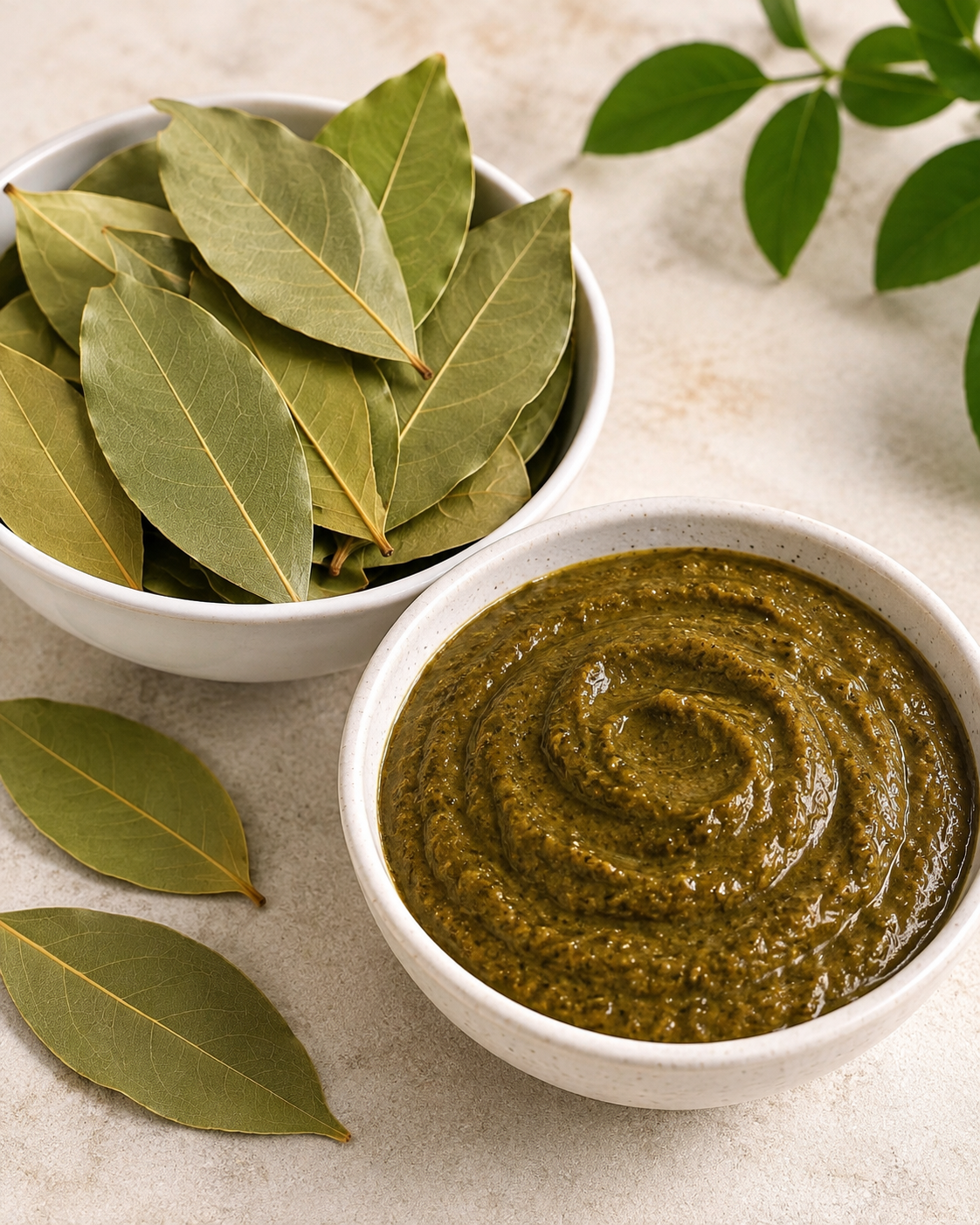
Bay leaves are best known for adding flavor to soups, stews, and slow-cooked meals. But recently, they’ve also become the star of a very different kind of recipe: DIY anti-wrinkle treatments.
Some viral posts suggest boiling bay leaves, applying the liquid to your face, and watching wrinkles become smoother almost immediately.
It’s an attractive promise—especially for adults noticing dryness, fine lines, or changes in skin texture after 50 or 60.
But can bay leaf really erase wrinkles?
Not in the way viral claims suggest.
Bay leaves contain aromatic plant compounds and antioxidants that are interesting from a research perspective. However, there isn’t strong clinical evidence showing that homemade bay-leaf water rapidly removes wrinkles or rebuilds lost collagen.
A homemade preparation may temporarily make skin feel refreshed or hydrated depending on what it’s combined with, but temporary softness is very different from reversing structural skin aging.
And because homemade botanical mixtures can irritate sensitive skin, stronger isn’t necessarily better.
Here’s what bay leaf may realistically offer, how to approach DIY skincare more safely, and which habits have much better evidence for keeping mature skin looking healthy.
Important: Bay leaf is not a proven wrinkle treatment. Never apply bay-leaf essential oil directly to the face, and stop using any homemade preparation that causes burning, redness, swelling, or persistent irritation.
🌿 Why Is Bay Leaf Being Used in Skincare?
Bay leaf—usually Laurus nobilis—contains numerous naturally occurring plant compounds.
These include aromatic compounds and polyphenols that have demonstrated antioxidant or antimicrobial activity in laboratory research.
That sounds impressive.
But laboratory activity doesn’t automatically mean a homemade bay-leaf toner has been clinically proven to improve wrinkles.
Skin is a complex organ.
For an ingredient to meaningfully change wrinkles, researchers need to know things such as:
- What compound is active?
- What concentration works?
- Can it penetrate the skin?
- Is that concentration safe?
- How frequently should it be applied?
- Does it produce visible improvement in humans?
- How does it compare with established skincare ingredients?
For homemade bay-leaf water, those questions haven’t been adequately answered.
👩 Why Do Wrinkles Form?
To understand why a leaf can’t simply “erase” wrinkles, it helps to understand what’s happening beneath the surface.
As skin ages, several changes occur.
Collagen gradually decreases
Collagen provides structural support.
With age, the skin produces less collagen and existing collagen becomes more fragmented.
Elastin changes
Elastic fibers help skin return to its original shape.
Over time, this system becomes less efficient.
Skin becomes drier
Oil production can decrease with age, particularly after hormonal changes.
Dry skin makes fine lines appear more noticeable.
Cell turnover changes
Older skin generally renews itself more slowly.
UV damage accumulates
Years of sun exposure accelerate collagen breakdown and contribute to:
- Wrinkles
- Uneven pigmentation
- Rough texture
- Loss of elasticity
This process is called photoaging.
A bay leaf can’t instantly reverse decades of these structural changes.
💧 Why DIY Remedies Can Make Wrinkles Look Better Temporarily
Here’s where many before-and-after claims become confusing.
Imagine dry skin with noticeable fine lines.
Now apply something that hydrates the outer layer of that skin.
The skin can temporarily become:
- Softer
- Plumper-looking
- Smoother
- More reflective
Fine lines may appear less noticeable.
That visual improvement can be real.
But it doesn’t necessarily mean new collagen was produced or the wrinkle disappeared.
Hydration can temporarily soften the appearance of fine lines.
That’s very different from:
Permanently reversing wrinkles.
Understanding this difference prevents unrealistic expectations.
🍃 Does Bay-Leaf Water Build Collagen?
There isn’t good clinical evidence demonstrating that applying homemade bay-leaf water significantly increases collagen production in aging human skin.
Antioxidant activity in a laboratory isn’t enough to prove collagen rebuilding.
This is a common problem with viral skincare claims.
A plant contains antioxidants.
Therefore, someone claims:
“This plant reverses aging.”
That’s a major scientific leap.
Many foods and plants contain antioxidants.
That doesn’t make all of them effective topical anti-aging treatments.
📊 Viral Bay-Leaf Claims vs. Reality
| Viral Claim | What We Actually Know |
| Bay leaf erases wrinkles quickly | Not established |
| Bay leaf contains plant compounds | Yes |
| Bay-leaf water rebuilds collagen | Not proven |
| Hydrated skin can look smoother | Yes |
| Essential oil is stronger and therefore better | No |
| Homemade botanical products can irritate skin | Yes |
| Daily sunscreen helps prevent photoaging | Yes |
| Proven skincare ingredients can improve fine lines over time | Yes |
The biggest mistake is confusing interesting chemistry with proven skincare effectiveness.
🧴 What About Bay-Leaf Essential Oil?
This deserves extra caution.
Essential oils are highly concentrated.
They are completely different from the weak concentration produced when a few leaves are steeped in water.
Putting undiluted essential oil directly on facial skin can cause:
- Burning
- Irritation
- Redness
- Allergic contact dermatitis
The skin around the eyes is particularly delicate.
Don’t assume an essential oil will work better simply because it’s stronger.
In skincare, irritation can actually make your skin look worse.
⚠️ Irritation Can Make Mature Skin Look Older
This is particularly relevant after age 50.
Mature skin can become:
- Drier
- More fragile
- More reactive
- Slower to recover from irritation
Repeatedly applying harsh DIY ingredients can disrupt the skin barrier.
The result may include:
- Flaking
- Tightness
- Redness
- Burning
- Increased sensitivity
- More visible fine lines
People sometimes interpret the tight feeling after an astringent DIY treatment as evidence that their skin is “lifting.”
Often, it’s simply dryness.
Tight skin isn’t necessarily healthier skin.
🌿 If You Still Want to Try Bay Leaf on Your Skin
The safest option is to remember that you don’t need bay leaf for healthy skin at all.
But if you’re determined to experiment with a mild homemade preparation, keep it simple.
Mild Bay-Leaf Rinse
Ingredients
- 1–2 dried culinary bay leaves
- 1 cup clean water
Preparation
Bring the water to a boil.
Remove it from the heat.
Add the bay leaves and allow them to steep briefly.
Remove the leaves.
Allow the liquid to cool completely.
Before applying it
Patch-test a small amount on a limited area of skin first.
Wait and watch for irritation.
Do not apply it to:
- Broken skin
- Active eczema
- Irritated skin
- Immediately after exfoliating
- Areas very close to the eyes
If burning, itching, swelling, or significant redness occurs, wash it off and discontinue use.
🧊 Don’t Make a Huge Batch
This is one of the biggest problems with homemade skincare.
Once you mix plant material with water, you’ve created a water-containing cosmetic preparation without a professional preservative system.
Microorganisms can potentially grow in it.
It doesn’t become shelf-stable simply because bay leaf has demonstrated antimicrobial activity in laboratory experiments.
Safer approach:
- Prepare very small quantities.
- Use clean equipment.
- Avoid touching the mixture repeatedly with your fingers.
- Don’t keep homemade water-based skincare for extended periods.
- Discard leftovers rather than trying to preserve them for weeks.
If you want a product designed for repeated use, a properly formulated commercial cosmetic with an appropriate preservative system is generally more reliable.
🚫 Don’t Add Lemon Juice
Bay-leaf wrinkle recipes frequently add lemon.
That’s not necessary.
Lemon juice is highly acidic and can irritate facial skin.
DIY lemon treatments may contribute to:
- Burning
- Redness
- Barrier damage
- Increased sensitivity
- Pigmentation problems in susceptible skin
Eating lemon is very different from rubbing concentrated acidic juice across your face.
Skip it.
🚫 Baking Soda Isn’t Better Either
Another viral combination involves:
Bay leaf + baking soda + lemon.
This is not an anti-aging breakthrough.
Baking soda is alkaline, while healthy skin naturally maintains a mildly acidic surface environment.
Repeatedly applying highly alkaline DIY preparations can interfere with the skin barrier.
You don’t need to make your skin sting or feel stripped for a product to work.
🍯 What About Bay Leaf and Honey?
Honey can act as a humectant in certain properly formulated skincare products.
But kitchen honey isn’t required for an effective anti-aging routine.
And adding honey to homemade bay-leaf water doesn’t transform the mixture into a clinically proven wrinkle treatment.
If your primary problem is dryness, a well-formulated fragrance-free moisturizer is easier to use consistently and has a more predictable composition.
🧴 What Actually Helps Mature Skin Look Smoother?
Instead of chasing one secret leaf, focus on a few fundamentals.
1. Moisturizer
This may be the most underestimated anti-aging step.
A good moisturizer can improve hydration and temporarily make fine lines less noticeable.
Look for ingredients such as:
- Glycerin
- Ceramides
- Hyaluronic acid
- Petrolatum
- Squalane
Not everyone needs all of these.
The goal is simply to support the skin barrier and reduce excessive water loss.
☀️ 2. Sunscreen
If you care about wrinkles, sun protection deserves far more attention than bay leaves.
UV exposure contributes significantly to premature skin aging.
Daily broad-spectrum sunscreen helps protect against additional photoaging.
Look for:
Broad-spectrum SPF 30 or higher.
Apply it to exposed skin and use other protective measures such as:
- Shade
- Hats
- Protective clothing
Sunscreen doesn’t erase every existing wrinkle.
Its major anti-aging value is helping prevent additional UV damage.
🌙 3. Retinoids
Retinoids have much stronger evidence for photoaging than homemade botanical toners.
Depending on the product and country, options include prescription retinoids and cosmetic retinol products.
They can help improve:
- Fine lines
- Uneven texture
- Certain pigmentation changes
But they work gradually.
They can also cause:
- Dryness
- Peeling
- Irritation
Start carefully and follow professional advice when appropriate.
People who are pregnant or trying to become pregnant should discuss retinoid use with a healthcare professional.
🍊 4. Vitamin C
Properly formulated topical vitamin C products may help support antioxidant protection and improve aspects of uneven pigmentation.
But formulation matters.
Vitamin C stability, concentration, packaging, and pH can influence performance.
Rubbing lemon juice on your face isn’t an equivalent substitute.
💧 5. Gentle Cleansing
Older skin doesn’t usually need aggressive scrubbing.
Use lukewarm rather than extremely hot water.
Avoid repeatedly stripping your skin with harsh soaps.
If your face feels painfully tight after cleansing, your routine may be too aggressive.
🌙 A Simple Nighttime Routine After 50
You don’t need ten products.
Step 1 — Gentle cleanse
Remove makeup, sunscreen, and daily buildup without aggressively scrubbing.
Step 2 — Treatment if desired
Use a proven treatment such as an appropriate retinoid according to your skin tolerance and professional guidance.
Don’t introduce several strong products simultaneously.
Step 3 — Moisturize
Apply a fragrance-free moisturizer while the skin is comfortable.
For very dry areas, a small amount of an occlusive product can help reduce water loss.
That’s enough for many people.
🌞 A Simple Morning Routine
Step 1
Gently cleanse or rinse according to your skin’s needs.
Step 2
Apply moisturizer.
Step 3
Finish with broad-spectrum SPF 30+ sunscreen.
If you’re spending significant time outdoors, remember that sunscreen isn’t permanent.
Follow the product’s reapplication instructions and use hats, shade, and protective clothing.
👵 Mature Skin Needs Consistency, Not Aggression
One of the biggest skincare mistakes after 50 or 60 is trying to force faster results.
People may combine:
- Retinol
- Strong acids
- Scrubs
- Essential oils
- Lemon
- DIY masks
all at once.
Then the skin becomes irritated.
Once the skin barrier is compromised, fine lines can appear more obvious because the surface becomes dry and inflamed.
A slower routine that you can tolerate consistently is often more useful.
🚫 7 Wrinkle Mistakes to Avoid
1. Expecting Overnight Results
Structural skin changes take time.
2. Applying Undiluted Essential Oils
Concentrated plant oils can irritate or sensitize skin.
3. Using Lemon Juice
Acidic kitchen ingredients aren’t necessary for anti-aging skincare.
4. Scrubbing Wrinkles
You can’t scrub away a wrinkle.
Over-exfoliation can damage the skin barrier.
5. Skipping Sunscreen
This undermines almost every other anti-aging effort.
6. Making Large Batches of DIY Toner
Water-based homemade preparations aren’t automatically preserved.
7. Starting Five New Products Together
If irritation develops, you won’t know which product caused it.
Introduce new products gradually.
🩺 When a Skin Change Isn’t “Just Aging”
Not every spot, bump, or rough patch appearing after 50 is simply a wrinkle.
See a healthcare professional or dermatologist about skin changes that:
- Bleed repeatedly
- Don’t heal
- Change noticeably in shape or color
- Grow rapidly
- Develop an unusual border
- Become persistently painful or itchy
Sun-damaged skin can develop conditions requiring medical evaluation.
Don’t cover a suspicious lesion with homemade remedies for months hoping it disappears.
⏳ How Long Do Real Anti-Aging Products Take?
This is another reason viral “instant wrinkle erasers” are appealing.
Real skincare usually works gradually.
Moisturizers
Can improve the appearance of dryness relatively quickly.
Sunscreen
Provides protection when used correctly but prevents future damage rather than instantly reversing existing wrinkles.
Retinoids
Visible improvements generally require consistent use over weeks to months.
Professional procedures
Certain procedures can produce more substantial improvements but also involve different costs, recovery periods, and risks.
Skin remodeling isn’t usually a 10-minute process.
📸 Be Skeptical of Before-and-After Photos
Online skincare images can be dramatically influenced by:
- Lighting
- Camera angle
- Makeup
- Moisturizer
- Facial expression
- Image sharpening
- Filters
- Editing
Even moving a light source can make facial lines look dramatically different.
A photograph alone doesn’t prove that a remedy rebuilt collagen.
Look for controlled clinical evidence rather than dramatic social-media comparisons.
🥗 Can Diet Help Your Skin?
Nutrition matters for overall skin health.
A balanced diet can provide:
- Protein
- Essential fats
- Vitamin C
- Vitamin A precursors
- Zinc
- Other micronutrients
Useful foods can include:
- Vegetables
- Fruit
- Fish
- Eggs
- Beans
- Nuts
- Seeds
- Whole grains
But no single food eliminates wrinkles.
Skin aging reflects decades of biology and environmental exposure.
Healthy eating supports the body.
It doesn’t replace sunscreen or evidence-based skincare.
❓ Frequently Asked Questions
Does bay leaf remove wrinkles?
There isn’t strong clinical evidence showing that topical bay leaf removes wrinkles.
Can bay-leaf water tighten skin?
It may temporarily change how the skin feels, but a tight sensation doesn’t mean wrinkles or sagging have been permanently corrected.
Can bay leaf increase collagen?
There isn’t good evidence that homemade bay-leaf water meaningfully rebuilds collagen in aging human skin.
Can I leave bay-leaf water on my face overnight?
There’s no established benefit to leaving it on overnight. Longer exposure may increase irritation in sensitive skin, and homemade water-based preparations have preservation concerns.
Is bay-leaf essential oil good for wrinkles?
There isn’t sufficient evidence to recommend bay-leaf essential oil as a wrinkle treatment. Don’t apply undiluted essential oils directly to facial skin.
Can I mix bay leaf with lemon?
It’s better to avoid DIY lemon juice on facial skin because of irritation risk.
What’s better for wrinkles than bay leaf?
Daily sun protection, moisturization, and appropriately used evidence-based ingredients such as retinoids have substantially stronger support.
What helps wrinkles immediately?
A moisturizer can temporarily make dehydrated fine lines appear smoother.
Permanent removal of established wrinkles isn’t realistically achieved overnight.
Is bay leaf safe for mature skin?
Not everyone will react the same way. Botanical ingredients can cause irritation or allergic reactions. Patch testing and discontinuing the product if irritation occurs are sensible precautions.
⭐ The Bottom Line
Bay leaf is an interesting culinary herb containing several naturally occurring plant compounds.
But there’s no convincing evidence that bay-leaf water rapidly erases wrinkles, lifts sagging skin, or rebuilds lost collagen.
If a DIY treatment makes your skin look temporarily smoother, hydration may be responsible.
That doesn’t make the effect meaningless—but it does make it temporary.
For mature skin, the fundamentals remain much more dependable:
Gentle cleansing. Regular moisturizing. Daily broad-spectrum SPF 30+ sunscreen. Evidence-based treatments such as retinoids when appropriate. And patience.
If you experiment with bay leaf, keep the preparation mild, patch-test it, avoid essential oils and lemon juice, and don’t store homemade water-based mixtures for long periods.
Most importantly, don’t damage healthy skin while trying to make it look younger.
Healthy-looking mature skin comes from protecting and supporting the skin barrier consistently—not trying to force wrinkles away overnight.