
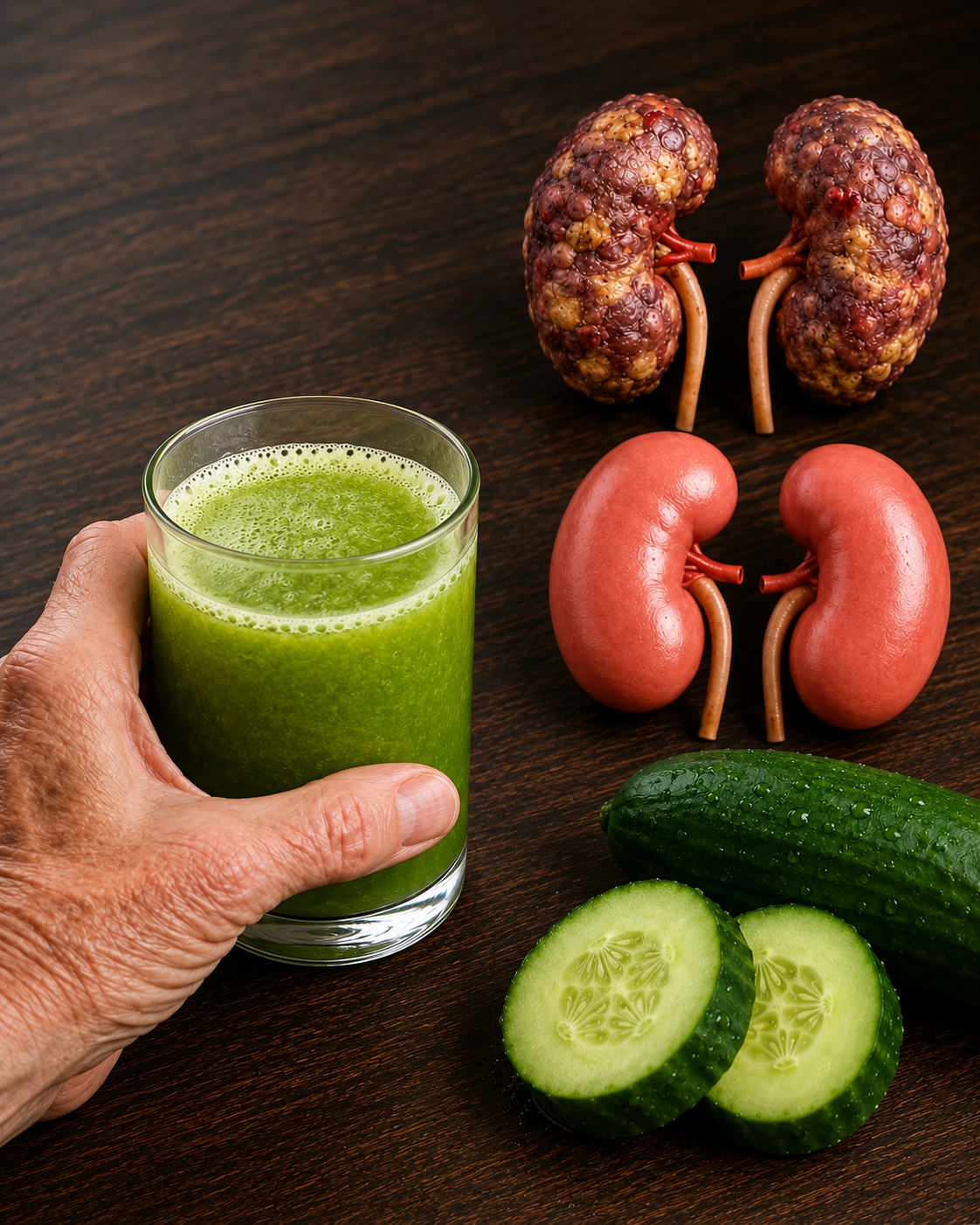
A glass of bright green cucumber juice.
A dramatic picture of damaged kidneys becoming perfectly healthy.
And one irresistible promise:
“Do this every day and eliminate high creatinine in just 24 hours.”
For anyone worried about kidney test results, that sounds almost too good to ignore.
Cucumber is refreshing, naturally low in sodium, and can absolutely fit into many healthy diets.
But there is one critical fact to understand:
No cucumber drink has been proven to repair damaged kidneys or reliably normalize elevated creatinine within 24 hours.
Creatinine can change from one blood test to another, and hydration, muscle mass, recent exercise, diet, medications, illness and kidney filtration can all influence the result.
So instead of trying to “flush creatinine out,” the useful goal is to understand why creatinine is elevated and what your kidney tests actually mean.
🥒 Why Cucumber Gets Linked to Kidney Health
Cucumber seems perfect for a kidney-remedy headline.
It’s mostly water.
It’s refreshing.
It’s naturally low in sodium.
And it works easily in salads, infused water and green drinks.
That creates an intuitive story:
More cucumber → more water → kidneys flush harder → creatinine disappears.
Unfortunately, kidney physiology isn’t that simple.
Your kidneys don’t work like dirty filters that can be rinsed clean with vegetable juice.
If kidney filtration is impaired, drinking a special juice doesn’t repair the filtering structures overnight.
🧪 What Is Creatinine?
Creatinine is a waste product associated with normal muscle metabolism.
Your bloodstream carries it to your kidneys, which normally filter it from the blood.
Healthcare professionals measure serum creatinine partly because it can help estimate:
eGFR — estimated glomerular filtration rate.
As kidney filtration worsens, creatinine often rises.
But creatinine alone doesn’t tell the complete story. NIDDK recommends evaluating kidney function using eGFR and checking urine for albumin; urine albumin-to-creatinine ratio, or UACR, is an important marker of kidney damage.
📊 Creatinine Is Not the Same as “Kidney Toxins”
This misconception drives many detox advertisements.
High creatinine doesn’t mean your kidneys contain a pile of toxins that cucumber juice can wash away.
Instead, an elevated result can indicate that creatinine isn’t being cleared from the bloodstream as efficiently—or that other factors temporarily affected the measurement.
That’s why doctors interpret creatinine alongside other information.
🩺 The Two Numbers Worth Knowing
If you’re concerned about kidney health, ask about:
1. eGFR
This estimates how effectively the kidneys are filtering blood.
NIDDK notes that an eGFR below 60 may indicate kidney disease, while an eGFR of 15 or lower represents kidney failure in many clinical contexts. Results need to be interpreted with your healthcare professional.
2. UACR
This checks whether albumin—a blood protein—is leaking into urine.
A healthy kidney normally keeps most albumin in the bloodstream.
NIDDK considers a UACR above 30 mg/g higher than normal and potentially indicative of kidney disease.
Those numbers provide much more information than the color of your morning juice.
⏰ Can Cucumber Lower Creatinine in 24 Hours?
There’s no established evidence that cucumber juice reliably lowers elevated creatinine within 24 hours by repairing the kidneys.
And a lower creatinine result doesn’t automatically prove kidney tissue recovered.
Imagine someone gets a high creatinine measurement after:
- Intense exercise
- Dehydration
- Illness
- A major change in diet
- Certain medications or supplements
Then conditions change and the next measurement is lower.
If that person happened to drink cucumber juice between tests, it’s tempting to credit the cucumber.
But two measurements don’t prove cause and effect.
📋 Viral Claim vs. Kidney Reality
| Viral Claim | What We Actually Know |
| Cucumber repairs damaged kidneys | Not established |
| Green juice eliminates high creatinine in 24 hours | Not established |
| Creatinine helps assess kidney filtration | Yes |
| eGFR provides important information about kidney function | Yes |
| UACR can detect albumin leakage and kidney damage | Yes |
| Diet matters in chronic kidney disease | Yes |
| Sodium control is often important | Yes |
| Potassium needs vary between kidney patients | Yes |
| Fluid needs can vary dramatically | Yes |
| Kidney diets should be individualized | Yes |
🥒 So Is Cucumber Kidney-Friendly?
For many people, cucumber can be an excellent vegetable choice.
It provides water and can help make meals fresh and satisfying without requiring large amounts of sodium.
For example, cucumber can replace:
- Salty pickles
- Chips
- Processed snacks
- High-sodium side dishes
That’s useful.
But notice what happened:
Cucumber didn’t “clean” the kidneys.
It simply helped improve the overall diet.
🥤 A Safer Cucumber Drink
If your healthcare professional hasn’t restricted your fluids, you can make a simple unsweetened drink.
Ingredients
- ½ cucumber
- 1 cup cold water
- Small squeeze of lemon
- A few mint leaves
Preparation
Wash the cucumber thoroughly.
Slice it.
Blend with water and mint.
Add a small squeeze of lemon.
Drink it as an ordinary beverage.
That’s it.
No sugar.
No detox powder.
No huge supplement dose.
And most importantly:
No promise that it will lower creatinine overnight.
🥗 Whole Cucumber May Be Better Than Juice
You don’t need to juice vegetables to make them healthy.
Whole cucumber preserves its intact structure and fiber.
Try:
Cucumber salad
Cucumber
Bell pepper
Lettuce
Parsley
Olive oil
Lemon
Add an appropriate protein according to your kidney nutrition plan.
For many people, that’s a much more satisfying way to use cucumber.
⚠️ But Kidney Diets Aren’t the Same for Everyone
This is extremely important.
Two people can both have chronic kidney disease and receive different dietary instructions.
One may need to watch:
Potassium.
Another:
Phosphorus.
Another:
Protein.
Another:
Fluid.
And nearly everyone needs individualized guidance based on disease stage, laboratory results, medications and other health conditions.
NIDDK specifically notes that nutritional needs change as CKD progresses and recommends individualized guidance, ideally with a dietitian experienced in kidney disease.
🍌 Potassium: The Biggest Green-Juice Problem
People often assume:
More fruits and vegetables = always better for kidneys.
Not necessarily.
Healthy kidneys regulate potassium.
Damaged kidneys may have difficulty removing excess potassium from the blood.
Too much—or too little—potassium can cause serious muscle and heart problems.
That’s why enormous homemade green juices can become problematic.
A drink might contain:
- Banana
- Orange
- Spinach
- Avocado
- Tomato
- Coconut water
- Several vegetables
Each ingredient may be nutritious individually.
Together, they can create a concentrated potassium load.
For someone with advanced CKD or hyperkalemia, that’s not automatically safe.
🧂 Watch “Healthy” Salt Substitutes
Here’s another mistake.
Someone is told:
“Eat less salt.”
So they buy a potassium-based salt substitute.
But many salt substitutes contain:
Potassium chloride.
NIDDK specifically warns that people who need potassium restriction should be cautious with potassium-containing salt substitutes.
Read ingredient labels.
“Low sodium” doesn’t automatically mean “kidney-safe.”
💧 Should You Drink More Water to Lower Creatinine?
This depends.
If you’re mildly dehydrated and otherwise healthy, appropriate hydration is obviously important.
But:
More water isn’t always better.
In advanced CKD, damaged kidneys may struggle to remove excess fluid.
Some people may therefore need fluid restriction.
NIDDK advises people with CKD to ask their healthcare professional how much liquid is appropriate because needs depend on kidney function.
So don’t respond to elevated creatinine by forcing down gallons of cucumber water.
🦵 What Happens When Too Much Fluid Builds Up?
Fluid retention can contribute to:
- Swollen feet
- Swollen ankles
- Puffy legs
- Facial swelling
- Increased blood pressure
In more serious situations, fluid accumulation can contribute to breathing problems.
If you’re developing swelling while drinking huge amounts because an online detox told you to “flush your kidneys,” stop guessing and seek medical guidance.
🧂 Sodium Often Matters More Than the Green Drink
High sodium intake encourages the body to retain fluid.
For people with CKD, this can contribute to:
- Swelling
- Higher blood pressure
- Increased stress on the heart and kidneys
NIDDK recommends reducing sodium as a foundational dietary strategy in CKD and notes that many people with CKD require individualized sodium limits.
Major sodium sources include:
- Processed meats
- Packaged soups
- Frozen meals
- Fast food
- Chips
- Sauces
- Restaurant meals
- Seasoning packets
Adding cucumber juice to an extremely salty diet misses the bigger issue.
🍗 Protein Needs Attention Too
Protein is essential.
Your body needs it for:
- Muscle
- Skin
- Tissues
- Healing
- Immune function
But protein metabolism produces waste that the kidneys must handle.
Some people with CKD may benefit from moderate rather than excessive protein intake.
At the same time, eating too little protein can contribute to malnutrition.
That’s why the answer isn’t:
“Stop eating protein.”
It’s:
“Find the appropriate amount for your kidney function and nutritional status.”
NIDDK recommends individualized protein guidance for people with CKD.
🥩 Don’t Start a Huge High-Protein Diet Without Checking
If your creatinine is elevated and kidney function is reduced, this probably isn’t the ideal moment to blindly begin:
- Multiple protein shakes
- Huge steaks
- Protein bars all day
- High-dose creatine
- Extreme bodybuilding diets
Talk to your healthcare professional or renal dietitian first.
The correct protein target depends on your situation.
🧪 Creatine Is Different From Creatinine
The words sound similar, but they’re not identical.
Creatine is a compound found naturally in the body and sold as a sports supplement.
Creatinine is a waste product measured in blood to help evaluate kidney filtration.
If you’re taking creatine supplements, tell the healthcare professional interpreting your kidney tests.
Never hide supplements because they seem unrelated.
💊 Your Medication List Matters
Certain medicines can affect kidney function or laboratory measurements.
That’s another reason a sudden creatinine change shouldn’t immediately lead to a detox drink.
Bring your full medication and supplement list to your appointment.
That includes:
- Prescription medications
- Over-the-counter painkillers
- Vitamins
- Herbal supplements
- Workout supplements
Your clinician needs the complete picture.
💊 Be Careful With NSAID Painkillers
People worried about kidney health should be particularly careful about frequent unsupervised use of NSAID pain relievers.
This category includes medications commonly used for pain and inflammation.
If you have CKD, diabetes, hypertension, heart disease, dehydration or take multiple medications, ask your healthcare professional which pain relievers are safest for you.
Don’t assume over-the-counter means harmless.
❤️ Blood Pressure Is a Kidney Issue
Your kidneys and cardiovascular system are closely connected.
High blood pressure can damage the kidneys.
Kidney disease can also make blood-pressure control more difficult.
That’s why managing kidney health often includes managing:
- Blood pressure
- Diabetes
- Cholesterol
- Smoking
- Weight when appropriate
- Physical activity
A cucumber smoothie cannot compensate for uncontrolled hypertension.
🩸 Diabetes Is Another Major Piece
Diabetes is a major risk factor for kidney disease.
Persistently elevated blood glucose can damage kidney filtering structures over time.
For someone with diabetes and kidney disease, kidney protection therefore includes good glucose management.
Again:
Don’t just ask:
“What juice lowers creatinine?”
Ask:
“What is damaging my kidneys, and how do we control it?”
That question is much more powerful.
🥗 A Simple Kidney-Conscious Meal
Here’s a meal that may fit many—but not all—kidney diets.
Fresh Cucumber Chicken Bowl
Ingredients
- Chopped cucumber
- Lettuce
- Bell pepper
- Small portion of grilled chicken
- Olive oil
- Lemon
- Garlic
- Black pepper
- Fresh herbs
Avoid heavily salted commercial dressing.
The exact protein, potassium and portion recommendations should be adapted to your kidney function and laboratory results.
🍎 What Foods Are “Kidney-Friendly”?
There’s no universal kidney superfood list.
Depending on your potassium and phosphorus needs, your dietitian may recommend different choices.
Some people can eat a wide variety of:
- Apples
- Berries
- Grapes
- Cabbage
- Bell peppers
- Green beans
- Cauliflower
- Cucumber
But these foods don’t “clean creatinine.”
They’re simply foods that can fit certain kidney-conscious meal plans.
NIDDK specifically warns against unnecessarily restricting healthy foods unless laboratory results or kidney function indicate a need.
🚫 8 Mistakes People Make When Creatinine Is High
1. Trying to Flush Creatinine With Juice
Creatinine isn’t dirt inside your kidneys.
2. Drinking Gallons of Water
Fluid needs depend on kidney function.
3. Assuming Every Green Food Is Kidney-Safe
Potassium can become a concern in advanced CKD.
4. Using Potassium Salt Substitutes
Some can significantly increase potassium intake.
5. Starting an Extreme High-Protein Diet
Protein needs should be individualized.
6. Taking Random Herbal “Kidney Cleanses”
Supplements may contain poorly characterized ingredients and can interact with medications.
7. Focusing Only on Creatinine
eGFR and urine albumin provide important additional information.
8. Waiting for Food to Fix Progressive Symptoms
Kidney disease needs proper diagnosis and management.
🧪 What Tests Should You Ask About?
If your creatinine is elevated, ask your healthcare professional about the broader kidney picture.
That may include:
Serum creatinine
Helps estimate filtration.
eGFR
Estimates kidney filtering ability.
UACR
Looks for albumin leaking into urine.
Potassium
Important because kidney dysfunction can disturb potassium balance.
Bicarbonate
May become abnormal in kidney disease.
Phosphorus
Can become elevated as CKD advances.
Blood pressure
A major kidney-health factor.
Blood glucose/A1C
Particularly important when diabetes is present.
Not everyone needs every test at every visit.
Your clinician decides based on your situation.
📉 Don’t Panic Over One Creatinine Result
One abnormal laboratory value doesn’t automatically establish chronic kidney disease.
CKD generally involves evidence of kidney damage and/or reduced kidney function that persists for more than three months.
Your healthcare professional may repeat tests to determine whether a result is:
- Temporary
- Stable
- Improving
- Progressively worsening
Patterns matter.
📈 Track Your eGFR Over Time
One number is a snapshot.
Several results create a trend.
For example:
| Test | January | April | July |
| Creatinine | 1.2 | 1.3 | 1.3 |
| eGFR | 67 | 61 | 61 |
| UACR | 18 | 16 | 15 |
This pattern tells a very different story from:
| Test | January | April | July |
| Creatinine | 1.2 | 1.7 | 2.2 |
| eGFR | 67 | 43 | 30 |
| UACR | 35 | 110 | 280 |
Those numbers are examples only.
The point is that kidney health is evaluated through trends and multiple markers, not one cucumber drink followed by one blood test.
🌿 What About Parsley Juice?
Parsley is nutritious as food.
But concentrated parsley drinks are often advertised as kidney cleanses without evidence that they repair CKD.
Use parsley as an herb.
Don’t expect it to replace kidney treatment.
🌿 What About Celery Juice?
Celery can fit into a healthy diet.
But celery juice doesn’t regenerate kidney tissue or reliably normalize creatinine.
Also remember:
Juicing multiple vegetables concentrates the amount you can consume quickly.
For someone managing potassium or fluids, that may matter.
🍋 What About Lemon Water?
Unsweetened lemon water can be a pleasant beverage.
It can also replace sugary drinks.
That’s useful.
But lemon water doesn’t reverse chronic kidney disease.
Don’t confuse:
Healthy beverage
with
medical treatment.
🥒 What About Cucumber Water Every Morning?
If you’re healthy, enjoy cucumber water and have no fluid restriction, it’s generally just another way to drink water.
For CKD patients, however, the appropriate amount of fluid should be individualized.
The kidney benefit doesn’t come from a mysterious cucumber detox reaction.
🚨 Warning Signs You Shouldn’t Treat With Juice
Seek medical attention for concerning symptoms such as:
- Markedly reduced urine output
- New or rapidly worsening swelling
- Shortness of breath
- Persistent nausea or vomiting
- Severe weakness
- Confusion
- Blood in the urine
- Significant flank or abdominal pain
These symptoms can have many causes.
They deserve proper evaluation rather than another detox recipe.
👴 Why This Matters Even More After 60
Older adults may have:
- Reduced kidney reserve
- Diabetes
- High blood pressure
- Heart disease
- Multiple medications
That makes aggressive self-treatment especially risky.
A “natural kidney flush” could affect:
- Fluid balance
- Potassium
- Blood pressure
- Medication effects
The safer approach is individualized care.
🗓️ A Better Daily Kidney Routine
Forget the 24-hour miracle.
Try building a routine you can maintain.
Morning
Take prescribed medication correctly.
Eat a balanced breakfast.
Use salt modestly.
Midday
Choose fresh foods more often than heavily processed meals.
Stay appropriately hydrated according to your medical plan.
Afternoon
Move your body if medically appropriate.
Dinner
Keep sodium under control and follow your individualized protein, potassium and phosphorus guidance.
Evening
Review your blood pressure or glucose if your healthcare plan calls for monitoring.
Regularly
Follow your:
- Creatinine
- eGFR
- UACR
- Potassium
- Blood pressure
- Blood glucose when appropriate
That’s genuine kidney monitoring.
❓ Frequently Asked Questions
Can cucumber lower creatinine?
There’s no good evidence that cucumber reliably lowers elevated creatinine by repairing kidney function.
Can cucumber juice repair damaged kidneys?
No evidence shows that cucumber juice regenerates damaged kidneys.
Can creatinine drop in 24 hours?
Creatinine can change, particularly when temporary factors influence it, but a change over 24 hours does not prove that kidney damage has been reversed.
Should I drink more water if creatinine is high?
Not automatically. Appropriate fluid intake depends on the cause of the abnormal result and your kidney, heart and overall health. Some people with CKD need fluid restriction.
Is cucumber safe for kidney disease?
It can fit many kidney diets, but individual needs vary. Portion size and your overall potassium, sodium and fluid plan matter.
What number matters besides creatinine?
Two particularly important measures are eGFR and UACR.
Can kidney disease improve?
Some acute kidney problems can improve substantially when the underlying cause is treated. Chronic kidney disease is different; treatment focuses heavily on slowing progression and preventing complications.
Should I stop eating protein?
No. Your body needs protein. Some CKD patients need moderate amounts rather than excessive amounts, and the appropriate target should be individualized.
Are potassium-rich foods bad for everyone with CKD?
No. Potassium restriction isn’t automatically necessary for every person with kidney disease. Blood tests and kidney function should guide the decision.
Can I use a potassium salt substitute instead of salt?
Be careful. Many salt substitutes contain potassium chloride, which may be inappropriate when potassium needs to be restricted.
What should I do if my creatinine keeps increasing?
Contact your healthcare professional. A rising trend deserves investigation rather than repeated detox attempts.
⭐ The Bottom Line
Cucumber deserves a place in the kitchen.
It doesn’t deserve responsibility for repairing your kidneys.
A cucumber-based drink can be:
Refreshing.
Low in added sugar.
Easy to prepare.
A useful replacement for sugary beverages for many people.
But it has not been shown to eliminate kidney inflammation, regenerate damaged kidneys, or reliably normalize elevated creatinine in 24 hours.
If creatinine is elevated, don’t focus exclusively on making the number fall.
Find out what your eGFR shows.
Check whether albumin is leaking into your urine with UACR.
Know your potassium.
Control blood pressure.
Manage diabetes when present.
Watch sodium.
Use the appropriate amount of protein and fluid for your individual condition.
And follow the trend in your kidney tests over time. NIDDK emphasizes that healthy eating can help people with CKD maintain appropriate mineral and fluid balance, but potassium, phosphorus, protein and fluid needs can change as kidney disease progresses.
Keep the cucumber if you enjoy it.
Skip the promise that one green glass can rebuild your kidneys by tomorrow morning.