
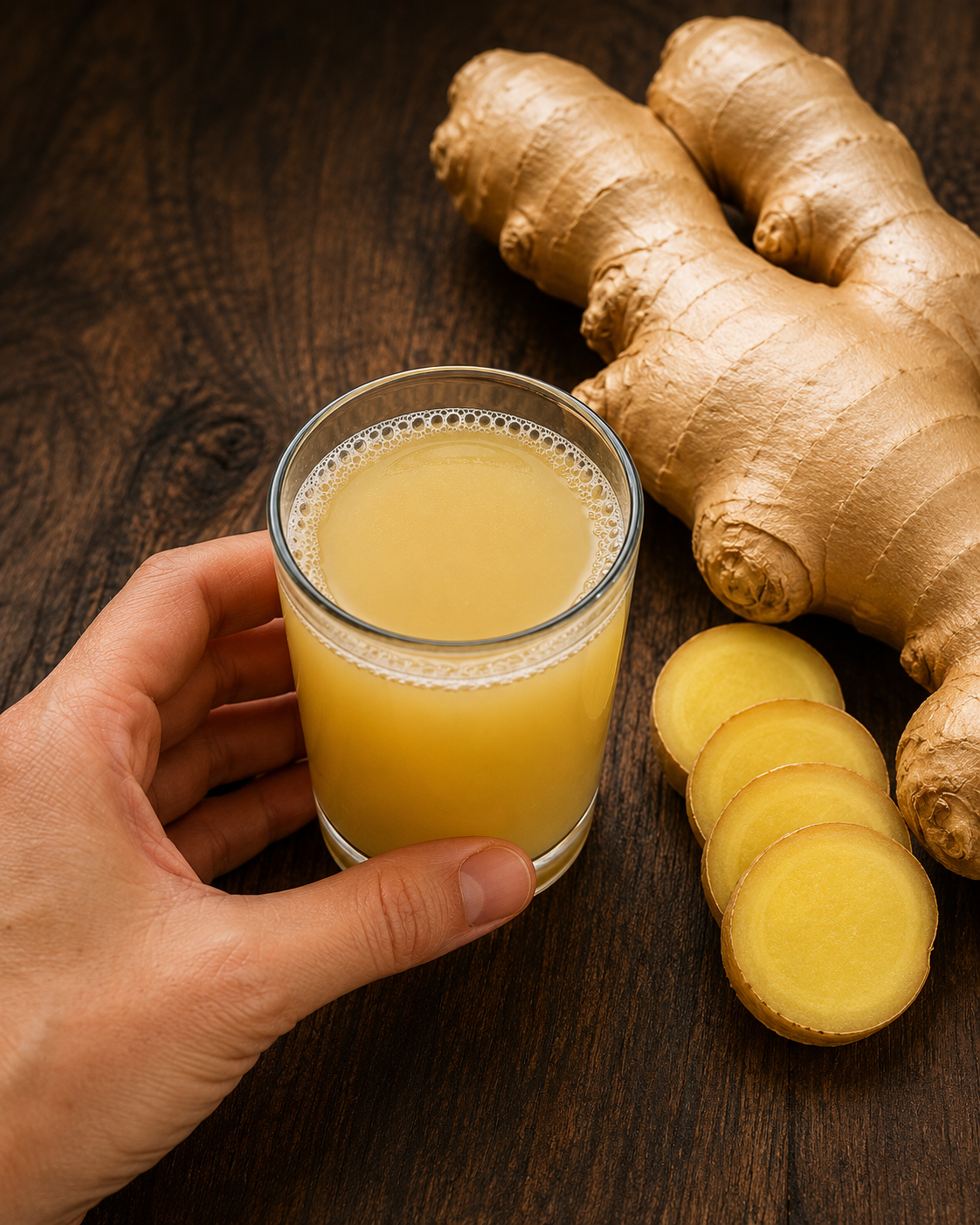
Ginger has earned a strong reputation.
People use it for nausea, digestion, colds, inflammation, joint discomfort, and even cholesterol. So when a viral post claims that one ginger drink can simultaneously lower cholesterol, calm aching joints, and bring energy back when fatigue feels “bone deep,” it sounds believable.
There is some genuine science behind ginger.
But the three promises are not equally well supported.
Ginger may have modest effects on some blood-lipid markers, and some studies suggest possible benefit for osteoarthritis symptoms. But it is not a proven treatment for high cholesterol, it does not rebuild damaged joints, and it cannot diagnose or correct the many possible causes of persistent fatigue.
🌿 What Makes Ginger Interesting?
Ginger, or Zingiber officinale, contains several biologically active compounds, including gingerols and shogaols.
These compounds have been studied for possible effects on inflammation, metabolism, nausea, pain, and other health outcomes.
That sounds promising.
But there is a crucial difference between:
“Ginger contains active compounds.”
and
“A cup of ginger tea treats three medical conditions.”
Most clinical studies use standardized ginger supplements or extracts, often for several weeks. That’s very different from drinking a homemade ginger beverage once or twice.
📊 Viral Claim vs. What Research Actually Shows
| Viral claim | What the evidence suggests |
| Ginger “cleans” cholesterol from arteries | No |
| Ginger may modestly affect some lipid markers | Possibly |
| Ginger reverses arthritis | No |
| Ginger may modestly help some OA symptoms | Evidence is mixed |
| Ginger rebuilds cartilage | Not established |
| Ginger restores severe fatigue | Not established |
| Persistent fatigue can signal another health problem | Yes |
| A healthy diet and activity matter more overall | Yes |
❤️ Can Ginger Really Lower Cholesterol?
This is one of the more interesting areas of ginger research.
A 2018 meta-analysis of 12 clinical trials involving 586 participants found that ginger supplementation was associated with reductions in triglycerides and some measures of LDL cholesterol, although results varied considerably between studies.
A later 2022 meta-analysis of 26 trials also found modest improvements in several lipid measures, including total cholesterol, triglycerides and LDL cholesterol.
But another 2023 review found significant improvements in total cholesterol and triglycerides while changes in LDL and HDL were not statistically significant.
That tells us something important:
The signal is interesting, but it is not perfectly consistent.
And when effects are present, they’re generally modest.
🧪 What About the Newer Research?
A 2026 umbrella review looking across meta-analyses of randomized trials found generally favorable effects of ginger supplementation on several metabolic measures, including triglycerides, total cholesterol and LDL cholesterol, although results varied between analyses.
A 2026 meta-analysis specifically in people with type 2 diabetes found a statistically significant reduction in triglycerides but no significant reduction in LDL or total cholesterol; the authors also noted that the magnitude of some changes was of limited clinical importance.
So ginger may have a place in a healthy diet.
But it doesn’t act like a statin.
And it certainly doesn’t dissolve plaque from arteries.
🚫 “Lowering Cholesterol” Is Not the Same as “Cleaning Arteries”
This distinction is often lost online.
High LDL cholesterol contributes to atherosclerosis—the gradual buildup of plaque inside arteries.
Reducing LDL can lower cardiovascular risk.
But even if ginger produces a small change in a blood test, that doesn’t mean it physically scrubs plaque from artery walls.
Atherosclerosis management is much bigger than one ingredient.
It can involve:
Diet.
Physical activity.
Weight management.
Blood-pressure control.
Diabetes management.
Smoking cessation.
And cholesterol-lowering medication when appropriate.
Ginger can complement that plan.
It cannot replace it.
🥤 A Simple Ginger Drink
If you enjoy ginger and your medical situation allows it, here’s a simple version.
Ginger-Lemon Tea
Ingredients
1 cup hot water
4–5 thin slices fresh ginger
Small squeeze of lemon
Optional pinch of cinnamon
Optional ½ teaspoon honey
Preparation
Add sliced ginger to hot water.
Let it steep for 5–10 minutes.
Add lemon after it cools slightly.
Use honey sparingly if desired.
Drink it because you enjoy it.
Not because you expect your arteries to be “clean” tomorrow morning.
🦵 What About Joint Pain?
This is more complicated.
Some earlier studies suggested a modest improvement in osteoarthritis pain and function.
A 2014 meta-analysis involving five trials and 593 participants found that oral ginger produced a statistically significant but modest improvement in pain and disability compared with placebo.
But later reviews have been less confident.
A 2020 systematic review concluded that evidence was insufficient to support oral ginger for knee osteoarthritis pain or function, largely because the available studies were small and methodologically inconsistent.
NCCIH therefore describes the evidence as uncertain rather than proven.
🧪 A More Recent Trial
A 2024 randomized controlled trial involving 100 people with mild knee osteoarthritis studied a standardized steamed ginger extract for 12 weeks.
Participants receiving the ginger extract had greater improvements in several pain and symptom measures compared with placebo.
That’s interesting.
But look carefully at what was actually studied:
A standardized extract.
For 12 weeks.
Not:
One kitchen drink for three days.
That’s a huge difference.
🦴 Does Ginger Rebuild Cartilage?
No clinical evidence shows that ginger regenerates worn cartilage.
Osteoarthritis affects multiple parts of the joint, including:
Cartilage.
Bone.
Synovium.
Muscles.
Ligaments.
And other tissues.
A small decrease in discomfort doesn’t prove structural repair.
This is an important distinction.
Less pain ≠ new cartilage.
🚫 Mistake #1: Calling All Joint Pain “Inflammation”
Aching knees don’t automatically mean the body is full of inflammation.
Joint pain can come from:
Osteoarthritis.
Rheumatoid arthritis.
Gout.
Bursitis.
Tendon problems.
Injury.
Muscle weakness.
Nerve irritation.
Referred pain from the hip or back.
Infection.
The correct treatment depends on the cause.
Ginger doesn’t diagnose any of them.
🚫 Mistake #2: Drinking Ginger Instead of Moving
For common knee osteoarthritis, appropriate exercise and strengthening are among the most important evidence-based treatments.
A person may drink ginger every morning but remain sedentary all day.
That’s usually the wrong priority.
Muscles help support joints.
Regular movement can improve:
Strength.
Function.
Mobility.
Balance.
Confidence.
Pain tolerance.
Ginger doesn’t substitute for those adaptations.
🏋️ Why Muscle Strength Matters So Much
Your quadriceps help stabilize the knee.
If those muscles weaken, stairs, walking and standing from a chair can become harder.
That creates a cycle:
Pain → less movement → weaker muscles → more difficulty moving.
Breaking that cycle may be more useful than chasing anti-inflammatory drinks.
For someone medically able to exercise, gradual strengthening can include:
Sit-to-stand practice.
Supported squats.
Straight-leg raises.
Walking.
Cycling.
Water exercise.
Physical therapy when needed.
⚖️ Weight Can Matter Too
For people with knee osteoarthritis and excess body weight, even modest weight reduction may reduce mechanical stress on the joint.
That’s physics, not detox.
Every step puts force through your knees.
If appropriate weight loss reduces that force repeatedly throughout the day, the cumulative effect can matter.
Ginger doesn’t reproduce that mechanical benefit.
😴 Now the Bigger Issue: “Bone-Deep Fatigue”
This is where miracle-drink claims become more concerning.
Persistent fatigue isn’t one disease.
The National Institute on Aging notes that ongoing fatigue can be associated with many conditions, including:
Anemia.
Diabetes.
Heart disease.
Kidney disease.
Liver disease.
Thyroid disorders.
Sleep apnea.
Chronic pain.
Infection.
Medication effects.
Depression and anxiety.
And other conditions.
So if someone feels exhausted for several weeks, the correct response isn’t:
“Use more ginger.”
It is:
“Find out why you’re exhausted.”
🩸 Could It Be Anemia?
Possibly.
Anemia means there aren’t enough healthy red blood cells or enough hemoglobin to carry oxygen effectively.
Possible symptoms can include:
Fatigue.
Weakness.
Shortness of breath.
Dizziness.
Reduced exercise tolerance.
Depending on the cause, treatment might require addressing:
Iron deficiency.
Vitamin B12 deficiency.
Folate deficiency.
Blood loss.
Kidney disease.
Chronic inflammation.
Other medical problems.
Ginger doesn’t correct these automatically.
🦋 Could It Be Thyroid Disease?
Yes.
An underactive thyroid can contribute to:
Low energy.
Feeling cold.
Weight changes.
Constipation.
Dry skin.
Slow thinking.
Muscle aches.
Again, the solution isn’t an anti-inflammatory drink.
A blood test may be needed.
😴 Could It Be Sleep Apnea?
Very commonly overlooked.
Clues include:
Loud snoring.
Breathing pauses during sleep.
Gasping.
Morning headaches.
Dry mouth.
Severe daytime sleepiness.
Someone with untreated sleep apnea can feel completely drained no matter how many “energy drinks” they consume.
💊 Medication Can Also Cause Fatigue
NIA specifically notes that some medicines—including certain antihistamines, antidepressants and pain medicines—can contribute to fatigue.
That’s why a medication review can sometimes be more useful than another supplement.
Never stop prescribed medication on your own.
Discuss persistent tiredness with your healthcare professional.
☕ Ginger Is Not a Stimulant
Unlike coffee or tea, ginger doesn’t contain caffeine.
Some people describe ginger tea as invigorating because of its:
Warmth.
Spicy taste.
Digestive comfort.
Morning ritual.
But that subjective feeling doesn’t mean ginger has corrected the biological cause of fatigue.
A person can feel temporarily refreshed and still have:
Anemia.
Sleep apnea.
Diabetes.
Thyroid disease.
Heart disease.
Or another condition.
🥗 A Better “Energy” Breakfast
Instead of depending on one drink, build a balanced meal.
Ginger Berry Yogurt Bowl
Plain Greek yogurt
Berries
Oats
Walnuts
Small amount of freshly grated ginger
This offers:
Protein.
Fiber.
Carbohydrate.
Healthy fats.
Micronutrients.
And ginger.
That’s a much more useful energy strategy than drinking ginger water while skipping breakfast.
🍲 Ginger Works Beautifully in Real Meals
Try this:
Ginger-Garlic Salmon Bowl
Salmon
Brown rice or another appropriate whole grain
Broccoli
Bell pepper
Carrots
Fresh ginger
Garlic
Olive oil
Lemon
This combines ginger with foods that support a broader heart-healthy eating pattern.
That’s where ginger belongs best:
Inside a good diet.
Not on a pedestal.
🍋 Does Adding Lemon Make It Stronger?
Lemon adds:
Flavor.
Vitamin C.
Acidity.
It can make unsweetened ginger tea more enjoyable.
But lemon does not suddenly convert ginger into a cholesterol medicine.
The combination doesn’t:
Dissolve arterial plaque.
Reverse arthritis.
Correct anemia.
Repair damaged joints.
Or cure chronic fatigue.
🍯 What About Honey?
Honey can make the drink more pleasant.
But it also adds sugar.
Someone with diabetes or high blood glucose shouldn’t assume that a “natural” sweetener is metabolically free.
If you use honey, use a small amount.
You don’t need to turn a low-calorie ginger tea into a dessert drink.
🌿 What About Turmeric?
Ginger and turmeric are often combined because both are promoted for inflammation.
That’s fine in cooking.
But mixing two herbs doesn’t automatically double the benefit.
And concentrated supplements introduce additional questions about:
Dose.
Quality.
Side effects.
Medication interactions.
Food amounts and supplement doses shouldn’t be treated as equivalent.
💊 Ginger Supplements Are Not the Same as Ginger Tea
Many clinical trials showing possible metabolic or joint effects have used:
Powders.
Capsules.
Standardized extracts.
Measured daily doses.
That’s very different from an unspecified amount of root steeped in water.
This is why it is misleading to take supplement-trial results and say:
“One ginger tea does the same thing.”
We don’t know that.
⚠️ Ginger Can Cause Side Effects
NCCIH reports that oral ginger can cause:
Abdominal discomfort.
Heartburn.
Diarrhea.
Mouth or throat irritation.
That means larger doses aren’t necessarily better.
Someone with reflux may actually feel worse after a very strong ginger drink.
💊 What About Medication Interactions?
This is another reason to distinguish normal culinary use from concentrated supplementation.
NCCIH advises people taking medications to discuss herbal products with their healthcare professional because herb-drug interactions can occur.
Be particularly cautious about deliberately taking concentrated ginger products if you’re already using multiple medicines.
📅 A Better 7-Day Ginger Experiment
Instead of trying to “cure cholesterol, joints and fatigue” in one week, use ginger as part of a broader experiment.
Day 1
Replace a sugary drink with unsweetened ginger tea.
Day 2
Add a 10–20 minute walk if medically appropriate.
Day 3
Build a higher-fiber meal with beans, oats, vegetables or whole grains.
Day 4
Add appropriate strength exercise.
Day 5
Review your sleep.
How many hours are you actually getting?
Do you snore heavily?
Day 6
Review your medications and supplements.
Day 7
Ask:
Is the joint pain persistent?
Has the fatigue lasted several weeks?
Do you know your cholesterol numbers?
If not, that’s the point where testing and evaluation become more useful than escalating your ginger dose.
🚫 8 Common Ginger Mistakes
1. Expecting It to “Clean” Arteries
Some lipid markers may change modestly, but ginger doesn’t scrub plaque away.
2. Replacing Cholesterol Medication
Don’t stop prescribed medication because of a spice.
3. Calling Pain Relief Cartilage Repair
Those are very different outcomes.
4. Assuming Every Joint Problem Is Inflammation
The diagnosis matters.
5. Ignoring Exercise
Movement and strengthening can be central to joint health.
6. Using Ginger to Mask Severe Fatigue
Persistent fatigue may need medical investigation.
7. Assuming More Ginger Works Better
Large amounts can cause gastrointestinal side effects.
8. Treating Tea Like a Clinical-Trial Extract
The dose and preparation may be completely different.
🧪 What Should You Check if Fatigue Persists?
If you have been unusually tired for several weeks, NIA recommends talking with a healthcare professional. Evaluation may include history, examination and laboratory testing based on your symptoms.
Depending on the situation, a clinician may investigate areas such as:
Blood count.
Iron status.
Vitamin B12.
Thyroid function.
Blood glucose or A1C.
Kidney function.
Liver function.
Sleep quality.
Medication effects.
The correct workup depends on the person.
🚨 When Joint Pain Needs More Than Ginger
Seek prompt medical attention for symptoms such as:
A very hot, red and swollen joint.
Fever with severe joint pain.
A major injury or deformity.
Sudden inability to bear weight.
Rapidly worsening swelling.
Significant calf swelling.
Chest pain or shortness of breath associated with leg swelling.
Those aren’t situations for a homemade anti-inflammatory drink.
🚨 When Fatigue Becomes Concerning
Fatigue should be taken especially seriously when accompanied by:
Chest pain.
Shortness of breath.
Fainting.
New confusion.
Unexplained weight loss.
Black or bloody stools.
Persistent fever.
Marked weakness.
Rapid decline in function.
Again:
The goal is to find the cause.
❓ Frequently Asked Questions
Can ginger lower cholesterol?
Some meta-analyses of clinical trials suggest modest improvements in several lipid measures, but results aren’t completely consistent and ginger shouldn’t replace established cholesterol treatment.
Does ginger lower LDL?
Some analyses have found modest LDL reductions while others have not found a statistically significant effect.
Can ginger unclog arteries?
No evidence shows that ginger physically removes established arterial plaque.
Can ginger help knee arthritis?
Possibly modestly for some people, but evidence is mixed. Earlier meta-analysis suggested small benefits, while later reviews considered the evidence insufficient or uncertain.
Does ginger rebuild cartilage?
No good clinical evidence shows that ginger regenerates damaged cartilage.
Can ginger cure fatigue?
No. Fatigue has many possible causes, and persistent fatigue may need medical evaluation.
Is ginger tea good in the morning?
It can be a pleasant caffeine-free beverage and may help some people with digestive comfort. Just don’t treat it as medication.
How much fresh ginger should I put in tea?
A modest amount such as several thin slices in a cup of hot water is reasonable for ordinary culinary use. You don’t need an extremely concentrated drink.
Is fresh ginger better than powder?
They’re different preparations. Clinical trials often use standardized powders or extracts, so results can’t automatically be transferred to homemade tea.
Can ginger cause heartburn?
Yes. Heartburn, abdominal discomfort and diarrhea are among the reported oral side effects.
Should I take ginger supplements with medication?
Discuss concentrated herbal supplements with your healthcare professional, particularly if you take regular medications.
⭐ The Bottom Line
That ginger drink is more interesting than many viral remedies because ginger has actually been studied in humans.
Research suggests that ginger supplementation may produce modest improvements in some cholesterol and triglyceride measures, although results vary between studies.
For osteoarthritis, the evidence is mixed. Some trials and reviews suggest small benefits for pain, while others conclude that the evidence isn’t strong enough to recommend ginger as a reliable treatment.
And when it comes to “bone-deep fatigue,” ginger is not the answer until you know the question.
Persistent fatigue can be linked to sleep problems, anemia, diabetes, thyroid disease, heart or kidney disease, chronic pain, medications, and other conditions.
So enjoy ginger.
Use it in tea.
Cook with it.
Add it to vegetables, fish and soups.
Let it complement a heart-healthy diet and an active lifestyle.
But don’t ask one spicy drink to lower cholesterol, rebuild your knees, and correct unexplained exhaustion all at once.