
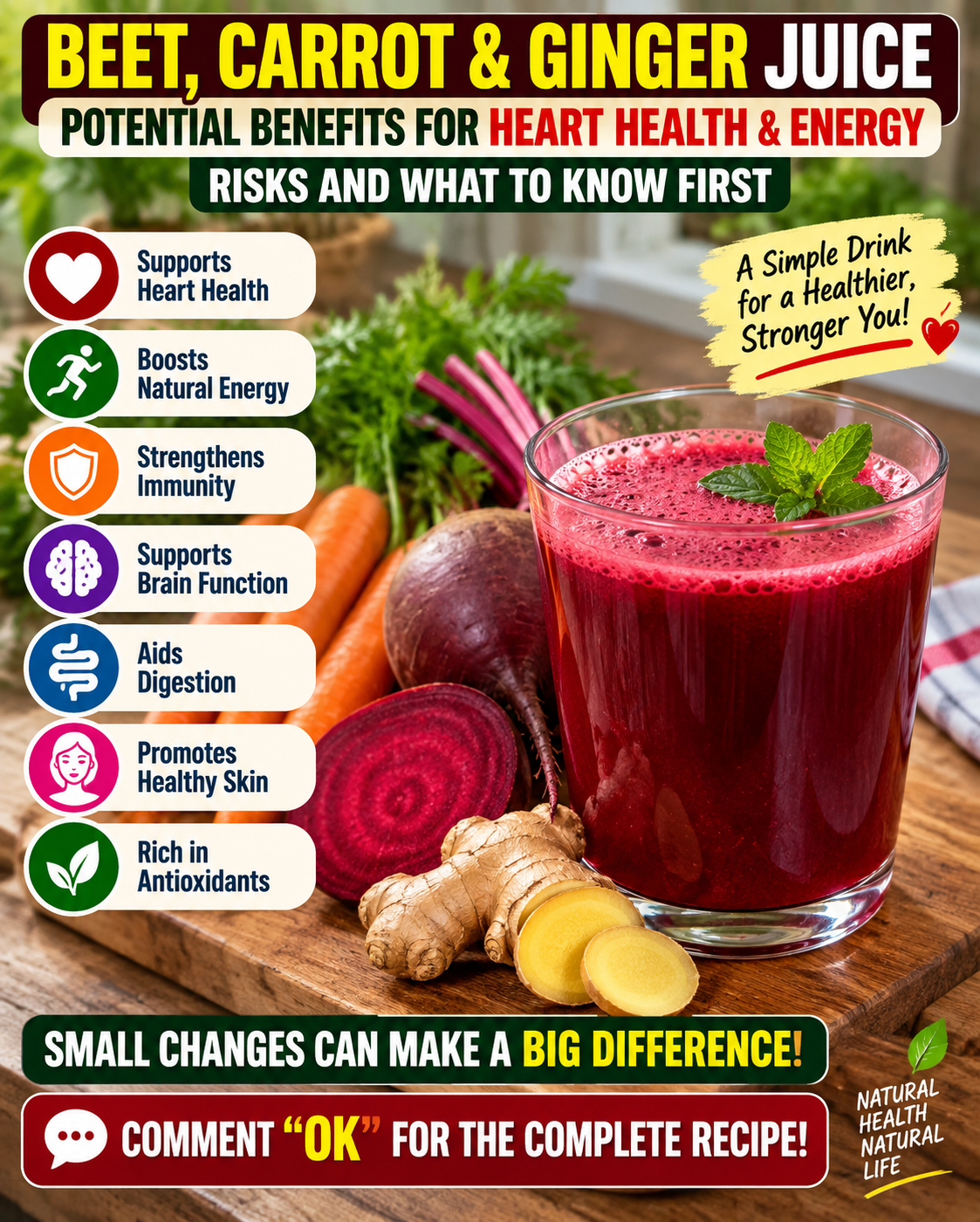
Beet, carrot, and ginger juice has become a popular “morning energy” and heart-health drink.
The combination sounds promising: beets provide dietary nitrate, carrots contain carotenoids and other nutrients, and ginger contains biologically active compounds such as gingerols.
But social-media claims often go much further, suggesting that one glass can:
“Clean” clogged arteries.
Immediately restore circulation.
Fix high blood pressure.
Give all-day energy.
Detox the blood.
Or prevent heart disease.
The evidence is more interesting—and more realistic—than those claims.
Among these ingredients, beetroot has particularly good research behind its effects on nitric-oxide pathways and blood pressure, although the benefits are generally modest and depend on the amount of nitrate consumed. A 2024 meta-analysis of 11 randomized trials involving 349 adults with hypertension found that nitrate-rich beetroot juice lowered clinic systolic blood pressure by about 5.3 mmHg on average, while effects on diastolic and 24-hour blood pressure were not significant. The certainty of evidence was rated low.
That is potentially useful.
It is not the same as unclogging an artery.
⚠️ Important Safety Note
This article is for general educational purposes only and is not a substitute for medical diagnosis or treatment.
Beet, carrot, and ginger juice does not cure hypertension, remove arterial plaque, reverse heart disease, treat anemia automatically, or replace prescribed medication.
Because beetroot may lower blood pressure, people taking blood-pressure medication should be cautious about using large or concentrated amounts regularly.
Ginger may cause heartburn, abdominal discomfort, diarrhea, or mouth and throat irritation, and herbal products may interact with medicines.
If you have kidney disease, recurrent kidney stones, diabetes, very low blood pressure, or take daily medications, discuss frequent concentrated juice use with your healthcare professional.
Seek urgent medical care for chest pressure or pain, severe shortness of breath, fainting, sudden weakness or numbness, difficulty speaking, or other possible heart-attack or stroke symptoms.
❤️ Why Beetroot Is Interesting for the Heart
Beetroot naturally contains nitrate.
After you consume nitrate-rich foods, bacteria in the mouth help convert nitrate into nitrite. The body can then convert some nitrite into nitric oxide.
Nitric oxide plays an important role in blood-vessel function.
One of its effects is helping blood vessels relax.
This is the biological reason researchers have investigated beetroot juice for blood pressure, circulation, and exercise performance. A systematic review notes that beetroot’s nitrate can increase nitric-oxide availability and influence vasodilation and oxygen delivery.
🩸 Can Beet Juice Lower Blood Pressure?
Potentially, by a modest amount in some people.
The 2024 systematic review of adults with hypertension found an average reduction in clinic systolic pressure of approximately 5.31 mmHg compared with control treatments.
However:
The trials were relatively small.
Responses varied.
Certainty of evidence was low.
And 24-hour blood-pressure outcomes were not significantly improved.
So it would be inaccurate to say:
“Beet juice cures high blood pressure.”
A more accurate statement is:
Nitrate-rich beetroot juice may modestly lower systolic blood pressure in some people.
🫀 Does It Clean Clogged Arteries?
No.
This is an important distinction.
Blood-vessel relaxation is not the same thing as removing plaque.
Atherosclerotic plaque develops within artery walls through complex processes involving cholesterol, inflammation, immune cells, calcium, and other factors.
Beetroot juice has not been shown to physically scrub plaque from arteries.
Neither have carrots nor ginger.
A person can potentially experience better vascular function without an established plaque suddenly disappearing.
🥕 What Do Carrots Add?
Carrots are nutritious vegetables.
They provide:
Beta-carotene.
Other carotenoids.
Potassium.
Vitamin K.
And additional plant compounds.
Beta-carotene can be converted by the body into vitamin A, which has important functions in vision, immune function, and normal cell biology.
But carrots should not be portrayed as artery-cleaning medicine.
They are valuable primarily because they contribute to a nutrient-rich dietary pattern.
🫚 What Does Ginger Add?
Ginger contributes flavor and biologically active compounds.
It has been studied extensively for several health purposes.
NCCIH notes that ginger has evidence for certain forms of nausea, particularly pregnancy-related nausea, while evidence for several other uses remains uncertain.
For this particular juice, ginger’s biggest practical advantages may simply be:
Adding flavor.
Reducing the need for added sugar.
And providing another plant ingredient.
It should not be expected to turn beet-and-carrot juice into heart medicine.
⚡ What About Energy?
The word energy needs some clarification.
A juice containing beet and carrot naturally provides carbohydrate and therefore calories.
That can supply metabolic energy.
Beetroot’s nitrate has also been studied extensively in exercise research.
A 2026 systematic review and meta-analysis involving 38 studies and 703 participants found a small improvement in maximal or peak oxygen uptake with beetroot-juice supplementation.
Another 2026 meta-analysis found improvements in several aerobic and anaerobic performance measures, although the authors noted that factors such as athlete status, supplementation strategy, dose, and timing may influence the response.
But the evidence is not universally positive.
A separate 2026 analysis of sprint studies found no significant improvements in several outcomes, including short-distance sprint performance, perceived exertion, heart rate, and blood lactate; evidence certainty was low to very low for most outcomes.
So beetroot may modestly support certain types of exercise performance.
It is not a guaranteed cure for everyday fatigue.
🪫 If You’re Tired All the Time, Don’t Assume You Need Beet Juice
Persistent fatigue can have many causes.
These include:
Poor sleep.
Iron deficiency.
Vitamin B12 deficiency.
Thyroid problems.
Diabetes.
Medication effects.
Depression.
Sleep apnea.
Heart or lung disease.
And many other conditions.
If unexplained fatigue persists, finding the cause is more useful than continually increasing the concentration of an “energy juice.”
🩸 Does Beet Juice Treat Anemia?
Not automatically.
Beets have a deep red color, which has helped create a widespread myth that they somehow “build blood” very rapidly.
Color does not determine whether a food treats anemia.
Iron-deficiency anemia requires adequate iron, and other forms of anemia have entirely different causes.
Beet juice should not replace appropriate testing when anemia is suspected.
🥤 A Simple Beet, Carrot & Ginger Juice
For an ordinary food-level drink, try:
½ small beet
1 medium carrot
½-inch piece fresh ginger
½–1 cup cold water
Optional:
A squeeze of lemon.
Blend until smooth.
If possible, keep the pulp instead of straining everything out.
That preserves more of the fiber from the vegetables.
There is no need to add:
Sugar.
Honey.
Syrup.
Or sweetened fruit juice.
🌿 Juice vs. Whole Vegetables
This distinction matters.
Juicing removes much of the fiber when the pulp is discarded.
Whole vegetables generally require more chewing and retain their natural fiber structure.
So if your goal is everyday cardiovascular nutrition rather than a concentrated pre-exercise drink, you do not need to juice beets and carrots.
You can eat them.
For example:
Roasted beets.
Carrot salad.
Leafy greens.
Beans.
Whole grains.
Fish.
Nuts.
Seeds.
And other vegetables.
One glass of juice cannot compensate for an otherwise poor dietary pattern.
🍭 Watch the Sugar Load
Beets and carrots naturally contain carbohydrate.
That does not make them unhealthy.
But concentrating several vegetables—and sometimes fruit—into one large glass can provide considerably more carbohydrate while reducing fiber compared with eating the vegetables whole.
This becomes particularly important when recipes contain:
Two large beets.
Three carrots.
An apple.
Orange juice.
Honey.
And dates
all in one glass.
That is very different from a modest vegetable drink.
If blood-sugar control matters, keep the serving moderate and avoid added sweeteners.
📊 What the Claims Actually Mean
| Claim | What to know |
| Beetroot contains dietary nitrate | Yes |
| Beetroot may modestly lower systolic BP | Supported by some trials |
| Beetroot may help some exercise outcomes | Possibly |
| Carrots are nutrient-rich | Yes |
| Ginger contains active plant compounds | Yes |
| Juice provides instant unlimited energy | No |
| Juice cleans arterial plaque | No |
| Juice cures hypertension | No |
| Beet juice automatically treats anemia | No |
| It replaces heart medication | No |
| Keeping pulp preserves more fiber | Yes |
💓 Blood Pressure: More Isn’t Better
If beetroot can lower blood pressure, drinking more is not automatically desirable.
Someone whose pressure is already low—or whose medication already lowers it effectively—may not want an additional substantial blood-pressure-lowering effect.
Possible symptoms of excessively low blood pressure can include:
Lightheadedness.
Weakness.
Blurred vision.
Dizziness.
Or fainting.
If you routinely use concentrated nitrate-rich beetroot products while taking antihypertensive medication, discuss the combination with your clinician.
🫚 Ginger Can Cause Side Effects Too
Ginger is often described online as completely harmless because it is natural.
That is not quite accurate.
NCCIH lists possible oral ginger side effects including:
Abdominal discomfort.
Heartburn.
Diarrhea.
And mouth or throat irritation.
If ginger repeatedly causes burning or digestive upset, use less or leave it out.
Pain is not evidence that the drink is “detoxing.”
💊 Ginger and Medication
Food-level ginger is different from taking high-dose ginger supplements.
NCCIH advises people who take medicines to discuss herbal products with their healthcare providers because some herbs and medicines can interact harmfully.
This is especially worth remembering if you take multiple daily medications.
Do not stop a prescription because you begin drinking a vegetable juice.
🪨 What About Kidney Stones?
Beets are relatively high in oxalate.
For most people, that does not mean beets must be avoided.
But someone with a history of certain calcium-oxalate kidney stones may have been advised to limit high-oxalate foods or change how they consume them.
If you repeatedly form kidney stones, individualized dietary advice is more useful than adopting a large daily beet-juice routine.
🫘 What About Kidney Disease?
People with chronic kidney disease sometimes need individualized limits on nutrients such as potassium, fluid, or other dietary components depending on kidney function, laboratory results, medications, and dialysis status.
There is no universal rule that everyone with kidney disease must avoid beets or carrots.
But concentrated vegetable juices can deliver substantial amounts of nutrients quickly.
If you have kidney disease, check whether this type of daily juice fits your individual plan.
🚽 Don’t Panic If Your Urine Turns Pink
Beet consumption can sometimes cause red or pink urine, a harmless phenomenon known as beeturia.
Beets can also change stool color.
However, never automatically assume unexplained red urine is from beets—especially if it persists after beet consumption stops or occurs with pain or other urinary symptoms.
Blood in the urine needs medical evaluation.
🦷 Don’t Forget Your Teeth
Frequent sipping of acidic juice throughout the entire day may expose teeth repeatedly to acids.
If you add lemon, the drink becomes more acidic.
Instead of sipping it continuously for hours, have it as a normal beverage and maintain good dental hygiene.
❤️ What Actually Protects the Heart?
A single drink matters much less than your long-term cardiovascular pattern.
Heart-health strategies include:
Maintaining healthy blood pressure.
Managing LDL cholesterol.
Managing diabetes.
Avoiding smoking.
Being physically active.
Getting adequate sleep.
Eating a nutrient-rich dietary pattern.
Maintaining an appropriate weight when relevant.
And taking prescribed medication when indicated.
Beetroot juice can potentially complement that approach.
It cannot replace it.
🚶 Movement Matters More Than a “Circulation Cleanse”
One of the best ways to support cardiovascular and physical fitness is regular movement.
Walking.
Cycling.
Swimming.
Resistance exercise.
Or another activity appropriate for your abilities
can provide benefits that a juice cannot reproduce.
For athletes, beetroot’s nitrate content may provide a small performance advantage in certain situations. Recent reviews suggest that effects depend on exercise type, population, dose, and timing.
For everyone else, the basic exercise habit is much more important than optimizing beetroot timing.
🕐 When Should You Drink It?
There is no universal medically necessary time.
If you simply enjoy it as part of your diet, have a moderate serving with breakfast or another meal.
Sports studies sometimes use nitrate-rich beetroot juice a few hours before exercise, but those protocols use specific nitrate amounts and should not be assumed equivalent to a homemade drink.
If beet juice makes you lightheaded, nauseated, or uncomfortable, stop using it.
📅 A Simple 14-Day Heart-Healthy Experiment
Instead of looking for an overnight transformation, try a realistic two-week routine.
Use a small beet rather than several large beets.
Use one carrot.
Add a modest amount of ginger.
Keep the pulp when practical.
Do not add sugar or honey.
Keep the serving moderate.
Continue your prescribed medications.
Eat plenty of whole vegetables too.
Walk or perform another appropriate activity regularly.
If you already monitor blood pressure, continue measuring it consistently.
Pay attention to dizziness, digestive discomfort, or reflux.
At the end of two weeks, ask whether the drink helped you replace:
Soda.
Sweet tea.
Energy drinks.
Or another highly sweetened beverage.
That can be a meaningful improvement even if nothing was “detoxed.”
🚫 10 Common Mistakes
1. Calling beet juice an artery cleanser.
Improving nitric-oxide availability is not the same as removing atherosclerotic plaque.
2. Stopping blood-pressure medication.
A modest dietary effect does not replace established treatment.
3. Assuming more beetroot gives more benefit.
4. Adding honey and several fruits to a “heart-health” juice.
5. Straining out all the fiber every day.
6. Believing red beet juice automatically treats anemia.
7. Ignoring dizziness while taking blood-pressure medicine.
8. Using enormous quantities of ginger.
Ginger can cause heartburn, diarrhea, and abdominal discomfort.
9. Assuming an athletic-performance study proves the drink cures chronic fatigue.
10. Expecting one morning beverage to compensate for smoking, inactivity, uncontrolled cholesterol, diabetes, or hypertension.
🚨 When to Seek Medical Care
Do not rely on vegetable juice if you develop:
Chest pressure, squeezing, or significant chest pain.
Severe or unexplained shortness of breath.
Fainting.
Sudden weakness or numbness, particularly on one side.
Sudden difficulty speaking or understanding speech.
Severe unexplained dizziness.
A new irregular or very rapid heartbeat with significant symptoms.
Persistent unexplained fatigue also deserves medical evaluation, particularly if it is accompanied by shortness of breath, palpitations, weakness, unexplained weight loss, bleeding, or other new symptoms.
❓ Frequently Asked Questions
Is beet, carrot and ginger juice good for the heart?
It can fit into a healthy diet. Beetroot is particularly interesting because dietary nitrate can influence nitric-oxide pathways. In adults with hypertension, a 2024 meta-analysis found a modest average reduction in clinic systolic blood pressure, although evidence certainty was low.
Does beet juice lower blood pressure immediately?
Beetroot can influence blood pressure, but responses vary. It should not be used as an emergency treatment or substitute for prescribed antihypertensive medication.
Can this juice unclog arteries?
No. There is no evidence that beet, carrot, and ginger juice physically removes arterial plaque.
Does beetroot increase energy?
Beetroot has been studied for exercise performance because of its nitrate content. Recent meta-analyses suggest small improvements in some aerobic or performance outcomes, but effects are not universal.
Will it cure fatigue?
No. Persistent fatigue has many possible causes and may require medical evaluation.
Does beet juice treat anemia?
It should not be considered an anemia treatment without knowing the cause of the anemia.
Should I strain the juice?
Keeping the blended pulp preserves more fiber. If you’re making an everyday drink rather than a specialized sports beverage, a smoothie-like preparation can be a sensible option.
Should I add honey?
It isn’t necessary. Honey increases the sugar content.
Can ginger upset my stomach?
Yes. NCCIH reports that ginger can cause abdominal discomfort, heartburn, diarrhea, and mouth or throat irritation.
Is it safe with blood-pressure medicine?
Because nitrate-rich beetroot may lower blood pressure, frequent concentrated use deserves extra caution if you already take blood-pressure-lowering medication. Do not alter medication without professional guidance.
Can I drink it if I have kidney stones?
Beets are relatively high in oxalate. If you have recurrent calcium-oxalate stones or have been prescribed an oxalate-restricted diet, discuss regular concentrated beet consumption with your clinician or dietitian.
⭐ The Bottom Line
Beet, carrot, and ginger juice can be a nutritious beverage when prepared sensibly.
Of the ingredients, beetroot has particularly interesting cardiovascular evidence because its dietary nitrate can increase nitric-oxide availability.
In people with hypertension, randomized-trial evidence suggests nitrate-rich beetroot juice may produce a modest reduction in systolic blood pressure, although certainty remains limited.
Research also suggests beetroot supplementation may produce small improvements in certain exercise-performance outcomes, but results vary depending on the type of exercise, population, dose, and study.
What the drink has not been proven to do is:
clean clogged arteries,
reverse heart disease,
cure hypertension,
treat every cause of fatigue,
automatically correct anemia,
or replace cardiovascular medication.
A sensible version is simple:
½ small beet + 1 carrot + a small piece of ginger + water, with the pulp retained when possible and no added sugar.
Enjoy it as one part of a larger heart-healthy lifestyle—not as a medical treatment in a glass.
Not a cure • May lower blood pressure • Ginger may interact with medications • Beets are relatively high in oxalate • Talk to your doctor if you have medical conditions or take daily medications.