After 60, nutrition becomes increasingly important—but not because there is a secret food that can “starve cancer,” eliminate abnormal cells, or guarantee a disease-free life.
The evidence points toward something more practical.
Long-term eating patterns rich in vegetables, whole fruits, whole grains, beans and other minimally processed plant foods are associated with better health and can help lower the risk of certain cancers. The American Cancer Society (ACS) recommends a dietary pattern centered largely on plant foods while limiting red and processed meats, sugar-sweetened beverages, highly processed foods, and refined grains.
The World Cancer Research Fund (WCRF) similarly recommends making whole grains, vegetables, fruits, beans, lentils and other pulses a major part of the everyday diet.
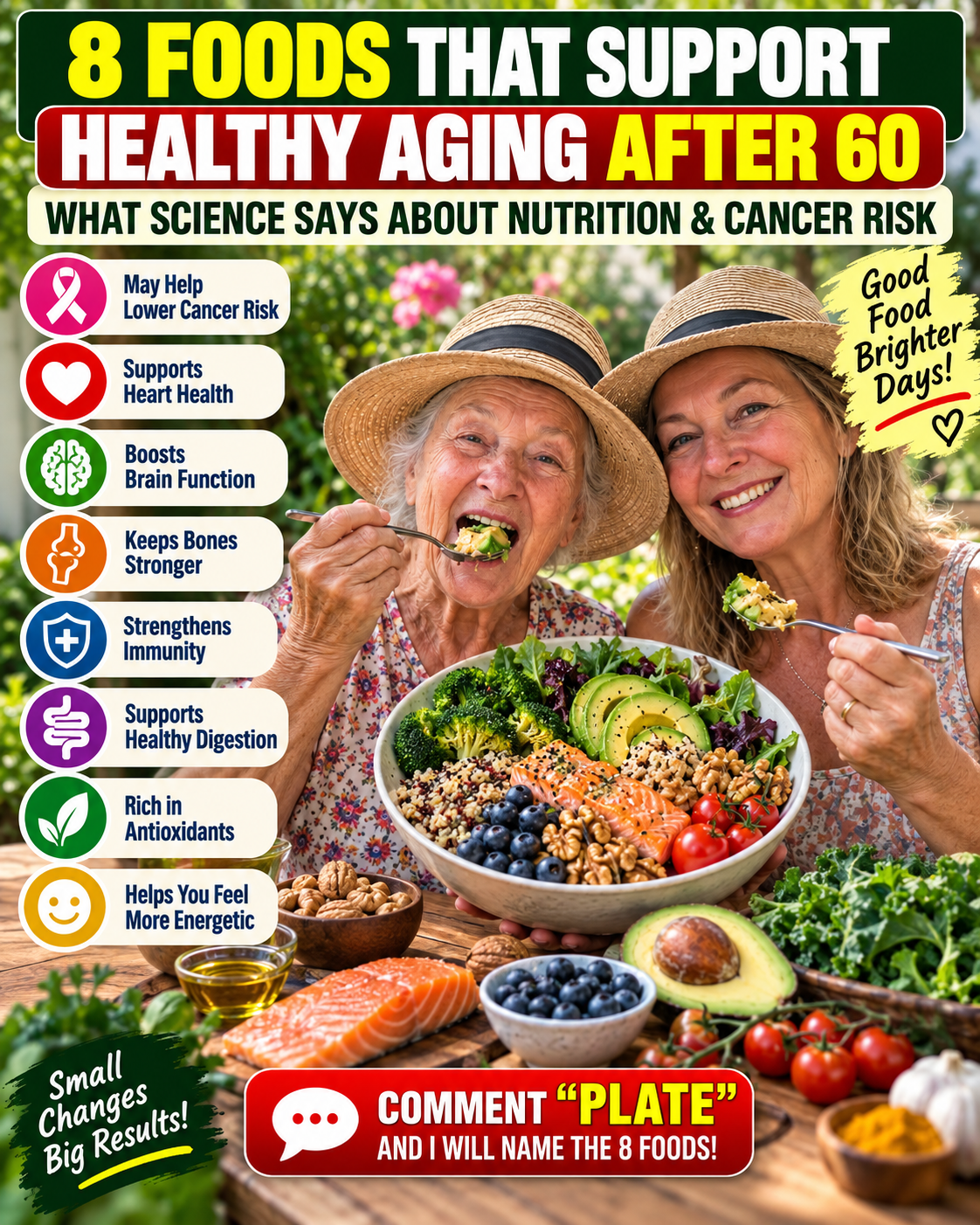
So instead of searching for one miracle “anti-cancer” ingredient, here are 8 useful food groups to build into a healthy-aging diet after 60.
⚠️ Important Safety Note
This article is for general educational purposes and is not a substitute for individualized medical or nutritional care.
No food on this list has been proven to cure cancer, eliminate tumors, replace cancer screening, or substitute for surgery, chemotherapy, radiation, immunotherapy, hormone therapy, or other prescribed treatment.
Cancer risk is influenced by many factors, including age, genetics, tobacco exposure, alcohol, body weight, physical activity, infections, environmental exposures and other factors.
If you have cancer, kidney disease, diabetes, heart disease, swallowing difficulties, unexplained weight loss, or take medications that affect your diet, your nutritional needs may be different.
Talk with your doctor or registered dietitian before making major dietary changes.
🥦 1. Cruciferous Vegetables
Broccoli, cauliflower, cabbage, Brussels sprouts and similar vegetables are excellent additions to an older adult’s diet.
They provide:
Fiber.
Vitamin C.
Folate.
Carotenoids.
And naturally occurring compounds called glucosinolates.
Cruciferous vegetables often appear in headlines about “cancer-fighting foods.”
That wording can be misleading.
Laboratory researchers have investigated compounds derived from these vegetables, but eating broccoli should not be viewed as cancer treatment.
What matters more is that cruciferous vegetables contribute to the broader vegetable-rich dietary pattern recommended by major cancer-prevention organizations.
WCRF recommends a wide variety of non-starchy vegetables and specifically identifies cruciferous vegetables as part of this category.
Easy ways to eat them
Try:
Steamed broccoli with olive oil and lemon.
Roasted cauliflower.
Cabbage added to soup.
Or Brussels sprouts roasted alongside fish or chicken.
You do not need enormous quantities.
Variety and consistency matter more.
🫘 2. Beans, Lentils & Chickpeas
Beans and other pulses are among the most useful foods for healthy aging.
They provide:
Plant protein.
Dietary fiber.
Folate.
Potassium.
Iron.
Magnesium.
And numerous plant compounds.
WCRF specifically recommends making beans, lentils and other pulses a major part of the everyday diet.
Their fiber content is particularly important.
Strong evidence indicates that foods containing dietary fiber reduce the risk of colorectal cancer.
That does not mean eating lentils makes colorectal cancer impossible.
It means a high-fiber dietary pattern is one evidence-supported component of risk reduction.
Easy meal
Try:
½–1 cup cooked lentils.
Tomatoes.
Cucumber.
Parsley.
A little red onion.
Olive oil.
Lemon.
Add eggs, fish or another protein if desired.
🫐 3. Berries & Other Whole Fruits
Blueberries, strawberries, raspberries and blackberries are rich in colorful plant compounds.
But there is no need to hunt for exotic “superberries.”
Apples, oranges, grapes, pears, peaches and other whole fruits can all contribute to a healthy dietary pattern.
ACS recommends fruits—especially whole fruits in a variety of colors—as part of a cancer-prevention eating pattern.
WCRF likewise recommends a diet rich in fruits and vegetables and notes that these foods provide fiber along with many vitamins and phytochemicals.
Whole fruit vs. juice
Whole fruit generally has an advantage over juice because it retains its fiber.
A bowl containing berries and plain yogurt is quite different nutritionally from drinking several pieces of fruit concentrated into a large sweet juice.
🌾 4. Whole Grains
Oats.
Barley.
Brown rice.
Whole-wheat bread.
Whole-grain pasta.
And other intact or minimally processed grains deserve more attention after 60.
Strong evidence reviewed by WCRF indicates that whole grains decrease colorectal cancer risk, while foods containing dietary fiber also reduce colorectal cancer risk.
Whole grains can additionally contribute:
B vitamins.
Magnesium.
Iron.
Fiber.
And other plant compounds.
Simple swaps
Instead of:
White bread → try whole-grain bread.
Sugary cereal → try oats.
White rice every day → occasionally use brown rice, barley or another whole grain.
You do not have to eliminate every refined grain.
The goal is to make whole grains a regular part of the diet.
🥬 5. Leafy Green Vegetables
Spinach, kale, collard greens, arugula and other leafy vegetables provide a dense package of nutrients for relatively few calories.
Depending on the vegetable, they can contribute:
Folate.
Vitamin K.
Carotenoids.
Vitamin C.
Magnesium.
And fiber.
Again, the strongest message isn’t that spinach kills cancer cells.
It is that eating a variety of non-starchy vegetables contributes to a dietary pattern associated with better health.
WCRF recommends at least 400 grams—about 15 ounces—of a variety of non-starchy vegetables and fruits per day as one practical dietary goal.
Important medication note
People taking warfarin or certain other vitamin-K-sensitive anticoagulation regimens should not suddenly make dramatic changes in their intake of vitamin-K-rich greens without professional advice.
The goal is generally consistency rather than avoiding nutritious vegetables entirely.
🥜 6. Nuts & Seeds
Walnuts, almonds, pistachios, peanuts and seeds can contribute:
Unsaturated fats.
Protein.
Fiber.
Magnesium.
Vitamin E.
And other nutrients.
ACS describes a healthy eating pattern as being largely based on plant foods including vegetables, fruits, whole grains, beans, nuts and seeds, with unsaturated fats favored over less healthy dietary patterns.
Nuts are calorie-dense, so the serving does not need to be enormous.
A small handful may be enough.
Easy ideas
Add walnuts to oatmeal.
Add ground flaxseed to plain yogurt.
Use almonds as a snack.
Sprinkle pumpkin seeds over a salad.
The goal isn’t to eat every nut and seed every day.
It is to create dietary variety.
🐟 7. Fish
Fish can provide high-quality protein, which becomes particularly important as people age and work to preserve muscle mass.
Fatty fish such as:
Salmon.
Sardines.
Trout.
Mackerel.
And herring
also provide omega-3 fatty acids.
Fish should not be called a cancer cure.
Its role is broader.
ACS recommends choosing healthy protein sources such as fish, poultry and beans more often while limiting red and processed meats.
That substitution may be particularly useful if fish replaces bacon, sausage, hot dogs or large amounts of red meat.
🍅 8. Tomatoes & Other Colorful Vegetables
Tomatoes contain the carotenoid lycopene.
Carrots and sweet potatoes contain carotenoids such as beta-carotene.
Bell peppers provide vitamin C and various plant compounds.
Purple vegetables contain different pigments and phytochemicals.
No single pigment provides complete cancer protection.
Eating a variety of colors is a much better strategy.
ACS specifically recommends a variety of vegetables, including dark-green, red and orange vegetables and fiber-rich legumes.
WCRF likewise emphasizes a variety of non-starchy vegetables rather than relying on one supposed superfood.
📊 What These Foods Can—and Cannot—Do
| Food pattern | What the evidence supports |
| Whole grains | Strong evidence for lower colorectal cancer risk |
| Fiber-rich foods | Strong evidence for lower colorectal cancer risk |
| Beans and lentils | Excellent source of fiber and plant protein |
| Vegetables | Important part of recommended cancer-prevention patterns |
| Whole fruits | Important part of recommended healthy dietary patterns |
| Nuts and seeds | Nutrient-rich plant foods |
| Fish | Useful protein source that can replace red/processed meat |
| One “superfood” that prevents all cancer | Does not exist |
| Food that destroys an existing tumor | Not established |
| Diet replacing cancer treatment | No |
The important pattern is not eight magical foods.
It is what these foods collectively replace and contribute to the overall diet.
🌈 Why Variety Matters More Than One Superfood
Cancer is not one disease.
There are many different cancers with different biological causes and risk factors.
Similarly, food contains thousands of nutrients and bioactive compounds.
WCRF notes that fruits and non-starchy vegetables contain many potentially beneficial compounds and that their combined effects likely matter more than one isolated nutrient.
That is one reason advice like:
“Eat this one fruit every morning and never get cancer”
should immediately raise skepticism.
Human biology is not that simple.
🌭 What You Eat Less Often Matters Too
Healthy aging isn’t only about adding foods.
It is also about what those foods replace.
ACS recommends limiting or avoiding:
Processed meat
Red meat
Sugar-sweetened beverages
Highly processed foods
Refined grain products.
Processed meat is particularly relevant.
Examples include:
Bacon.
Sausages.
Hot dogs.
Ham.
And many deli meats.
ACS notes that the International Agency for Research on Cancer classifies processed meat as carcinogenic to humans based on evidence related particularly to colorectal cancer.
This does not mean eating one slice of bacon causes cancer.
Cancer risk is about probability and long-term exposure—not an immediate consequence of a single meal.
🥩 Does That Mean You Must Never Eat Red Meat?
Not necessarily.
WCRF recommends eating moderate amounts of red meat and little, if any, processed meat.
You can gradually shift the balance.
For example:
Replace some ground beef with lentils.
Choose fish more often.
Use beans in soups.
Make vegetables a larger part of the plate.
Small habits repeated over years are more important than a one-week “anti-cancer diet.”
🍺 Alcohol Deserves Attention Too
Alcohol is sometimes forgotten in discussions about food and cancer.
For cancer prevention, WCRF recommends limiting alcohol, while ACS states that it is best not to drink alcohol.
Changing the smoothie while ignoring substantial alcohol intake misses an important part of the evidence.
💊 What About Anti-Cancer Supplements?
This is another area where caution is important.
If vegetables contain beneficial nutrients, it can seem logical that swallowing large doses of those nutrients should provide even more protection.
That assumption does not reliably hold.
WCRF specifically recommends not using supplements for cancer prevention and instead meeting nutritional needs through food when possible.
Supplements can still be medically appropriate when someone has:
A diagnosed deficiency.
Malabsorption.
A medication-related need.
Restricted food intake.
Or another specific medical indication.
But that is different from taking megadoses because a social-media post says they “kill cancer cells.”
🧓 After 60, Don’t Forget Muscle
Cancer prevention isn’t the only goal of healthy aging.
Preserving:
Muscle.
Strength.
Mobility.
Bone health.
And independence
matters enormously.
That means an older adult’s diet should not become so restrictive that protein and calorie intake become inadequate.
Beans, lentils, fish, eggs, poultry, dairy foods, tofu and other appropriate protein sources can all contribute.
Someone who is unintentionally losing weight or muscle should not automatically begin an aggressive low-calorie “cancer prevention” diet.
🥗 A Simple Healthy-Aging Plate
You don’t need an elaborate menu.
One practical dinner could look like:
½ plate: broccoli, spinach, carrots, tomatoes or other vegetables.
¼ plate: lentils, beans, fish, chicken, tofu or another protein.
¼ plate: brown rice, barley, whole-grain pasta or another whole grain.
Add:
A small amount of olive oil.
Whole fruit for dessert.
Water or another unsweetened beverage.
Rotate the foods throughout the week.
The diversity is a feature—not a problem.
🌾 Fiber Is One of the Strongest Parts of the Evidence
Among nutrition-related cancer findings, fiber deserves special attention.
WCRF reports strong evidence that foods containing dietary fiber decrease colorectal cancer risk.
Fiber is found in:
Beans.
Lentils.
Whole grains.
Vegetables.
Whole fruits.
Nuts.
Seeds.
This is another reason the overall dietary pattern matters.
You do not need a fiber “detox.”
You need fiber-rich foods consistently.
💧 Increase Fiber Gradually
If someone currently eats very little fiber, suddenly doubling or tripling intake may cause:
Gas.
Bloating.
Abdominal discomfort.
Or changes in bowel habits.
Increase fiber gradually and maintain appropriate hydration unless you have been medically instructed to restrict fluids.
People with certain gastrointestinal diseases may need individualized fiber recommendations.
⚖️ Healthy Weight Matters Too
Diet influences cancer risk partly through body weight.
WCRF notes that high-fiber plant foods can help protect against weight gain and overweight, which are themselves associated with several cancers.
But after 60, weight advice needs nuance.
The goal should not be aggressive dieting for everyone.
Someone who is frail, losing weight unintentionally, recovering from illness, or losing muscle needs individualized nutrition advice.
🚶 Food Works Better as Part of a Lifestyle
Nutrition is only one component of cancer prevention.
Physical activity also matters.
ACS recommends adults aim for 150–300 minutes of moderate-intensity activity or 75–150 minutes of vigorous activity per week, or a combination, while limiting sedentary time.
After 60, resistance exercise can also be valuable for maintaining muscle and physical function.
The exact program should reflect health, mobility and medical conditions.
🚭 And Food Cannot Cancel Smoking
Someone cannot compensate for smoking by eating blueberries and broccoli.
Tobacco avoidance remains one of the most important cancer-prevention measures.
Likewise, nutrition does not replace:
Appropriate cancer screening.
Sun protection.
Vaccinations when indicated.
Medical evaluation of concerning symptoms.
Or treatment of existing disease.
📅 A Simple 7-Day Healthy-Aging Challenge
Instead of buying an expensive supplement, spend one week improving your basic pattern.
Every day: eat at least one whole fruit.
Most meals: include vegetables.
Several meals: add beans, lentils or chickpeas.
Breakfast: try oatmeal or another whole grain.
Twice during the week: consider fish if it fits your diet.
Snacks: replace some highly processed snacks with fruit, plain yogurt or a small portion of nuts.
Drinks: choose water or unsweetened beverages more often.
Processed meat: reduce bacon, sausages, hot dogs and deli meats.
Movement: include appropriate daily physical activity.
This closely reflects the overall pattern recommended by major cancer-prevention organizations: more whole grains, vegetables, fruits and beans, with less processed meat and heavily processed food.
🚫 10 Common Nutrition Mistakes After 60
1. Searching for one cancer-fighting superfood.
Cancer risk cannot be reduced to one ingredient.
2. Drinking vegetables instead of eating them all the time.
Whole plant foods provide valuable fiber.
3. Taking megadose supplements for cancer prevention.
WCRF recommends meeting nutritional needs through diet rather than supplements for cancer prevention.
4. Eating processed meat daily.
Evidence links processed meat with increased colorectal cancer risk.
5. Avoiding fruit because it contains natural sugar.
Whole fruits are part of the dietary pattern recommended by ACS.
6. Ignoring protein while trying to eat “clean.”
7. Cutting calories aggressively despite losing muscle.
8. Believing organic food makes cancer impossible.
9. Assuming a healthy diet eliminates the need for screening.
10. Thinking healthy food can treat an existing cancer without medical care.
🚨 Symptoms Food Should Never Be Used to “Treat”
Nutrition supports health.
It should not delay evaluation of unexplained symptoms such as:
A new lump or swelling.
Blood in the stool or urine.
Unexplained bleeding.
Unintentional weight loss.
Persistent difficulty swallowing.
A persistent change in bowel habits.
A new or changing skin lesion.
Persistent unexplained pain.
Unusual fatigue that does not improve.
A persistent cough or other unexplained symptom.
These symptoms do not automatically mean cancer.
But persistent or concerning changes deserve medical evaluation.
❓ Frequently Asked Questions
What are the best foods for healthy aging after 60?
There is no single best food. A strong pattern includes vegetables, whole fruits, beans and lentils, whole grains, nuts and seeds, and appropriate healthy protein sources such as fish. ACS and WCRF emphasize this overall plant-rich pattern.
Which food has the strongest evidence for preventing cancer?
Cancer prevention cannot be reduced to one food. However, there is strong evidence that whole grains and dietary fiber reduce colorectal cancer risk.
Does broccoli kill cancer cells?
Laboratory research investigates compounds found in cruciferous vegetables, but eating broccoli is not an established cancer treatment.
Are berries anti-cancer foods?
Berries are nutritious whole fruits and can be part of a healthy dietary pattern. They should not be described as cancer medicine.
Are beans good after 60?
Yes, for many people. Beans provide protein, fiber and micronutrients. WCRF specifically recommends beans, lentils and other pulses as part of a cancer-prevention dietary pattern.
Should I stop eating meat?
Not necessarily. Major cancer-prevention guidance emphasizes limiting red meat and eating little, if any, processed meat while choosing foods such as fish, poultry and beans more often.
Are cancer-prevention supplements worth taking?
WCRF recommends not using dietary supplements specifically for cancer prevention and instead meeting nutritional needs through diet where possible.
Does sugar feed cancer?
All cells use glucose, and eliminating dietary sugar does not selectively starve cancer cells. A more evidence-based concern is that diets high in sugary, energy-dense foods can contribute to excess calorie intake and weight gain. WCRF recommends limiting sugar-sweetened drinks and highly processed foods as part of its overall cancer-prevention strategy.
Can healthy eating guarantee that I won’t get cancer?
No. Diet can influence risk, but cancer also involves aging, genetics, environmental exposures and numerous other factors. Risk reduction is not a guarantee.
Can these foods treat cancer if someone already has it?
No. Food does not replace cancer treatment. Anyone undergoing cancer treatment should discuss dietary changes and supplements with their oncology team.
⭐ The Bottom Line
There is no magical list of eight foods that can guarantee cancer prevention after 60.
But there is strong evidence supporting an overall pattern.
Make foods such as:
Vegetables
Beans and lentils
Whole fruits
Whole grains
Leafy greens
Nuts and seeds
Fish
and a variety of colorful vegetables
regular parts of your diet.
WCRF reports strong evidence that whole grains and fiber-containing foods reduce colorectal cancer risk, and its broader recommendation is to make whole grains, vegetables, fruits and beans a major part of the usual diet.
ACS similarly recommends a plant-forward eating pattern while limiting red and processed meats, sugary beverages, highly processed foods and refined grains.
The goal after 60 is not to find a food powerful enough to “kill cancer.”
It is to build a dietary pattern that supports healthy weight, muscle, cardiovascular health, digestive health and long-term disease-risk reduction while remaining enjoyable enough to follow for years.
No single food prevents or cures cancer • Food does not replace screening or medical treatment • Avoid megadose supplements marketed as cancer cures • Individual nutrition needs may change with medications and medical conditions.