
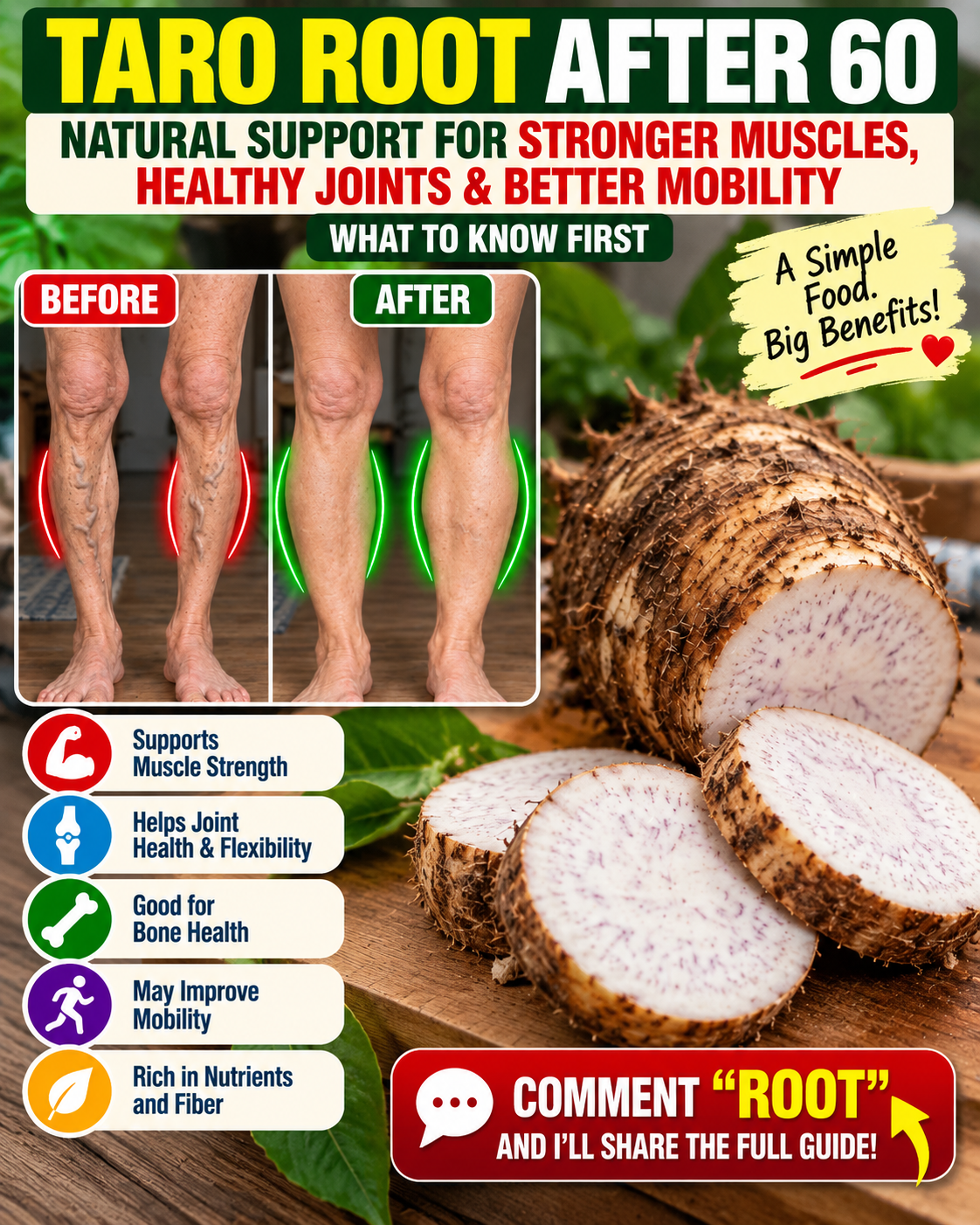
Taro Root After 60: Nutrition Benefits for Muscle, Bone & Joint Health — Risks and What to Know First
Taro root has been eaten for centuries in many parts of Africa, Asia, the Pacific Islands, and the Caribbean.
With its starchy texture and slightly nutty flavor, cooked taro can be boiled, mashed, baked, or added to soups and stews.
Recently, however, social-media posts have begun giving taro a much bigger reputation.
You may see claims that eating taro after 60 can:
Rebuild weak muscles.
Strengthen fragile bones.
Repair worn knee cartilage.
Eliminate joint pain.
Reverse osteoporosis.
Or even make aging legs “young again.”
Those claims go beyond the evidence.
Taro can certainly be part of a nutritious diet. But it is primarily a starchy root vegetable, not a treatment for arthritis, osteoporosis, sarcopenia, or chronic joint pain.
For healthy aging, the bigger picture matters: adequate protein, calcium, vitamin D, physical activity, resistance exercise, and an overall nutrient-rich diet all play important roles in preserving muscle and bone health. NIH guidance emphasizes adequate calcium, vitamin D, protein, and a balanced diet for older adults.
⚠️ Important Safety Note
This article is for general educational purposes only and is not a substitute for medical diagnosis or treatment.
Taro root has not been proven to rebuild cartilage, reverse osteoporosis, cure arthritis, restore lost muscle, or eliminate chronic bone and joint pain.
Raw or inadequately cooked taro should not be eaten. Taro contains calcium oxalate crystals and other irritating compounds, so proper preparation and thorough cooking are important. Research on taro tissues shows that cooking—particularly boiling—can reduce soluble oxalates.
People with recurrent calcium-oxalate kidney stones, kidney disease, diabetes, swallowing difficulties, or medically prescribed dietary restrictions should discuss major dietary changes with an appropriate healthcare professional.
Seek prompt medical attention for sudden severe joint pain with redness or swelling, inability to bear weight, a new fracture after a minor fall, one-sided leg swelling or warmth, or significant new weakness or numbness.
🌱 What Exactly Is Taro?
Taro, scientifically known as Colocasia esculenta, is a tropical root crop.
The underground portion is often called:
Taro root.
Taro corm.
Dasheen.
Eddo, depending on the variety and region.
Once properly cooked, taro develops a soft, dense texture somewhat reminiscent of potato.
It is commonly eaten:
Boiled.
Steamed.
Mashed.
Baked.
Or incorporated into soups and stews.
From a nutritional perspective, taro primarily supplies carbohydrate, along with fiber and several micronutrients.
That makes it potentially useful as an alternative to other starchy foods.
But it is important to understand what it does—and what it does not—provide.
💪 Does Taro Build Muscle After 60?
Not by itself.
Muscle loss becomes an increasingly important issue as people age.
Maintaining muscle requires several things working together:
Adequate protein.
Enough total calories.
Regular resistance exercise.
Physical activity.
And adequate intake of essential vitamins and minerals.
The National Institute on Aging describes protein as one of the body’s building blocks and encourages older adults to consume a variety of nutrient-dense protein foods, including seafood, eggs, beans, nuts, seeds, soy, poultry and lean meats.
Taro is not a particularly concentrated protein food.
That means a large bowl of taro by itself is not an ideal muscle-preserving meal.
🍽️ The Better Strategy: Pair Taro With Protein
This is where taro can fit nicely into a healthy-aging diet.
Instead of:
Taro alone
try:
Taro + fish
Taro + eggs
Taro + beans or lentils
Taro + chicken
Taro + tofu
Taro + plain Greek yogurt in an appropriate meal
Think of taro as the carbohydrate portion of the meal rather than the main muscle-building ingredient.
That small distinction makes the meal much more balanced.
🦴 Does Taro Strengthen Bones?
Taro contributes various nutrients to the diet, but it should not be treated as a substitute for the nutrients most strongly associated with maintaining bone health.
Two particularly important nutrients are:
Calcium
and
Vitamin D.
NIH explains that calcium is needed to maintain healthy bones and that vitamin D helps the body absorb calcium. Inadequate calcium over time can contribute to weaker bones and osteoporosis.
For adults:
Women older than 50 generally need about 1,200 mg of calcium per day.
Men ages 51–70 generally need about 1,000 mg per day.
Men older than 70 generally need about 1,200 mg per day.
Vitamin D recommendations are generally:
600 IU (15 mcg) daily through age 70
and
800 IU (20 mcg) daily after age 70.
Taro should not be expected to supply this entire bone-health strategy.
🥛 Better Calcium Partners for Taro
A taro meal can become more bone-friendly when combined with calcium-rich foods.
Depending on your dietary preferences, examples include:
Milk.
Plain yogurt.
Calcium-fortified soy milk.
Calcium-set tofu.
Sardines with edible bones.
Canned salmon with bones.
And appropriate leafy green vegetables.
NIH lists dairy products, calcium-fortified foods, certain greens, tofu, sardines, and canned salmon among useful calcium sources.
So rather than asking:
“Can taro rebuild my bones?”
a more useful question is:
“How can taro fit into a meal that gives me protein, calcium, vitamin D and other nutrients?”
🦵 What About Joint Health?
This is where internet claims become particularly misleading.
Joint pain after 60 can have many causes.
Common possibilities include:
Osteoarthritis.
Previous injuries.
Inflammatory arthritis.
Tendon problems.
Bursitis.
Gout.
Muscle weakness.
Nerve problems.
And referred pain from the back or hip.
Taro does not diagnose or treat these conditions.
Eating taro may contribute nutrients and energy to an overall healthy diet, but there is no good clinical evidence that taro root rebuilds worn knee cartilage.
🧬 Can Taro Regrow Cartilage?
There is no established food that simply regrows severely damaged knee cartilage after you eat it.
Cartilage biology is complicated.
Osteoarthritis involves changes not only in cartilage but also in:
Bone.
Synovial tissue.
Ligaments.
Muscles.
And the overall mechanics of the joint.
That is why claims such as:
“Eat this root for seven days and rebuild your knees”
should be treated cautiously.
Improving nutrition can support overall musculoskeletal health.
That is not the same as regenerating damaged cartilage.
📊 Taro Claims vs. Reality
| Claim | What the evidence supports |
| Taro can be part of a nutritious diet | Yes |
| Taro provides carbohydrate and fiber | Yes |
| Taro can replace other starches in meals | Yes |
| Taro alone builds muscle | No |
| Taro rebuilds knee cartilage | Not established |
| Taro cures arthritis | No |
| Taro reverses osteoporosis | No |
| Taro replaces calcium/vitamin D needs | No |
| Taro replaces resistance exercise | No |
| Raw taro should be eaten for more nutrients | No — cook it thoroughly |
⚡ Taro Can Provide Useful Dietary Energy
One genuine advantage of taro is its carbohydrate content.
Carbohydrates provide energy.
For an older adult who is physically active, walking regularly, gardening, exercising, or doing resistance training, carbohydrate-rich foods can help supply fuel.
The problem arises when “provides energy” becomes:
“Taro cures weakness.”
Persistent weakness should not automatically be blamed on aging.
It can be related to:
Anemia.
Vitamin B12 deficiency.
Vitamin D deficiency.
Thyroid disease.
Diabetes.
Medication effects.
Heart or lung disease.
Poor nutrition.
Loss of muscle mass.
Or neurological problems.
If weakness is new, severe, progressive, or unexplained, evaluation matters more than adding one particular root vegetable.
🌾 What About Fiber?
Taro can contribute fiber to the diet.
Fiber can support:
Normal bowel function.
Digestive health.
Satiety.
And overall diet quality.
This can be particularly useful if taro replaces a more heavily processed refined carbohydrate.
But fiber does not directly rebuild bone or cartilage.
Again, one nutrient can have benefits without making the food a cure-all.
🍠 Is Taro Better Than Potatoes?
There is no need to declare one universally superior.
Both can fit into healthy diets.
The better choice depends on:
Portion.
Preparation.
The rest of the meal.
Medical conditions.
Personal preference.
And overall dietary pattern.
Boiled taro paired with vegetables and fish is very different from deep-fried taro chips.
Likewise, a baked potato with vegetables and protein is very different from heavily salted French fries.
Preparation matters.
🔥 Why Taro Must Be Cooked Properly
This is one of the most important sections of the article.
Do not treat raw taro like a raw carrot.
Taro tissues can contain needle-like calcium oxalate crystals called raphides.
These crystals can irritate tissues and produce unpleasant sensations in the mouth and throat.
Research on taro has confirmed the presence of calcium oxalate crystals, while cooking can alter or reduce problematic oxalate components.
This is why taro traditionally undergoes thorough cooking before consumption.
🍲 A Safer Way to Prepare Taro
Preparation methods differ by variety and cuisine, but a practical approach is:
Peel the taro carefully.
Wash your hands and utensils afterward.
Cut it into manageable pieces.
Boil it thoroughly until completely tender.
Discard the cooking water.
Then use the cooked taro in your meal.
Do not taste raw taro to determine whether it is ready.
It should be thoroughly cooked.
Research on taro leaves found that boiling reduced soluble oxalate content by about 36%, while soaking alone produced smaller reductions depending on duration.
The exact result varies by taro tissue, variety and preparation method, so the key practical message is simple:
Cook taro thoroughly.
⚠️ Why Your Mouth Shouldn’t Tingle
If taro causes:
Intense tingling.
Burning.
Stinging.
Numbness.
Or significant mouth or throat irritation,
stop eating it.
Do not assume that sensation means the food is “activating circulation.”
It can indicate irritation from inadequately prepared taro.
If you develop significant throat swelling, trouble breathing, or difficulty swallowing, seek urgent medical attention.
🪨 Taro, Oxalate & Kidney Stones
Oxalate occurs naturally in many plant foods.
Research confirms that oxalate-rich foods can contribute dietary oxalate and that soaking and cooking can reduce soluble oxalate through leaching.
For most healthy people, occasionally eating properly cooked taro as part of a varied diet is very different from consuming huge quantities every day.
But someone who repeatedly develops calcium-oxalate kidney stones may have individualized dietary recommendations.
If that applies to you, ask your healthcare professional or renal dietitian whether taro fits your plan.
🩺 What If You Have Kidney Disease?
Kidney disease changes nutritional requirements in ways that vary greatly from one person to another.
Some people need to monitor:
Potassium.
Phosphorus.
Sodium.
Protein.
Or fluid.
Others do not need the same restrictions.
Therefore, statements such as:
“Taro is always good for kidneys”
or
“Everyone with kidney disease must avoid taro”
are both too simplistic.
If you have chronic kidney disease, use your individual laboratory results and dietary plan to guide food choices.
🩸 What About Blood Sugar?
Taro is a starchy carbohydrate.
That means portion size matters for people with diabetes or prediabetes.
It should not be treated as a “free food” simply because it is a root vegetable.
A more balanced meal might combine a moderate portion of taro with:
Protein.
Non-starchy vegetables.
And healthy fats.
That usually makes more nutritional sense than eating a very large plate of taro alone.
🧈 Preparation Can Change the Meal Completely
Consider these two meals.
Meal A
Boiled taro.
Grilled fish.
Steamed vegetables.
Olive oil.
Water.
Meal B
Deep-fried taro.
Processed meat.
Heavy salty sauce.
Sugary soda.
Both contain taro.
But nutritionally they are very different meals.
A single ingredient does not determine whether an entire meal is healthy.
💪 The Missing Ingredient for Stronger Muscles: Resistance Exercise
If your goal after 60 is maintaining strength, food alone is not enough.
Muscles respond strongly to being used.
Appropriate resistance exercises may include:
Chair squats.
Wall push-ups.
Resistance-band rows.
Calf raises.
Light weights.
Step-ups.
Or supervised strength training.
Nutrition supplies building materials.
Exercise provides the stimulus.
Combining the two is far more useful than searching for a muscle-building root vegetable.
🥚 Protein Still Matters
Older adults should regularly include nutrient-dense protein sources.
The National Institute on Aging recommends variety, including:
Seafood.
Eggs.
Beans.
Nuts.
Seeds.
Soy foods.
Lean poultry.
And lean meat.
Research on aging also suggests adequate dietary protein plays an important role in maintaining muscle mass and may support skeletal health.
So if you enjoy taro, pair it with protein.
🦴 Calcium + Vitamin D + Protein: A Better Bone Strategy
Instead of focusing on taro alone, remember this combination:
Protein → supports muscle and tissue
Calcium → major structural mineral in bone
Vitamin D → helps the body absorb calcium
NIH emphasizes both calcium and vitamin D for bone health, while adequate protein is also part of a nutrient-rich diet that supports musculoskeletal health.
That is a far stronger healthy-aging strategy than relying on one root vegetable.
🍽️ A Balanced Taro Meal After 60
Here’s one practical example:
½–1 cup thoroughly cooked taro
3–4 ounces grilled salmon or another appropriate protein
1–2 cups mixed vegetables
1 teaspoon olive oil
Plain yogurt or another calcium-rich food
Water
This meal provides something taro alone cannot:
Carbohydrate.
Protein.
Vegetables.
Healthy fats.
And a calcium-rich component.
Adjust portions for appetite, medical conditions and energy needs.
🌅 A Healthy-Aging Breakfast Alternative
Taro can also be used differently.
Try a modest portion of mashed cooked taro alongside:
Eggs.
Spinach or another vegetable.
And plain yogurt.
Again, the benefit comes from the whole meal, not from taro behaving like medicine.
📅 A Simple 14-Day Muscle & Bone Routine
Instead of testing whether taro “rebuilds your knees,” try a routine with realistic goals.
For two weeks:
Eat protein at each main meal.
Include calcium-rich foods regularly.
Make sure your vitamin D intake is appropriate.
Use taro as one of several possible carbohydrate sources.
Eat plenty of vegetables.
Walk regularly if medically appropriate.
Perform resistance exercises two or more days per week if your health and mobility allow.
Sleep consistently.
Stay adequately hydrated unless you have been prescribed a fluid restriction.
Pay attention to:
Strength.
Walking ability.
Energy.
Balance.
Joint stiffness.
And overall function.
These are more meaningful measures than expecting a food to regenerate cartilage.
🚫 10 Common Mistakes With Taro After 60
1. Eating taro raw.
Taro contains irritating calcium oxalate crystals and should be properly cooked.
2. Believing taro rebuilds cartilage.
There is no good evidence supporting this claim.
3. Eating taro instead of protein.
Taro is primarily a starchy food, not a concentrated muscle-building protein.
4. Assuming taro replaces calcium-rich foods.
5. Expecting it to reverse osteoporosis.
6. Ignoring portion size with diabetes.
7. Deep-frying taro and assuming it has the same nutritional profile as boiled taro.
8. Ignoring kidney-stone history.
Taro contains oxalate, which may matter for certain stone formers.
9. Taking supplements instead of correcting the overall diet.
Older adults may need certain supplements when intake is inadequate, but needs should be individualized.
10. Treating persistent bone or joint pain with food instead of finding the cause.
🚨 When Bone, Muscle or Joint Symptoms Need Medical Attention
Do not assume every ache after 60 is simply “old age.”
Seek prompt medical evaluation for:
Sudden severe joint pain with significant redness, heat or swelling.
One leg suddenly becoming swollen, red, warm or painful.
Inability to stand or bear weight after an injury.
A possible fracture after a minor fall.
New significant muscle weakness.
Progressive numbness or loss of sensation.
A cold, pale or unusually discolored foot.
Persistent bone pain without an obvious explanation.
Unexplained weight loss accompanied by pain or weakness.
These symptoms require more than dietary experimentation.
❓ Frequently Asked Questions
Is taro good for people over 60?
Properly cooked taro can be part of a balanced diet for many older adults. It provides carbohydrate, fiber and micronutrients, but it should be combined with adequate protein and other nutrient-rich foods.
Does taro build muscle?
Not by itself. Taro is primarily a carbohydrate food. Maintaining muscle after 60 requires adequate protein, calories and resistance exercise. NIA recommends a variety of nutrient-dense protein sources for older adults.
Can taro strengthen bones?
Taro can contribute to overall nutrition, but calcium, vitamin D, protein and physical activity are more central to bone health.
Does taro rebuild knee cartilage?
There is no good clinical evidence showing that eating taro regenerates damaged knee cartilage.
Can taro cure arthritis?
No. Arthritis has multiple causes, and taro is not an established arthritis treatment.
Can I eat raw taro?
No. Taro contains calcium oxalate crystals that can irritate the mouth and throat. Proper cooking is important.
Why does taro sometimes make the mouth itch or tingle?
Inadequately prepared taro can contain irritating calcium oxalate crystals. Significant tingling or burning is a reason to stop eating it rather than interpreting the sensation as a health benefit.
Is taro safe with kidney stones?
Taro contains oxalate. People with recurrent calcium-oxalate stones may need individualized dietary advice. Cooking and soaking can reduce soluble oxalates in certain foods, including taro tissues.
Is taro good for osteoporosis?
Taro is not an osteoporosis treatment. Adequate calcium, vitamin D, protein, physical activity and medical treatment when indicated are much more important.
What’s the healthiest way to eat taro?
For many people, thoroughly boiled or steamed taro served in a moderate portion alongside protein and vegetables is a practical option.
⭐ The Bottom Line
Taro root can absolutely have a place in a healthy diet after 60.
When properly cooked, it can provide:
Carbohydrate for energy.
Fiber.
Several micronutrients.
And a satisfying alternative to other starchy foods.
But it should not be promoted as a miracle treatment.
There is no good evidence that eating taro can:
rebuild lost muscle by itself,
regrow damaged knee cartilage,
cure arthritis,
reverse osteoporosis,
or eliminate chronic joint pain.
For maintaining strength and mobility after 60, the stronger strategy is much broader:
Adequate protein + calcium + vitamin D + nutrient-rich foods + resistance exercise + regular movement. NIH guidance emphasizes these nutritional foundations for maintaining muscle and bone health as people age.
And remember the most important taro-specific safety rule:
Cook it thoroughly.
Raw or inadequately cooked taro can contain irritating calcium oxalate crystals, and cooking helps make taro safer and more pleasant to eat.
Enjoy taro as food, not as medicine.
Not a cure • Cook thoroughly • Taro contains oxalate • Pair it with protein for a more balanced meal • Talk to your doctor or dietitian if you have kidney disease, recurrent kidney stones, diabetes, or medically prescribed dietary restrictions.