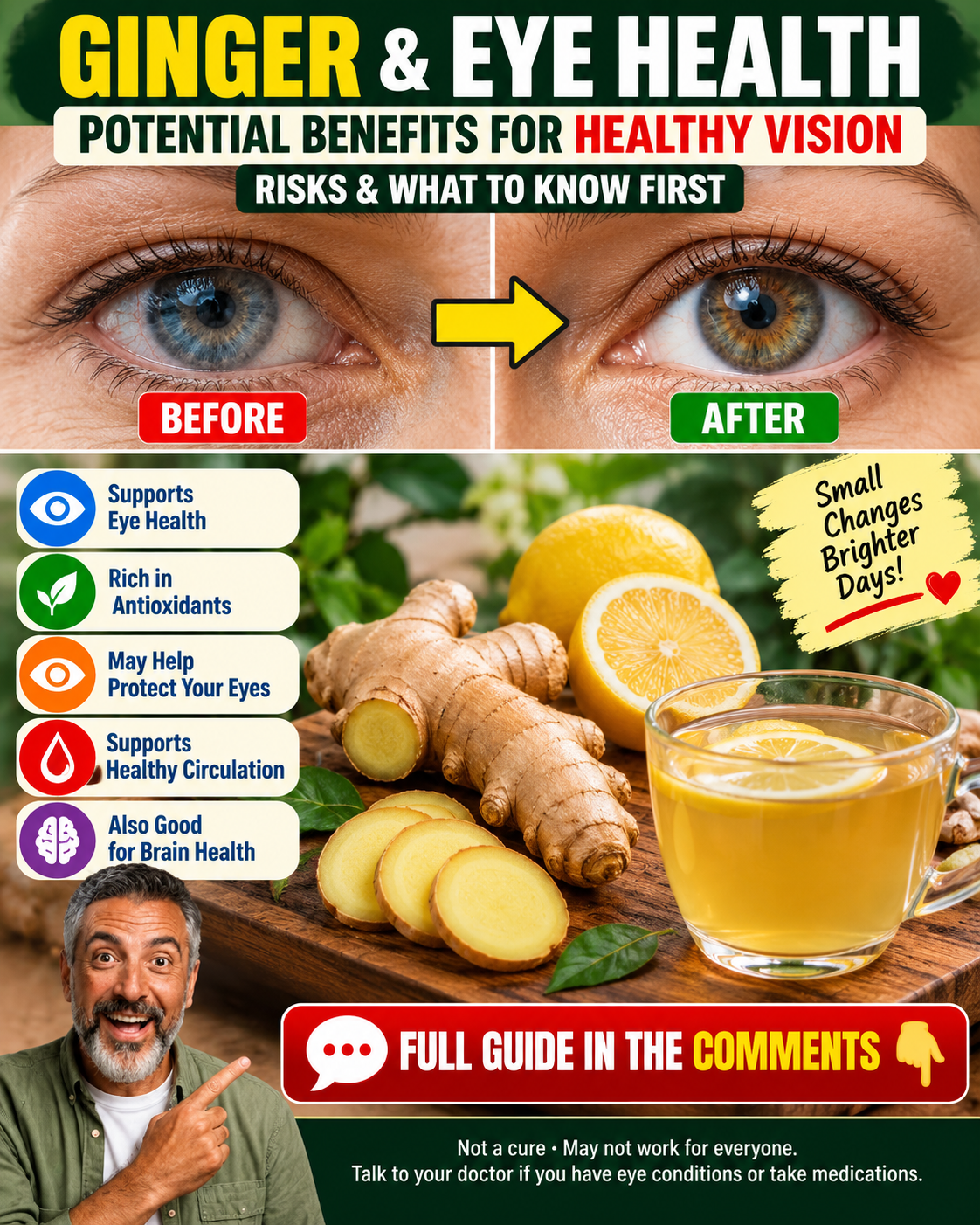
Ginger is one of the world’s most familiar kitchen spices—and one of the most frequently promoted natural remedies.
Its underground stem, or rhizome, contains compounds such as gingerols and shogaols that have attracted scientific interest for their potential effects on inflammation, metabolism, digestion, and other areas of health.
That has led to a new generation of eye-health claims.
You may have seen posts suggesting that ginger can:
Restore blurry vision.
Remove cataracts.
Lower eye pressure.
Reverse glaucoma.
Repair the retina.
Or even “bring eyesight back naturally.”
Those claims go far beyond what has been demonstrated in people.
Ginger can be part of a nutritious diet, and laboratory research on its compounds is scientifically interesting. But there is currently no established clinical evidence showing that eating ginger or drinking ginger tea can restore lost vision or treat major eye diseases.
For protecting eyesight—especially after 60—regular comprehensive eye examinations, control of diabetes and blood pressure, sun protection, avoiding smoking, and an overall nutrient-rich diet are much more important. The National Eye Institute (NEI) describes a dilated eye exam as the best way to detect many eye diseases early, often before they cause noticeable vision loss. (National Eye Institute)
⚠️ Important Safety Note
This article is for general educational purposes only and is not a substitute for diagnosis or treatment from an ophthalmologist, optometrist, or other healthcare professional.
Ginger has not been proven to cure cataracts, glaucoma, age-related macular degeneration (AMD), diabetic retinopathy, retinal disease, or unexplained blurry vision.
Most importantly:
Never put ginger juice, ginger water, ginger powder, ginger essential oil, or homemade ginger mixtures directly into your eyes.
Food that is safe to swallow is not automatically safe for the surface of the eye.
Seek urgent medical attention for sudden vision loss, a new curtain or shadow across your vision, sudden flashes or many new floaters, severe eye pain, a painful red eye, or sudden neurological symptoms such as facial drooping, weakness, or difficulty speaking.
🫚 What Makes Ginger Interesting?
Ginger’s scientific name is Zingiber officinale.
Its major bioactive compounds include:
Gingerols.
Shogaols.
Paradols.
And other naturally occurring phytochemicals.
A systematic review examining 109 randomized controlled trials found human research on ginger across areas such as nausea, inflammation, metabolic health, and digestive function, although the quality and consistency of evidence varied substantially depending on the condition. (PubMed)
Notice what is missing from that list:
Ginger is not an established treatment for common vision-threatening eye diseases.
That distinction is important.
👁️ Can Ginger Improve Eyesight?
There is no good evidence that eating ginger makes someone with impaired eyesight suddenly see clearly again.
Vision depends on multiple structures working together:
The cornea.
Lens.
Retina.
Optic nerve.
Eye muscles.
Blood vessels.
And the brain.
Blurry or reduced vision can result from problems affecting any of these structures.
Common causes include:
Refractive errors.
Dry eye.
Cataracts.
Glaucoma.
Diabetic retinopathy.
Age-related macular degeneration.
Retinal disorders.
And other eye conditions.
NEI identifies AMD, cataracts, diabetic retinopathy, and glaucoma among major causes of low vision, particularly in older adults. (National Eye Institute)
One kitchen ingredient cannot correct all of these very different problems.
🔬 What About Ginger’s Antioxidants?
This is where many online claims begin.
Ginger contains biologically active compounds with antioxidant and anti-inflammatory properties that are frequently studied in laboratory settings.
That is scientifically interesting.
But there is a major difference between:
A compound affecting cells in a laboratory
and
a person eating ginger and reversing an eye disease.
The human body has to digest, absorb, metabolize, distribute, and eliminate compounds.
The amount that eventually reaches a particular eye tissue may be very different from the concentration used in a laboratory experiment.
So laboratory antioxidant activity should not be translated into:
“Ginger repairs the retina.”
That conclusion has not been established.
📊 Ginger Eye-Health Claims vs. Current Evidence
| Claim | Current evidence |
| Ginger contains bioactive plant compounds | Yes |
| Ginger can be part of a healthy diet | Yes |
| Ginger has been studied extensively for some health conditions | Yes |
| Eating ginger restores lost eyesight | Not established |
| Ginger removes cataracts | No established evidence |
| Ginger reverses glaucoma | No |
| Ginger repairs retinal damage | Not established clinically |
| Ginger cures diabetic retinopathy | No |
| Ginger juice is safe as homemade eye drops | No |
| Ginger replaces a dilated eye exam | No |
| Overall diet can support eye health | Yes |
👓 Ginger Won’t Fix a Prescription Problem
Sometimes blurry vision has a simple explanation.
A person may be:
Nearsighted.
Farsighted.
Astigmatic.
Or developing age-related difficulty focusing up close.
No amount of ginger corrects the optical shape of the eye.
Glasses, contact lenses, or other appropriate treatments are designed to address refractive errors.
If vision has gradually become blurry, an eye examination can help determine whether the problem is simply an outdated prescription—or something requiring further treatment.
☁️ Can Ginger Remove Cataracts?
No clinical evidence establishes ginger as a cataract treatment.
A cataract occurs when the normally clear lens of the eye becomes cloudy.
As cataracts progress, vision can become:
Cloudy.
Hazy.
Less colorful.
More sensitive to glare.
And increasingly difficult at night.
NEI explains that cataracts worsen over time and recommends protective habits including sunglasses, avoiding smoking, eye protection against injury, and an eye-healthy diet. (National Eye Institute)
Ginger does not dissolve a cloudy lens.
When a cataract becomes sufficiently troublesome, an eye specialist can determine whether cataract surgery is appropriate.
🟢 What About Glaucoma?
Glaucoma deserves particular caution because some forms can cause permanent vision loss without noticeable early symptoms.
NEI explains that many people with glaucoma have elevated eye pressure and that treatments that lower eye pressure can help slow the disease. (National Eye Institute)
There is no established evidence that ginger tea can replace glaucoma medication, laser treatment, surgery, or professional monitoring.
Do not stop prescribed glaucoma eye drops because an herbal remedy promises to lower eye pressure.
Vision already lost from glaucoma generally cannot simply be restored by drinking ginger.
👁️🗨️ What About Macular Degeneration?
Age-related macular degeneration affects the macula—the part of the retina responsible for detailed central vision.
Ginger is not an established AMD treatment.
There is, however, a very specific nutritional intervention with strong evidence for certain people with AMD.
The AREDS2 formula can reduce progression to advanced AMD in people with intermediate AMD and certain people with late AMD in one eye.
NEI reports that AREDS/AREDS2 supplementation reduced the risk of progression from intermediate to advanced AMD by about 25%. It does not, however, prevent AMD from developing in the first place. (National Eye Institute)
That is very different from recommending random antioxidant supplements—or ginger—to everyone.
💊 Don’t Replace AREDS2 With Ginger
If an eye doctor has recommended AREDS2 because you have the appropriate stage of AMD, ginger is not a substitute.
Likewise, someone without the appropriate stage of AMD should not automatically start taking high-dose eye supplements.
NEI notes that AREDS2 contains high levels of vitamins and minerals that can interact with medicines, so patients should discuss its use with their healthcare professional. (National Eye Institute)
Evidence-based nutritional treatment needs to match the disease.
🩸 Ginger, Blood Sugar & Eye Health
This connection requires careful explanation.
Diabetes can damage small blood vessels in the retina and cause diabetic retinopathy.
Ginger has been studied for metabolic conditions, including blood-sugar-related outcomes.
But even if ginger modestly affects a metabolic marker in some people, that does not make it a treatment for diabetic retinopathy.
NEI notes that people with diabetes are at risk for diabetic retinopathy and emphasizes appropriate eye examinations and management of overall health. (National Eye Institute)
If you have diabetes, protecting your vision means taking glucose control, blood pressure, medical treatment, and retinal examinations seriously.
Ginger tea cannot replace those measures.
🥗 What Should You Eat for Healthy Eyes?
Instead of searching for one “vision-restoring” spice, build a diet around a variety of nutritious foods.
NEI specifically highlights foods such as salmon and kale when discussing eye-healthy eating and recommends maintaining overall health to help protect the eyes. (National Eye Institute)
A practical pattern can include:
Leafy green vegetables.
Colorful vegetables.
Whole fruits.
Fish.
Beans.
Nuts and seeds.
Whole grains.
And appropriate protein sources.
Ginger can easily fit into that pattern as a seasoning.
🫚 A Simple Ginger Drink
If you enjoy ginger, there is nothing wrong with using it as a beverage for most healthy adults.
Try:
1 cup hot water
3–4 thin slices fresh ginger
Optional:
A small squeeze of lemon.
Allow it to steep for several minutes.
Drink it because you enjoy it—not because you expect it to remove cataracts or repair the retina.
Avoid adding large amounts of honey or sugar if you’re trying to manage blood glucose.
🚫 Never Put Ginger Directly in Your Eyes
This deserves repeating.
Do not use:
Ginger juice.
Ginger tea.
Ginger powder mixed with water.
Ginger and honey drops.
Ginger and lemon drops.
Ginger essential oil.
Or any homemade ginger preparation
as eye drops.
The surface of the eye is delicate.
A homemade mixture is not sterile and has not been formulated for ocular use.
Burning does not mean the remedy is “working.”
🔥 Burning Is Not Healing
Some viral remedies create an immediate burning or tearing sensation.
People may interpret this as:
“Cleaning the eye.”
“Opening circulation.”
Or “removing toxins.”
That is not a medically sound interpretation.
Pain, burning, redness, or excessive tearing after putting a substance into the eye may indicate irritation or injury.
If you accidentally get an irritating homemade product in your eye, rinse it with plenty of clean water. Persistent pain, redness, light sensitivity, or vision changes require prompt professional evaluation.
💊 Ginger Supplements Are Different From Food
A few ginger slices in dinner are not equivalent to a concentrated supplement.
NCCIH notes that many human studies of ginger have investigated dietary supplements rather than ordinary food amounts. (NCCIH)
This matters because concentrated products may provide much larger doses.
Do not assume:
More ginger = better eyesight.
No clinical evidence supports that equation.
⚠️ Ginger Can Have Side Effects
Ginger is commonly eaten safely as food, but concentrated oral use is not completely risk-free.
NCCIH lists possible side effects including:
Abdominal discomfort.
Heartburn.
Diarrhea.
Mouth irritation.
And throat irritation. (NCCIH)
If ginger repeatedly makes you uncomfortable, reduce the amount or stop using it.
You do not need to tolerate side effects to obtain an imaginary eye benefit.
💊 What About Medication Interactions?
Herbal supplements can interact with medications.
NCCIH specifically advises people taking medicines to discuss ginger and other herbal products with their healthcare provider because some herb-drug combinations can be harmful. (NCCIH)
This becomes particularly relevant if someone uses:
Concentrated ginger extracts.
Multiple herbal supplements.
Prescription medications.
Or drugs with narrow safety margins.
Food-level culinary ginger and high-dose supplements should not automatically be treated as equivalent.
🥕 What About Carrots?
Carrots often appear alongside ginger in “restore your eyesight” drinks.
Carrots provide beta-carotene, which the body can convert to vitamin A.
Vitamin A is essential for normal vision.
But eating extra carrots does not correct every type of blurry vision.
Someone who already gets adequate vitamin A does not gain superhero eyesight by consuming enormous amounts of carrots.
Nutrition helps provide what the eye needs.
It cannot necessarily repair established structural eye disease.
🌿 Leafy Greens Deserve More Attention
If your goal is long-term eye health, leafy greens deserve a place in your diet.
They provide compounds such as lutein and zeaxanthin.
NEI notes that previous studies have associated diets rich in green leafy vegetables with lower AMD risk, and AREDS2 research specifically evaluated lutein and zeaxanthin. (National Eye Institute)
Again, the message is not:
“Spinach cures AMD.”
It is:
Build a diverse diet instead of betting your eyesight on one spice.
🐟 Don’t Forget Fish
Fish—particularly fatty fish—can be part of an eye-healthy dietary pattern.
But supplements are not automatically equivalent to food.
In the AREDS2 trials, adding omega-3 fatty-acid supplements did not provide an additional effect on AMD or cataracts. (National Eye Institute)
This is another useful reminder that nutritional science is more complicated than:
“If a nutrient is healthy, taking more must be better.”
🕶️ Protect Your Eyes From UV Exposure
Diet is only one piece of eye health.
NEI recommends protecting the eyes from the sun as one strategy that may help reduce cataract risk. (National Eye Institute)
Choose sunglasses that provide appropriate UV protection.
A brimmed hat can provide additional shade.
No amount of ginger compensates for years of unnecessary UV exposure.
🚭 Smoking Matters Too
Smoking increases the risk of several serious health problems and is also relevant to eye health.
NEI specifically recommends quitting smoking as part of cataract prevention. (National Eye Institute)
Smoking status also matters when choosing certain eye supplements.
The older AREDS formula contained beta-carotene, which increased lung-cancer risk in people who smoke or used to smoke. AREDS2 replaced beta-carotene with lutein and zeaxanthin. (National Eye Institute)
👨⚕️ After 60, Eye Exams Become Especially Important
A person can have an eye disease without realizing it.
That is one reason routine eye examinations matter so much.
NEI recommends a dilated eye exam every 1 to 2 years for people over age 60, although individual needs may vary depending on risk factors and existing disease. (National Eye Institute)
A dilated examination allows the eye-care professional to look for conditions including:
Cataracts.
Glaucoma.
Diabetic retinopathy.
AMD.
And other abnormalities.
This can detect problems before someone tries to self-treat worsening eyesight with supplements.
📅 A Simple 14-Day Eye-Health Routine
Instead of trying a “ginger eyesight challenge,” use the next two weeks to build habits with better evidence.
Morning: Take prescribed medicines and eye drops exactly as directed.
Meals: Include colorful vegetables, leafy greens, whole fruits, appropriate protein, and fish when it fits your diet.
Ginger: Use it as a seasoning or moderate beverage if you enjoy it.
Outdoors: Wear appropriate sunglasses.
Screens: Take regular visual breaks and remember to blink.
Diabetes: Follow your glucose-management plan.
Blood pressure: Continue appropriate monitoring and treatment.
Smoking: Work toward quitting if you smoke.
Eye exam: If you’re overdue—especially after 60—schedule a comprehensive dilated examination.
These habits are much more meaningful than expecting ginger to restore vision.
📊 What Actually Supports Healthy Vision?
| Strategy | Evidence-based role |
| Regular dilated eye exams | Detect eye disease early |
| Appropriate glasses/contacts | Correct refractive error |
| Diabetes management | Helps reduce diabetic eye complications |
| Blood-pressure management | Supports vascular and overall eye health |
| Leafy greens and balanced nutrition | Supports healthy dietary pattern |
| Sunglasses/UV protection | Helps protect eyes |
| Avoiding smoking | Supports long-term eye health |
| AREDS2 for appropriate AMD patients | Can slow progression |
| Ginger as food | Fine as part of a healthy diet |
| Ginger to reverse cataracts/glaucoma | Not established |
| Homemade ginger eye drops | Avoid |
🚫 10 Common Ginger & Eye-Health Mistakes
1. Drinking ginger tea to remove cataracts.
Ginger has not been established as a cataract treatment.
2. Putting ginger juice into the eyes.
Do not put homemade food preparations into the eye.
3. Believing burning means healing.
4. Stopping glaucoma drops because of an herbal remedy.
Glaucoma treatment that lowers eye pressure can help slow disease progression. (National Eye Institute)
5. Assuming antioxidant activity equals restored eyesight.
6. Taking increasingly large ginger doses.
Ginger can cause gastrointestinal side effects. (NCCIH)
7. Ignoring medication interactions.
8. Treating sudden blurry vision with tea.
9. Taking random high-dose eye supplements without knowing whether you have AMD.
AREDS2 is intended for specific AMD situations. (National Eye Institute)
10. Skipping eye exams because your eyes don’t hurt.
Many eye diseases have no early warning symptoms. (National Eye Institute)
🚨 Eye Symptoms That Need Prompt Attention
Do not wait for ginger, vitamins, or another home remedy to work if you develop:
Sudden loss of vision.
A dark curtain or shadow across your vision.
Sudden flashes of light.
A sudden large increase in floaters.
Severe eye pain.
A red, painful eye with blurry vision.
Sudden double vision.
Eye injury or chemical exposure.
Vision changes accompanied by facial drooping, weakness, numbness, severe dizziness, or difficulty speaking.
A particularly painful red eye with blurred vision and nausea can occur with angle-closure glaucoma, which requires immediate medical attention. (National Eye Institute)
❓ Frequently Asked Questions
Is ginger good for eyesight?
Ginger can be part of a healthy diet, but there is no established clinical evidence that eating ginger restores lost eyesight.
Can ginger cure blurry vision?
No. Blurry vision has many possible causes, ranging from refractive errors and dry eye to cataracts, glaucoma, diabetic retinopathy, and retinal disease. An eye examination is the appropriate way to identify the cause. (National Eye Institute)
Does ginger remove cataracts?
No clinical evidence shows that ginger can remove a cataract.
Can ginger lower eye pressure?
Ginger is not an established glaucoma treatment. Do not replace prescribed glaucoma treatment with ginger. (National Eye Institute)
Can ginger prevent macular degeneration?
There is no established evidence that ginger prevents AMD. For certain people who already have intermediate AMD, the evidence-based AREDS2 formula can slow progression. (National Eye Institute)
Can I put ginger juice in my eyes?
No. Do not use ginger juice or another homemade food mixture as eye drops.
Is ginger tea safe?
Moderate food-level use is generally tolerated by many adults, but ginger can cause heartburn, abdominal discomfort, diarrhea, and mouth or throat irritation. (NCCIH)
Can ginger interact with medication?
Potential interactions are possible, particularly with concentrated herbal products. NCCIH recommends discussing herbal products with your healthcare provider if you take medicines. (NCCIH)
What foods are better established for eye health?
Rather than relying on one food, emphasize an overall nutrient-rich diet that includes leafy greens, colorful vegetables, whole fruits, appropriate protein sources, and fish. NEI highlights foods such as salmon and kale as examples of eye-healthy choices. (National Eye Institute)
How often should people over 60 get their eyes checked?
NEI recommends a dilated eye examination every 1 to 2 years for adults over 60, with frequency adjusted according to individual risk and existing eye disease. (National Eye Institute)
⭐ The Bottom Line
Ginger is a flavorful plant food containing biologically active compounds, and it has been investigated for numerous health effects.
But the evidence does not establish ginger as a treatment capable of:
restoring lost vision,
removing cataracts,
reversing glaucoma,
repairing retinal damage,
curing diabetic retinopathy,
or replacing glasses, prescribed eye drops, surgery, or professional eye care.
For protecting vision—particularly after 60—the stronger strategy is much less dramatic:
Get regular dilated eye examinations.
Manage diabetes and blood pressure appropriately.
Protect your eyes from UV exposure.
Avoid smoking.
Eat a varied, nutrient-rich diet.
Use prescribed eye treatments exactly as directed.
NEI recommends dilated eye exams every 1 to 2 years for people over 60 because many eye diseases can develop without obvious early symptoms. (National Eye Institute)
Enjoy ginger in meals or a moderate cup of ginger tea if you like it.
Just keep it in the right category:
Ginger is food—not a vision-restoring medicine.
Not a cure • Never put ginger or homemade mixtures directly in the eyes • Supplements may interact with medications • Sudden vision changes require prompt medical evaluation.