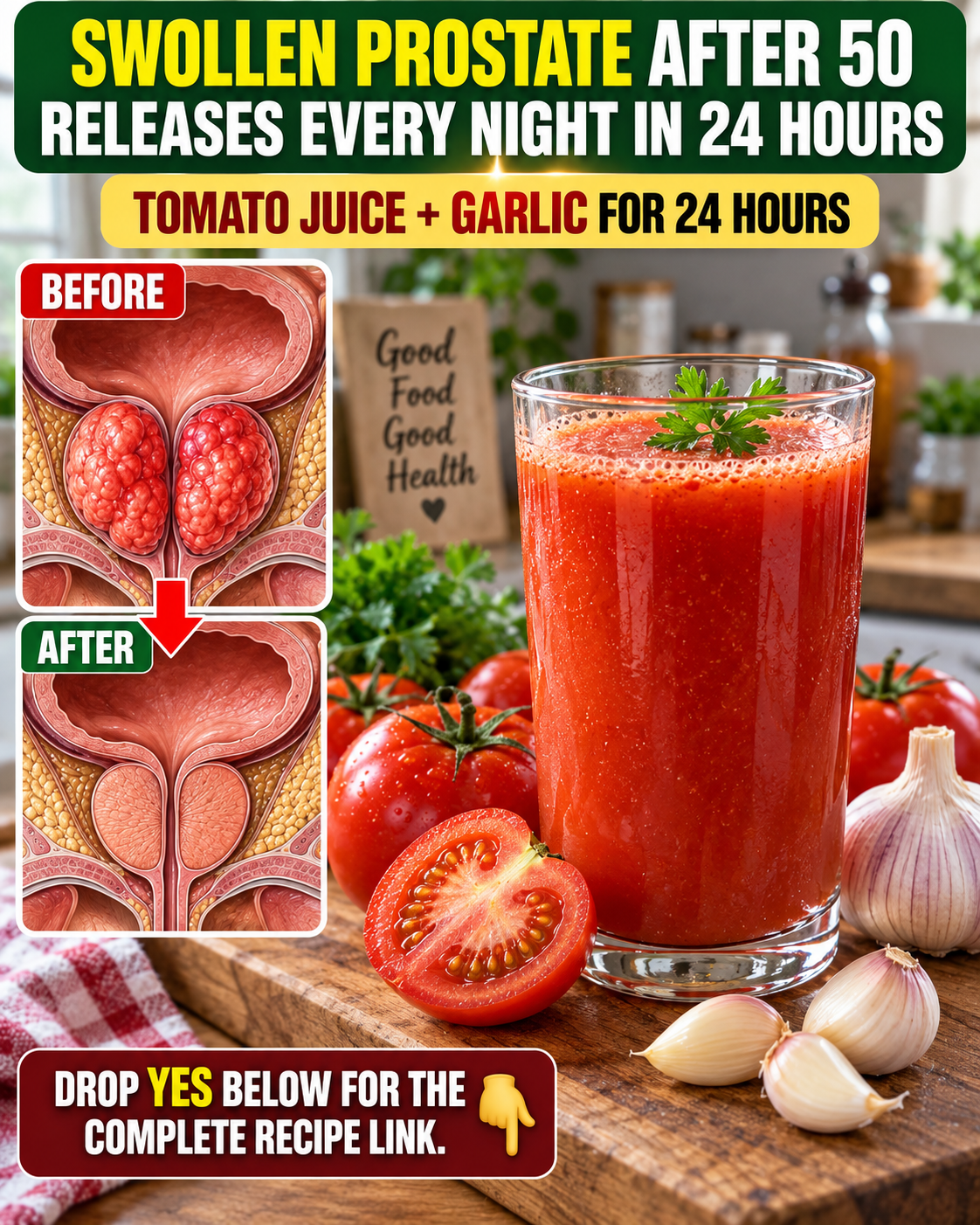
Tomato juice mixed with garlic sounds like the kind of simple kitchen remedy that could attract a lot of attention—especially among men over 50 dealing with a weak urine stream, frequent bathroom trips, or waking several times during the night.
Tomatoes contain lycopene, while garlic contains sulfur-containing plant compounds. Both have been studied for potential health effects.
But there is an important distinction:
Tomatoes and garlic can be part of a healthy diet. They have not been proven to rapidly shrink an enlarged prostate or replace medical treatment for benign prostatic hyperplasia (BPH).
BPH is the most common prostate problem in men over 50, and established management ranges from lifestyle changes to medicines and procedures depending on symptom severity. (NCCIH)
⚠️ Important Safety Note
This article is for general educational purposes only and is not a substitute for medical diagnosis or treatment.
Tomato juice and garlic are foods—not cures for an enlarged prostate, prostate cancer, urinary retention, or another urinary disorder.
Do not stop or change prescribed prostate, blood-pressure, blood-thinning, diabetes, or other medications because of a food remedy.
Concentrated supplements can behave differently from normal amounts of food and may cause side effects or interact with medications.
If you suddenly cannot urinate, have blood in your urine, fever or chills with urinary symptoms, severe pelvic/lower abdominal pain, or rapidly worsening difficulty urinating, seek prompt medical care.
🍅 Why Tomatoes Get So Much Attention
The bright red color of tomatoes comes partly from lycopene, a carotenoid that has attracted considerable research interest.
Lycopene has been studied in connection with:
Prostate health.
Cardiovascular health.
Oxidative stress.
And prostate cancer.
Some individual clinical trials involving lycopene or specially formulated tomato products have reported potentially favorable findings in men with BPH. For example, one small trial involving 40 men found that lycopene supplementation was associated with lower PSA and less prostate enlargement over six months compared with placebo. (PubMed)
Another small randomized trial involving 40 men found improvement in urinary symptom scores after two months with a specially developed whole-tomato food supplement. (PubMed)
Those findings are interesting.
But they do not prove that an ordinary glass of tomato juice will shrink the prostate.
🔬 What the Bigger Evidence Picture Shows
When researchers look beyond individual small studies, the evidence becomes much less certain.
A systematic review identified eight randomized controlled trials of lycopene for BPH or prostate cancer. Because the trials were limited and varied considerably in design and quality, the researchers concluded that the available evidence was insufficient to support or refute lycopene for preventing or treating BPH or prostate cancer. (PubMed)
The National Center for Complementary and Integrative Health reaches a similarly cautious conclusion:
There is insufficient evidence to support lycopene for the prevention or treatment of BPH. (NCCIH)
So tomatoes are worth eating.
But they should not be advertised as prostate medicine.
🧄 What About Garlic?
Garlic is another food surrounded by strong health claims.
It contains organosulfur compounds and has been investigated for antioxidant, inflammatory, cardiovascular, and other biological effects.
Research has also examined garlic in relation to prostate enlargement.
One Italian observational study compared 1,369 men with BPH with 1,451 controls. Higher garlic consumption was associated with lower odds of BPH. Higher onion consumption showed an association as well. (PubMed)
But this was an observational case-control study.
It cannot prove that garlic prevented prostate enlargement.
Men who regularly eat garlic and vegetables may differ from other men in numerous ways, including:
Overall diet.
Body weight.
Physical activity.
Smoking.
Alcohol use.
And other lifestyle habits.
🧪 Interesting Garlic Research Isn’t the Same as Human Proof
You may also encounter studies suggesting that garlic reduces prostate growth.
One frequently cited experiment found that garlic reduced prostate enlargement and altered inflammatory and hormonal markers in rats with experimentally induced BPH. (PubMed)
That is useful early-stage research.
But the key word is:
rats.
Results from an animal model cannot establish that drinking garlic water or eating raw garlic will shrink an enlarged human prostate.
Human clinical trials are needed.
📊 Tomato & Garlic Claims vs. Evidence
| Claim | What to know |
| Tomatoes are nutritious | Yes |
| Tomatoes contain lycopene | Yes |
| Garlic contains bioactive plant compounds | Yes |
| Some small tomato/lycopene trials show promising findings | Yes |
| Lycopene is proven to treat BPH | No |
| Garlic has been proven to shrink the human prostate | No |
| Tomato-garlic juice rapidly restores urine flow | Not established |
| Tomato juice stops nocturia | Not established |
| Tomato and garlic prevent prostate cancer | Not proven |
| These foods can replace BPH medication | No |
🥤 A Simple Tomato & Garlic Drink
If you enjoy tomato juice, you can use it as food rather than medicine.
Try:
¾–1 cup unsalted or low-sodium tomato juice
½ small garlic clove, finely grated or crushed
A squeeze of fresh lemon
A pinch of black pepper, optional
Stir well.
If raw garlic bothers your stomach, skip it or simply use cooked garlic in meals instead.
You do not need:
Honey.
Sugar.
Large amounts of garlic.
Or concentrated garlic extract.
This drink should be viewed as a savory vegetable drink—not as a BPH treatment.
🧂 Choose Tomato Juice Carefully
Commercial tomato juice can contain substantial amounts of sodium.
That matters particularly for people managing:
High blood pressure.
Heart disease.
Kidney disease.
Fluid retention.
Or another condition requiring sodium restriction.
Look for:
Unsalted
or
Low sodium
on the label when appropriate.
You can also blend fresh tomatoes at home.
🍅 Whole Tomatoes May Be an Even Simpler Choice
You do not actually need tomato juice to obtain lycopene.
Tomatoes can be included in:
Salads.
Soups.
Sauces.
Egg dishes.
Bean dishes.
Fish meals.
And vegetable stews.
A Mediterranean-style meal containing cooked tomatoes, garlic, vegetables, olive oil, beans or fish is probably a more sensible long-term dietary habit than repeatedly drinking concentrated “prostate shots.”
🫒 Tomatoes With a Little Fat
Lycopene is fat-soluble.
That is one reason tomato dishes are commonly eaten with foods containing some fat, such as olive oil.
Instead of obsessing over one medicinal drink, consider a simple meal:
Cooked tomatoes.
Garlic.
Olive oil.
Vegetables.
Beans or fish.
Whole grains.
That gives you an entire nutrient-rich eating pattern rather than one isolated compound.
🧄 More Garlic Isn’t Necessarily Better
One clove does not become twice as medicinal simply because you use two.
Large quantities of raw garlic can cause:
Heartburn.
Abdominal discomfort.
Gas.
Nausea.
And strong irritation in sensitive people.
Concentrated garlic supplements also require more caution than ordinary culinary garlic.
If you take medications—particularly medicines affecting bleeding—discuss concentrated garlic products with your healthcare professional rather than assuming “natural” means interaction-free.
💊 What About Lycopene Supplements?
Supplements are not automatically equivalent to tomatoes.
NCCIH specifically notes that evidence remains insufficient to recommend lycopene for preventing or treating BPH. It also notes that adequate safety data for lycopene supplements are lacking and that reported concerns can include gastrointestinal effects, low blood pressure, and potentially increased bleeding risk. (NCCIH)
This is another reason to distinguish:
Eating tomatoes
from
taking concentrated supplements for medical purposes.
👨⚕️ What Exactly Is BPH?
Benign prostatic hyperplasia means the prostate has enlarged but is not cancerous.
BPH becomes increasingly common with age and is the most common prostate problem among men over 50. (NCCIH)
As the prostate enlarges, it can affect the urethra and bladder.
Symptoms may include:
Difficulty starting urination.
Weak or interrupted urine stream.
Dribbling.
Urgency.
Frequent urination.
Feeling that the bladder remains partly full.
And waking during the night to urinate.
🚽 Nighttime Urination Isn’t Always a Prostate Problem
This is particularly important for men over 50.
Waking repeatedly to urinate can occur with BPH.
But it can also be associated with:
Large amounts of evening fluid.
Caffeine.
Alcohol.
Diabetes.
Sleep disorders.
Overactive bladder.
Certain medications.
Leg swelling.
Or other urinary conditions.
So if you start drinking a large glass of tomato-garlic juice immediately before bed, you may actually make nighttime urination worse simply because you have added more evening fluid.
The timing matters.
🌙 Better Timing for the Drink
If you enjoy tomato juice, consider having it:
With lunch.
In the afternoon.
Or with an early dinner.
Rather than drinking a large amount immediately before going to bed.
This doesn’t turn tomato juice into a treatment.
It simply avoids adding unnecessary fluid close to bedtime if nocturia is already a problem.
🍅 Will Tomato Juice Shrink an Enlarged Prostate?
This has not been established.
Some small clinical studies of lycopene or specially developed tomato supplements have produced interesting results. (PubMed)
But a systematic review of randomized trials found that the available evidence was too limited and inconsistent to establish lycopene as a BPH treatment. (PubMed)
NCCIH therefore continues to describe the evidence as insufficient. (NCCIH)
That is the appropriate conclusion.
Promising is not the same as proven.
🧄 Will Garlic Shrink the Prostate?
This has not been established in high-quality human clinical trials either.
There are observational human findings linking higher garlic intake with lower odds of BPH, and there are interesting animal experiments. (PubMed)
Neither proves that garlic can treat an enlarged prostate once it develops.
🧬 What About Prostate Cancer?
This is where online claims become particularly dangerous.
Tomatoes, lycopene, garlic, and other plant foods have all been investigated in relation to prostate cancer.
But they should not be presented as cancer-prevention guarantees or cancer treatments.
A systematic review of randomized lycopene trials found insufficient evidence to support or refute its use for preventing or treating prostate cancer. (PubMed)
Another randomized trial involving men undergoing prostate biopsy found that lycopene supplementation substantially raised blood lycopene levels, but that does not establish it as a prostate-cancer treatment. (PubMed)
If prostate cancer is suspected, dietary changes should never delay appropriate testing or treatment.
🚫 Garlic Isn’t a Cancer Cure Either
Laboratory and animal studies often generate headlines about garlic and cancer.
Those experiments can help scientists identify compounds worth studying.
They do not prove that eating garlic destroys prostate cancer in humans.
A food can be healthy without being chemotherapy.
💊 What Actually Treats BPH?
BPH treatment depends on:
How severe the symptoms are.
How much they interfere with daily life.
Prostate size.
Other medical conditions.
And whether complications have developed.
NCCIH summarizes established BPH management as including:
Lifestyle changes
Medication
Minimally invasive procedures
and
Surgery. (NCCIH)
Some men with mild symptoms may initially need monitoring and lifestyle changes.
Others require medication or a procedure.
🌿 Don’t Assume Prostate Supplements Work Better
Saw palmetto is probably the best-known herbal supplement marketed for enlarged prostate symptoms.
Yet evidence has been inconsistent, with larger studies and systematic reviews failing to show reliable superiority over placebo. (NCCIH)
Lycopene also remains unsupported as an established BPH treatment. (NCCIH)
This is useful perspective when evaluating viral tomato-and-garlic remedies.
☕ Look at Your Evening Habits
For someone waking three or four times every night, the easiest improvements may have little to do with supplements.
Consider:
How much you’re drinking after dinner.
Whether you drink coffee late.
Whether you drink caffeinated tea at night.
Whether you consume alcohol in the evening.
And whether a medication may be increasing urination.
Small changes can sometimes reduce symptoms even though they do not shrink the prostate.
📓 Try a 3-Day Bladder Diary
Before experimenting with multiple remedies, collect useful information.
For three days, write down:
When you drink.
Approximately how much.
When you urinate.
How often you wake at night.
Whether you experience urgency.
Whether the stream feels weak.
Whether you have difficulty starting.
And whether your bladder feels completely empty afterward.
That information can help distinguish a fluid-timing issue from a persistent lower urinary-tract problem that needs evaluation.
📅 A Practical 14-Day Prostate-Support Routine
For two weeks, keep the approach simple.
Include tomatoes regularly in meals.
Use garlic as a culinary ingredient if you tolerate it.
Choose low-sodium tomato products when appropriate.
Eat more vegetables overall.
Include whole fruit rather than relying on juices.
Stay physically active.
Reduce excessive evening fluid intake.
Limit late caffeine.
Limit evening alcohol.
Keep prescribed medicines unchanged unless your clinician advises otherwise.
Track nighttime urination.
Track urgency.
Track urine-stream strength.
Track whether you feel completely empty afterward.
At the end of two weeks, look for patterns.
Do not judge prostate size based on how you feel after one glass of tomato juice.
🚫 Common Mistakes to Avoid
1. Calling tomato juice a prostate cure.
The evidence does not support that claim. (NCCIH)
2. Assuming lycopene supplements and tomatoes are interchangeable.
3. Drinking a large amount immediately before bed when nocturia is already a problem.
4. Using excessive raw garlic because a smaller amount “wasn’t strong enough.”
5. Adding large amounts of salt to tomato juice.
6. Stopping prescribed BPH medication after beginning a food remedy.
7. Assuming animal garlic research proves human prostate shrinkage.
One frequently cited BPH experiment was performed in rats. (PubMed)
8. Believing a lower PSA after a supplement proves cancer has disappeared.
9. Ignoring progressively worsening urinary symptoms.
10. Waiting at home if you suddenly cannot urinate.
🚨 When Urinary Symptoms Need Medical Attention
Arrange medical evaluation if you develop persistent:
Weak urine flow.
Difficulty starting urination.
Frequent urination.
Repeated nighttime urination.
Urgency.
Dribbling.
Or a sensation that your bladder never completely empties.
These symptoms can occur with BPH, but other conditions can produce similar problems.
Seek prompt care if you develop:
Complete inability to urinate.
Blood in the urine.
Severe lower abdominal or pelvic pain.
Fever or chills with urinary symptoms.
Rapidly worsening difficulty urinating.
A glass of tomato juice is not appropriate emergency treatment.
❓ Frequently Asked Questions
Are tomatoes good for prostate health?
Tomatoes are nutritious and contain lycopene. Some small studies have reported potentially favorable prostate findings, but current evidence is insufficient to recommend lycopene as a treatment for BPH. (NCCIH)
Does tomato juice shrink an enlarged prostate?
That has not been established.
Can garlic shrink the prostate?
There is no strong clinical evidence proving that eating garlic shrinks an enlarged human prostate.
Why is garlic associated with prostate health?
Observational research has found an association between higher garlic intake and lower odds of BPH, while animal experiments have reported biological effects on prostate enlargement. These findings do not establish garlic as a human BPH treatment. (PubMed)
Is lycopene good for BPH?
Research is mixed. NCCIH concludes that there is currently insufficient evidence to support lycopene for prevention or treatment of BPH. (NCCIH)
Are there any promising tomato studies?
Yes. Small randomized trials have reported improvements in some prostate-related measures with lycopene or specialized whole-tomato preparations. However, these studies are too limited to establish ordinary tomato juice as a treatment. (PubMed)
Is raw garlic better than cooked garlic?
There is no established clinical evidence showing that raw garlic is a superior BPH treatment. If raw garlic causes stomach irritation, there is no reason to force yourself to consume it.
Should I drink tomato and garlic juice before bed?
Not necessarily. If nighttime urination is already a problem, adding a large drink close to bedtime may be counterproductive.
Can tomato and garlic prevent prostate cancer?
Neither should be described as a proven prostate-cancer preventive treatment. Evidence for lycopene remains insufficient. (PubMed)
Can I stop my prostate medicine if I improve my diet?
No. Do not stop prescribed medication without discussing it with the clinician managing your treatment.
⭐ The Bottom Line
Tomatoes and garlic are healthy foods that can fit comfortably into a prostate-conscious diet after 50.
Tomatoes provide lycopene, while garlic provides a range of sulfur-containing plant compounds.
There are intriguing findings.
Some small clinical trials involving lycopene or specialized tomato products have reported improvements in selected BPH-related outcomes. (PubMed)
Observational research has also linked higher garlic intake with lower odds of BPH. (PubMed)
But the evidence is not strong enough to conclude that tomato juice and garlic can:
shrink an enlarged prostate,
restore urine flow quickly,
stop nighttime urination,
prevent prostate cancer,
or replace BPH medication.
NCCIH continues to conclude that evidence is insufficient to support lycopene for preventing or treating BPH. (NCCIH)
So enjoy tomatoes.
Cook with garlic.
Build meals around vegetables, healthy proteins, and minimally processed foods.
And if urinary symptoms are persistent or worsening, find out what is causing them rather than relying on a stronger homemade drink.
Not a cure • Food-level use is different from concentrated supplements • May interact with medications • Talk to your doctor if you have medical conditions or take daily medications.