
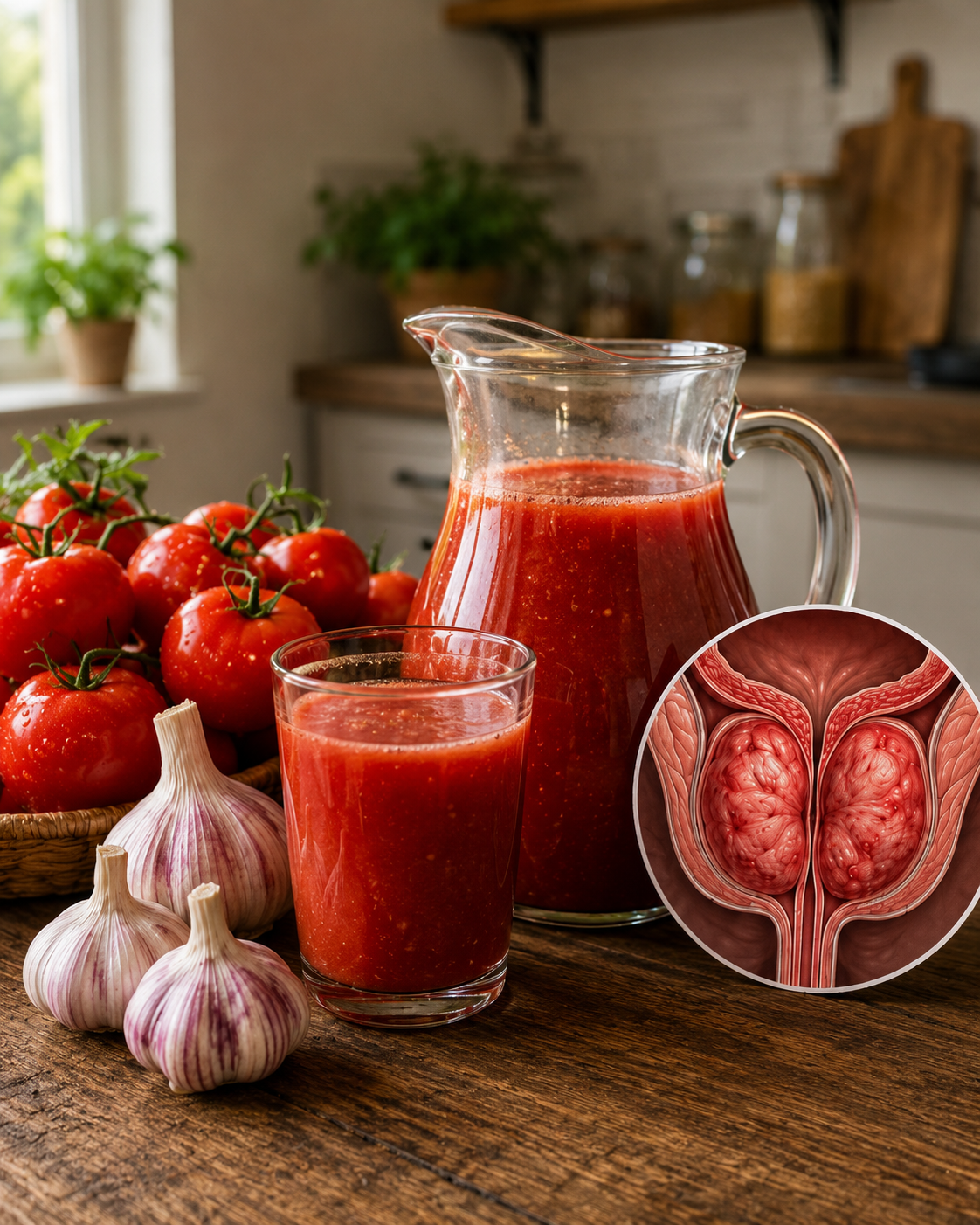
A glass of bright red tomato juice. A few cloves of garlic. And a dramatic promise:
“Heal a swollen prostate in just 6 hours—20 times more powerful than medication.”
For a man waking up several times every night to urinate, struggling with a weak stream, or feeling as though his bladder never completely empties, that kind of claim can be extremely tempting.
Tomatoes genuinely contain potentially useful compounds—particularly lycopene—and garlic is a nutritious ingredient with interesting cardiovascular research behind it.
But there is an important line between nutrition and treatment:
There is no good evidence that tomato and garlic juice can shrink an enlarged prostate in six hours, and there is no evidence that this drink is “20 times stronger” than BPH medication.
Some research involving lycopene has explored possible effects on prostate-related measures, but studies have generally lasted weeks, not hours, and results remain limited.
So what can tomato and garlic actually do—and what should a man over 50 know before relying on this viral drink?
🍅 Why Tomatoes Keep Appearing in Prostate Remedies
Tomatoes are one of the richest common dietary sources of lycopene, a carotenoid pigment responsible for their red color.
Lycopene has attracted considerable research attention in prostate health.
That makes tomatoes much more scientifically interesting than a completely random “miracle” ingredient.
But it doesn’t mean tomato juice acts like a drug.
One randomized clinical trial involving men with BPH studied lycopene-containing supplements for eight weeks. Some changes were observed, but most relevant differences were not statistically significant compared with placebo.
Eight weeks.
Not six hours.
And importantly, a standardized supplement used in a research trial isn’t identical to drinking a glass of homemade tomato juice.
👨 What Is a “Swollen Prostate” Anyway?
Most viral posts use “swollen prostate” to describe benign prostatic hyperplasia, or BPH.
BPH means the prostate has become enlarged, but the growth isn’t cancerous.
The prostate sits beneath the bladder and surrounds part of the urethra.
As it enlarges, it can squeeze the urethra and make it more difficult for urine to leave the bladder.
That can lead to the familiar symptoms many men notice after 50.
🚽 Common BPH Symptoms
They can include:
- Difficulty starting urination
- Weak urine stream
- Stop-and-start flow
- Dribbling after urination
- Feeling that the bladder hasn’t emptied
- Frequent urination
- Sudden urinary urgency
- Waking repeatedly at night to urinate
Interestingly, prostate size doesn’t perfectly predict symptoms. NIDDK notes that some men with substantially enlarged prostates have relatively few urinary problems, while a smaller enlargement may sometimes interfere considerably with urination.
That’s why you can’t diagnose the severity of BPH from symptoms—or an internet illustration—alone.
⏰ Can Tomato Juice Shrink the Prostate in Six Hours?
There’s no established evidence for that claim.
Prostate enlargement develops gradually.
Even medications specifically designed to affect prostate growth don’t normally transform the prostate in a few hours.
For example, 5-alpha reductase inhibitors are medications used to stop prostate growth or help shrink the gland over time. Other drugs, such as alpha blockers, primarily relax muscles around the prostate and bladder neck so urine can flow more easily.
A tomato-and-garlic beverage isn’t equivalent to either treatment.
📊 Viral Claim vs. What We Actually Know
| Viral claim | Evidence-based reality |
| Tomato juice heals BPH in 6 hours | Not established |
| Garlic rapidly shrinks the prostate | Not established |
| The drink is 20× stronger than medication | Unsupported |
| Tomatoes provide lycopene | Yes |
| Lycopene has been studied in prostate health | Yes |
| Evidence for treating BPH remains limited | Yes |
| Diet may support overall health | Yes |
| BPH medications can improve urinary symptoms | Yes |
| Significant urinary obstruction needs evaluation | Yes |
🧄 What About Garlic?
Garlic is also interesting—but for different reasons.
Research has focused much more heavily on garlic’s possible effects on cardiovascular and metabolic markers than on BPH.
NCCIH reports that garlic supplements may produce small reductions in total and LDL cholesterol in people with elevated cholesterol, and limited evidence suggests modest effects on blood pressure and blood glucose in some populations.
Those findings don’t establish garlic as a prostate treatment.
Still, cardiovascular health matters.
Healthy blood vessels, blood pressure, physical activity and metabolic health are all worthwhile targets for healthy aging.
So garlic can absolutely stay in the kitchen.
Just don’t call it prostate medication.
🥤 A Simple Tomato-Garlic Drink
If you enjoy tomato-based drinks and your medical diet allows them, here’s a much more reasonable version.
Ingredients
2 medium ripe tomatoes
½ small garlic clove
¼ cup water
Small squeeze of lemon
Pinch of black pepper
Fresh parsley or basil, optional
Preparation
Wash the tomatoes thoroughly.
Blend them with the water.
Add a small amount of garlic rather than several raw cloves.
Add lemon, pepper and herbs.
Blend until smooth.
Drink it with or alongside a meal.
Most importantly:
Don’t expect your prostate to shrink six hours later.
This is food.
Not a medical treatment.
⚠️ Check the Sodium in Bottled Tomato Juice
This is one of the easiest mistakes to make.
Someone reads:
“Tomatoes are good for you.”
Then starts drinking several glasses of commercially prepared tomato juice every day.
But some packaged vegetable juices contain considerable added sodium.
If you’re also managing high blood pressure, heart disease, kidney disease or fluid retention, that’s worth paying attention to.
Check the Nutrition Facts panel and compare products.
Homemade tomato drinks give you much greater control over added salt.
🍅 Whole Tomatoes vs. Juice
You don’t have to juice tomatoes to obtain lycopene.
Try:
Tomato salad.
Tomato sauce.
Roasted tomatoes.
Tomato-based vegetable soup.
Tomatoes with olive oil.
Tomatoes with beans.
The obsession with “drinks” comes largely from social-media remedy culture.
Your digestive system doesn’t require vegetables to arrive in a glass.
🔥 Are Cooked Tomatoes Actually Interesting?
Yes.
Lycopene bioavailability can differ depending on how tomatoes are prepared.
Cooking tomatoes and consuming them with some dietary fat can improve the absorption of lycopene.
That means something as ordinary as:
Cooked tomato sauce + olive oil
can be a perfectly reasonable way to include tomatoes.
No blender required.
🥗 A Better Prostate-Friendly Tomato Meal
Try this simple Mediterranean-style plate:
Tomato & White Bean Bowl
Chopped tomatoes
White beans
Cucumber
Parsley
Olive oil
Lemon
Small amount of minced garlic
Black pepper
Serve alongside fish or another appropriate protein.
Instead of chasing one compound, you’re getting a combination of:
Fiber.
Plant foods.
Unsaturated fat.
Protein.
And micronutrients.
That’s how nutrition usually works best.
🚫 Mistake #1: Expecting a Six-Hour Cure
This is the biggest problem with the viral claim.
If you’re struggling to urinate at breakfast, tomato juice isn’t a reliable way to remove an obstruction by lunchtime.
Research involving lycopene and BPH has investigated changes over much longer periods, and evidence remains insufficient to treat tomato products as a replacement for established BPH therapies.
🚫 Mistake #2: Using Huge Amounts of Raw Garlic
More garlic doesn’t mean more prostate benefit.
Large quantities of raw garlic may cause:
Heartburn.
Abdominal discomfort.
Gas.
Nausea.
Garlic supplements may also increase bleeding risk, particularly in people taking anticoagulants or aspirin.
Using garlic normally in food is very different from swallowing large concentrated doses.
🚫 Mistake #3: Drinking the Remedy Right Before Bed
This one is almost ironic.
A man is trying to stop nighttime urination.
So at 10 PM he drinks:
A giant glass of tomato-garlic juice.
Then he wakes up repeatedly to urinate.
NIDDK specifically recommends that men with BPH who are bothered by nocturia consider drinking fewer liquids before bedtime.
If nighttime urination is your main problem, consuming a large “prostate drink” immediately before sleep can work against your goal.
🌙 Why You Keep Waking Up to Urinate
BPH can absolutely cause nocturia.
But prostate enlargement isn’t the only possibility.
Nighttime urination can be influenced by fluid intake and other urinary or medical conditions.
That’s why automatically assuming:
“Night urination = enlarged prostate = tomato juice”
can lead you in the wrong direction.
Persistent symptoms deserve proper evaluation.
☕ Your Evening Coffee May Matter More
NIDDK recommends reducing or avoiding caffeine when urinary frequency is troublesome.
So consider what happens after dinner.
Coffee?
Strong tea?
Cola?
Energy drinks?
Then a large “prostate juice”?
Reducing unnecessary evening liquids and caffeine may be far more useful for nighttime symptoms than adding another drink.
🍺 Alcohol Can Work Against You Too
Alcohol can also contribute to urinary problems and sleep disruption.
NIDDK includes limiting alcohol among lifestyle changes that may help reduce BPH symptoms.
Again, this is less exciting than a six-hour remedy.
But it’s grounded in actual BPH management.
🚽 Don’t Hold Your Urine for Hours
Men sometimes begin adapting to urinary problems without realizing it.
They postpone bathroom trips.
Then rush when urgency becomes overwhelming.
NIDDK recommends using the restroom regularly rather than holding urine for long periods.
Give yourself enough time to empty your bladder comfortably.
Don’t strain aggressively.
And if you repeatedly feel that substantial urine remains afterward, mention that to your healthcare professional.
💊 What Actually Helps BPH?
Treatment depends on symptom severity and how much BPH affects daily life.
For mild symptoms, a healthcare professional may recommend watchful waiting plus lifestyle changes.
When more treatment is needed, NIDDK lists several medication categories.
Alpha blockers
These relax muscles in the bladder neck and prostate.
That can make urination easier.
5-alpha reductase inhibitors
These can help stop prostate growth or shrink the prostate.
PDE-5 inhibitors
These may relieve certain BPH symptoms in selected men.
Some patients benefit from combination therapy.
Notice the difference:
These treatments have defined mechanisms, doses, clinical trials, known side effects and medical monitoring.
A tomato drink doesn’t become “20 times stronger” simply because a social-media graphic says so.
🔧 When Medication Isn’t Enough
Modern BPH treatment also includes minimally invasive procedures.
Some techniques remove or reduce obstructing tissue.
Others widen the urethral pathway.
NIDDK describes options including water-vapor therapy and prostatic urethral lift, while surgery may be recommended for severe symptoms, treatment failure or complications.
These aren’t necessary for every man.
But they’re important options when urinary obstruction becomes significant.
⚠️ BPH Can Cause Complications
An enlarged prostate isn’t always merely annoying.
When bladder emptying becomes impaired, complications can include:
Urinary retention.
Urinary tract infections.
Bladder stones.
Blood in the urine.
Kidney problems.
That’s one reason relying indefinitely on food remedies can become dangerous.
🚨 The Symptom That Cannot Wait
If you:
Cannot urinate at all
seek medical attention immediately.
Don’t drink another tomato juice.
Don’t take extra garlic.
Don’t wait six hours to see whether it works.
Inability to urinate can represent acute urinary retention and needs prompt treatment.
NIDDK also recommends prompt medical attention for urinary symptoms accompanied by fever and chills, blood in the urine, or substantial lower abdominal or urinary-tract pain.
🩺 BPH Isn’t the Only Possibility
Urinary symptoms can also occur with:
Bladder problems.
Urinary tract infections.
Prostatitis.
Other urinary disorders.
Prostate cancer can also cause overlapping symptoms.
This doesn’t mean weak urine flow automatically indicates cancer.
It means symptoms alone can’t reliably tell you the cause.
🧪 How BPH Is Evaluated
Depending on the situation, evaluation can include a medical history, symptom review, physical examination and urinary testing.
Additional testing may include:
Urinalysis.
PSA testing when appropriate.
Urine-flow studies.
Post-void residual testing.
Ultrasound.
Cystoscopy.
Other urologic tests.
The goal isn’t to order every test for every man.
It’s to determine what’s actually causing the problem.
🧄 Can Garlic Interact With Medication?
Yes—particularly concentrated garlic supplements.
NCCIH warns that garlic supplements can increase bleeding risk, especially when combined with anticoagulant medicines or aspirin. Garlic can also interact with certain other medications.
This doesn’t mean you must stop cooking with garlic.
Ordinary culinary use and concentrated supplementation aren’t the same thing.
If you’re considering high-dose garlic capsules or extracts, discuss them with your healthcare professional.
🍅 What About Lycopene Supplements?
A tomato and a lycopene capsule aren’t interchangeable.
Clinical research sometimes uses standardized doses that are far higher or more controlled than what someone gets from an ordinary meal.
And even those studies don’t establish lycopene as a six-hour BPH cure.
For example, the randomized BPH trial mentioned earlier studied 25 mg/day of lycopene for eight weeks, alone or combined with another tomato-related compound. Most relevant reductions were not statistically significant versus placebo.
That’s far more nuanced than:
“Drink this and your prostate heals today.”
🎃 What About Pumpkin Seeds?
Pumpkin seeds are another popular prostate food.
They’re nutritious and some pumpkin-seed preparations have been studied for urinary symptoms.
They can fit into a balanced diet.
But the same rule applies:
Food isn’t a substitute for diagnosing significant urinary obstruction.
You don’t need to combine tomato juice + garlic + pumpkin seeds + supplements + herbs into one enormous prostate protocol.
More ingredients don’t automatically create more benefit.
🍉 What About Watermelon?
Watermelon contains lycopene too.
It’s nutritious.
But here’s the practical problem for someone with nocturia:
Watermelon also contains a lot of water.
Eating a large amount immediately before bed could contribute to overnight urine production.
So timing matters.
A healthy food can still be poorly timed for a particular symptom.
🌶️ What About Cayenne or Black Pepper?
Adding a little black pepper to tomato dishes is perfectly reasonable.
But pepper doesn’t suddenly activate a prostate-shrinking reaction.
Be particularly skeptical when a recipe claims:
Tomato + garlic + pepper = prostate medicine.
That’s not how clinical evidence works.
📅 A Better 7-Day Prostate Experiment
Instead of expecting six-hour prostate regeneration, spend one week identifying your symptom pattern.
Day 1: Record how often you urinate.
Day 2: Track how many times you wake overnight.
Day 3: Move most fluids earlier in the day.
Day 4: Reduce late caffeine.
Day 5: Reduce evening alcohol.
Day 6: Give yourself enough time to empty your bladder without straining.
Day 7: Review the pattern.
If you’re still waking repeatedly, struggling to start urination or noticing progressively weaker flow, take the record to your healthcare professional.
That’s useful information.
📋 A Simple Bladder Diary
| Time | Drink | Urination | Symptom |
| 7 AM | Coffee | Normal | Mild hesitation |
| 10 AM | Water | Normal | None |
| 6 PM | Water | Weak | Slow start |
| 9 PM | Large drink | — | — |
| 12 AM | — | Urinated | Weak stream |
| 3 AM | — | Urinated | Urgency |
| 5 AM | — | Urinated | Small amount |
Three days of information like this can be much more useful than simply saying:
“I pee a lot.”
❓ Frequently Asked Questions
Can tomato juice shrink an enlarged prostate?
Tomatoes contain lycopene, which has been studied in prostate health, but tomato juice isn’t an established treatment for shrinking BPH.
Can tomato and garlic work within six hours?
There’s no good evidence that this combination can shrink an enlarged prostate or reverse BPH within six hours.
Is it 20 times stronger than medication?
No credible evidence supports that claim.
Can lycopene help BPH?
Research exists, but results are limited and don’t establish lycopene as a replacement for BPH treatment. One small randomized trial studied lycopene for eight weeks, not hours.
Is garlic good for the prostate?
Garlic is nutritious, but it isn’t an established BPH treatment.
Should I drink tomato juice before bed?
If nocturia is a major problem, drinking a large volume shortly before sleep may be counterproductive. NIDDK recommends limiting liquids before bedtime when nighttime urination is troublesome.
Can I replace tamsulosin with tomato juice?
Don’t stop prescribed BPH medication and replace it with food or supplements without discussing the change with your healthcare professional.
What medication actually shrinks the prostate?
5-alpha reductase inhibitors are among the medications that can stop prostate growth or help shrink the gland over time. Alpha blockers work differently by relaxing muscles to make urination easier.
Does BPH mean prostate cancer?
No. BPH is noncancerous prostate enlargement. However, some urinary symptoms overlap with other prostate and urinary conditions, which is why persistent symptoms should be evaluated.
Why do I urinate three or four times every night?
BPH is one possible cause, but fluid timing, caffeine, alcohol and other urinary or medical conditions may contribute.
When should I see a doctor?
Persistent weak flow, difficulty starting urination, incomplete emptying, worsening urgency or frequent nighttime urination deserve evaluation.
When is it an emergency?
Seek immediate medical care if you cannot urinate at all. Prompt evaluation is also important for blood in the urine, significant urinary/lower-abdominal pain, or painful urgent urination accompanied by fever and chills.
⭐ The Bottom Line
Tomatoes and garlic don’t need miracle claims to be worth eating.
Tomatoes provide lycopene and fit beautifully into Mediterranean-style meals.
Garlic adds flavor and contains biologically active compounds; research suggests garlic supplements may modestly affect some cardiovascular risk markers, although concentrated products can cause gastrointestinal effects and interact with certain medications.
But neither ingredient has been shown to:
Heal an enlarged prostate in six hours.
Restore urine flow immediately.
Reverse BPH.
Or work “20 times better” than medication.
For a man over 50 with mild urinary symptoms, the more useful routine is to keep most fluids earlier in the day, reduce late caffeine and alcohol, remain physically active, empty the bladder without prolonged holding, and monitor symptoms. These are among the lifestyle measures NIDDK discusses for BPH.
And when symptoms become persistent or troublesome, effective medical treatments exist—from medications that improve urine flow or affect prostate growth to minimally invasive procedures and surgery when necessary.
So enjoy tomatoes.
Cook with garlic.
Use olive oil and herbs.
Make the red drink if you enjoy the taste.
Just don’t give a glass of tomato juice a job that belongs to proper prostate evaluation and treatment.