
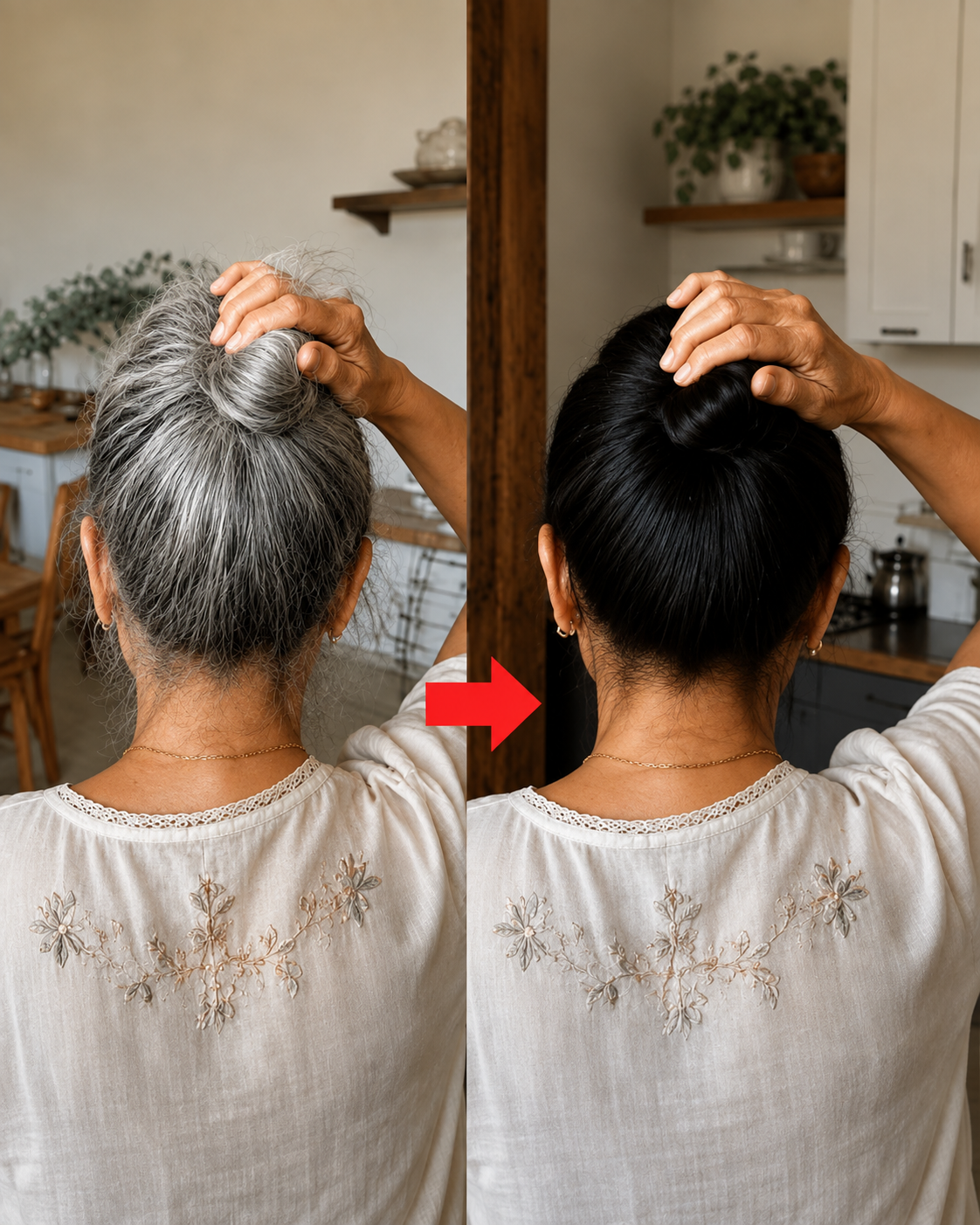
Hair often changes after 50.
It may feel drier. The strands may break more easily. The scalp can become less comfortable. A once-full ponytail may look thinner, and styling may suddenly require more effort than it used to.
That is why simple homemade hair remedies—especially old-fashioned two-ingredient mixtures—can be so appealing.
One of the gentler combinations is:
Aloe vera gel + jojoba oil.
Used correctly, this mixture may help hair feel softer, smoother, and better conditioned while giving a dry scalp some temporary comfort.
But there is an important distinction:
Aloe vera and jojoba oil can improve the appearance and feel of hair. They have not been proven to reverse age-related hair loss, reactivate dormant follicles, or restore a full head of hair after 50.
The American Academy of Dermatology notes that hair growth naturally slows with age and that hereditary female-pattern hair loss often begins during the 40s, 50s, or 60s. When true thinning is occurring, identifying the cause matters because treatment works best when started early.
🌿 Why Aloe Vera?
The clear inner gel of the aloe plant contains water and a variety of naturally occurring plant compounds.
Topical aloe has been studied much more extensively for skin conditions than for hair growth.
NCCIH reports that topical aloe gel is generally well tolerated and has some evidence for conditions such as burns and certain skin problems. However, there isn’t reliable clinical evidence showing that aloe gel stimulates substantial scalp-hair regrowth.
That means aloe’s most realistic role in a hair routine is cosmetic and conditioning.
It may help provide:
Moisture.
Slip.
A cooling sensation.
Temporary scalp comfort.
Softer-feeling strands.
But that isn’t the same as creating new follicles.
💧 Why Add Jojoba Oil?
Jojoba oil is commonly used in hair and skin products because it works well as an emollient.
A very small amount can help coat dry hair, reduce roughness, and improve shine.
This can become particularly useful when aging hair becomes:
Coarser.
More brittle.
More prone to tangling.
More vulnerable to heat and chemical processing.
Again, we’re talking about the hair shaft.
An oil can make an existing strand look healthier without increasing the number of hairs growing from the scalp.
📊 Viral Promise vs. Realistic Result
| Claim | What is more realistic |
| Aloe regrows thinning hair in days | Not established |
| Jojoba wakes dormant follicles | Not established |
| The mixture reverses menopause-related thinning | No evidence |
| It may soften dry hair | Yes |
| It may improve shine | Yes |
| It can help reduce friction during styling | Yes |
| Aloe can feel soothing on some scalps | Possibly |
| True hair loss may require treatment | Yes |
🧴 Grandma’s Simple 2-Ingredient Hair Mask
You only need:
1 tablespoon plain aloe vera gel
Use a simple commercially prepared aloe gel intended for skin, preferably without heavy fragrance or unnecessary additives.
1 teaspoon jojoba oil
Mix them together immediately before use.
You don’t need ten oils.
You don’t need essential oils.
You don’t need onion juice.
You don’t need to leave it fermenting in a jar.
How to Use It
Apply a small amount to damp hair.
Concentrate most of the mixture on:
Mid-lengths.
Ends.
Dry areas.
If your scalp is dry and you tolerate aloe well, you can gently apply a thin layer there too.
Leave it on for approximately 15–30 minutes.
Rinse thoroughly and shampoo gently if needed.
Start with once weekly.
If your hair is very fine or becomes greasy easily, use much less jojoba oil.
✨ What You May Notice After One Use
This is where the recipe can genuinely shine.
Hair may appear:
Smoother.
Less frizzy.
More reflective.
Easier to comb.
Less dry.
Those changes can make thinning hair appear healthier and more polished.
But they come from conditioning the existing strands, not growing thousands of new hairs overnight.
🚫 Mistake #1: Calling Shine “Hair Regrowth”
This is extremely common with before-and-after photos.
Hair is conditioned.
It lies flatter.
Frizz decreases.
Light reflects differently.
Then the caption says:
“Hair grew back.”
Not necessarily.
A cosmetic improvement can be beautiful without being follicle regeneration.
🚫 Mistake #2: Using Fresh Aloe Without Care
Fresh aloe straight from a plant sounds more “natural,” but the aloe leaf contains different components.
The clear inner gel is not the same as the yellowish aloe latex closer to the outer leaf.
NCCIH specifically distinguishes aloe gel from aloe latex and whole-leaf preparations because their composition and safety profiles differ. Topical aloe gel is generally well tolerated, although occasional burning, itching, rash, and eczema have been reported.
For a simple scalp routine, a clean commercial gel is often easier to use consistently.
⚠️ Always Patch Test First
Apply a small amount of the mixture to a limited area of skin.
Wait and watch for:
Redness.
Burning.
Itching.
Swelling.
Rash.
If irritation occurs, wash it off and don’t continue.
Natural ingredients can still cause reactions.
🚫 Mistake #3: Adding Lemon Juice
Lemon appears in countless homemade hair recipes.
But a sensitive or aging scalp doesn’t need unnecessary acidity.
Lemon juice can sting irritated skin and may make an already uncomfortable scalp worse.
The aloe-and-jojoba mixture doesn’t need it.
🚫 Mistake #4: Adding Essential Oils “for Growth”
Rosemary oil, peppermint oil, and other essential oils are heavily promoted for hair growth.
But essential oils are concentrated substances and can irritate the scalp, particularly when used incorrectly.
For this recipe, simple is better:
Aloe + jojoba.
Nothing else is necessary.
👩 Why Hair Often Gets Thinner After 50
Aging itself influences hair.
AAD explains that as people age, hair growth slows and some follicles eventually stop producing hair.
But age isn’t the only possible cause.
Hair thinning after 50 can also involve:
Female-pattern hair loss.
Menopause-associated hormonal changes.
Genetics.
Recent illness.
Major stress.
Rapid weight loss.
Certain medications.
Nutritional deficiencies.
Thyroid disease.
Scalp disorders.
Tight hairstyles.
Other forms of alopecia.
This is why putting oil on every form of hair loss doesn’t make sense.
Different causes require different approaches.
👩🦳 Female-Pattern Hair Loss After Menopause
Female-pattern hair loss is particularly important.
AAD says it’s the most common type of hair loss in women and typically begins during midlife.
A common early sign is:
A widening center part.
The ponytail may also gradually feel smaller, and thinning can become more noticeable across the top of the scalp.
This condition is progressive.
That means waiting several years while experimenting exclusively with kitchen remedies can allow more thinning to occur.
💊 What Has Better Evidence for Female-Pattern Hair Loss?
One treatment stands out:
Minoxidil
AAD describes topical minoxidil as the most-recommended treatment for female-pattern hair loss. Products containing 2% or 5% minoxidil have been approved for women.
But don’t expect instant results.
Hair grows slowly.
AAD notes that women generally need to use minoxidil continuously for approximately 6–12 months before they can judge how well it works.
That’s a useful reality check whenever a viral remedy promises:
“New hair in seven days.”
Even proven treatments usually require months.
⏳ Why Real Hair Regrowth Takes Time
Hair follicles cycle through different growth stages.
Growing hair isn’t like inflating a balloon.
Even when an effective treatment improves follicle activity, the visible strand must physically grow out of the scalp.
That takes time.
So a product claiming dramatic new length or density within a few days should immediately raise skepticism.
🧼 Your Shampoo May Matter More Than Another Supplement
Hair after 50 can be easier to damage.
Overwashing with harsh products can leave strands rough and brittle.
A gentler approach may include:
Shampooing primarily the scalp.
Letting the lather rinse through the lengths instead of scrubbing them aggressively.
Using conditioner after washing.
Detangling carefully.
Limiting very hot water.
Protecting hair from excessive heat.
These habits won’t cure hereditary loss, but they can reduce avoidable breakage.
🔥 Heat Can Make Thin Hair Look Even Thinner
Flat irons.
Curling irons.
Very hot blow dryers.
Repeated heat styling can damage the hair shaft.
If strands are already fine, breakage can make overall density appear worse.
Use lower temperatures when possible.
Don’t repeatedly run hot tools over the same section.
And give hair breaks from heat styling.
🎨 Chemical Processing Adds Up
Bleaching.
Permanent coloring.
Relaxing.
Perming.
Repeated treatments can weaken hair.
That doesn’t mean everyone over 50 must stop coloring their hair.
It means spacing treatments appropriately and paying attention to breakage becomes increasingly valuable.
Beautiful-looking hair isn’t only about stimulating growth.
It’s also about keeping the hair you already have intact.
🎀 Tight Hairstyles Can Cause Real Hair Loss
This is more serious than ordinary breakage.
Repeated tension from tight:
Ponytails.
Braids.
Extensions.
Buns.
Cornrows.
can produce traction alopecia.
AAD warns that continual pulling may lead to permanent hair loss, particularly if the practice continues long enough.
One simple rule from AAD is useful:
If the hairstyle hurts, it’s too tight.
No aloe mask can compensate for continuous traction.
🥚 Protein Matters Too
Hair is largely made from keratin, a protein.
Extreme restrictive dieting or inadequate nutrition can contribute to shedding in susceptible people.
Useful protein foods can include:
Eggs.
Fish.
Greek yogurt.
Chicken.
Beans.
Lentils.
Tofu.
Other appropriate protein sources.
That doesn’t mean protein powder makes hair grow faster.
It simply means your body needs adequate nutrition to support normal tissue growth.
🥗 A Hair-Friendly Breakfast
Try:
Berry & Walnut Greek Yogurt Bowl
Plain Greek yogurt
Berries
Oats
Walnuts
Chia or ground flaxseed
This provides a combination of:
Protein.
Healthy fats.
Fiber.
Micronutrients.
It’s not a baldness cure.
It’s simply good nutrition.
🐟 A Hair-Friendly Dinner
A simple meal might include:
Salmon.
Leafy vegetables.
Sweet potato or whole grains.
Olive oil.
Beans or another appropriate side.
Again, think:
Nutritional pattern.
Not:
One miracle ingredient.
💊 Should You Take Biotin?
Biotin is probably the most heavily marketed “hair vitamin.”
But taking high doses isn’t automatically useful when you aren’t deficient.
And there’s another issue:
High-dose biotin can interfere with certain laboratory tests.
So don’t assume an enormous biotin supplement is necessary because your hair feels thin.
A better approach is to investigate the cause of hair loss first.
🩸 Could Low Iron Be Involved?
Sometimes.
Iron deficiency can contribute to hair shedding.
But taking iron unnecessarily isn’t harmless either.
If hair loss is accompanied by:
Fatigue.
Weakness.
Shortness of breath.
Heavy bleeding.
Dietary restriction.
or other concerning symptoms,
a clinician may decide that blood testing is appropriate.
Don’t treat every thinning part with iron tablets.
🦋 What About Thyroid Problems?
Thyroid disorders can also affect hair.
If thinning is accompanied by symptoms such as:
Marked fatigue.
Feeling unusually cold.
Unexplained weight changes.
Constipation.
Dry skin.
or other systemic changes,
medical evaluation may be useful.
Again:
The correct treatment depends on the cause.
😰 Stress Can Trigger Shedding
A major illness, surgery, emotional stress, or other physical stress can sometimes push more hairs into a shedding phase.
People may notice shedding several months after the triggering event.
This is another reason it helps to look back at what happened before the hair loss started.
Aloe doesn’t tell you the diagnosis.
Your history may.
🚫 8 Common Hair Mistakes After 50
1. Expecting a Two-Ingredient Mask to Reverse Genetic Hair Loss
It won’t.
2. Confusing Reduced Breakage With New Growth
Both are useful, but they’re different.
3. Applying Heavy Oil Every Day
This can leave fine hair limp and greasy.
4. Using Irritating DIY Ingredients
Lemon, undiluted essential oils, onion juice, and other harsh mixtures can irritate sensitive scalps.
5. Pulling Hair Tight
Traction can lead to permanent loss.
6. Overusing Heat
Breakage makes thinning appear worse.
7. Buying Supplements Before Finding the Cause
Hair loss has many possible causes.
8. Waiting Years Before Seeking Help
AAD emphasizes that hair-loss treatment often works best when started early.
📅 A Better 30-Day Hair Routine
Don’t judge actual regrowth after three days.
Instead, use the first month to improve the health and appearance of the hair you have.
Week 1: Simplify your routine and stop harsh DIY treatments.
Week 2: Use the aloe-jojoba mask once and monitor how your scalp responds.
Week 3: Reduce heat and tight hairstyles.
Week 4: Compare shedding, breakage, scalp comfort, and your center part using photos taken under the same lighting.
If your part continues widening or density is clearly decreasing, consider a dermatologist rather than making the mask stronger.
📸 Take Monthly Photos
This is surprisingly useful.
Hair changes slowly.
Daily mirror checks can make everything feel worse because tiny differences are impossible to judge reliably.
Once every month, photograph:
Front hairline.
Center part.
Both temples.
Crown.
Use similar:
Lighting.
Hair style.
Camera distance.
This provides a much better record of whether thinning is actually progressing.
🚨 When Hair Loss Should Be Checked
Consider seeing a dermatologist if you notice:
A rapidly widening part.
Sudden heavy shedding.
Clearly visible scalp.
Round bald patches.
Scarring.
Persistent scalp pain.
Severe itching.
Scaling.
Redness.
Broken hairs.
Loss of eyebrows or eyelashes.
Hair loss following a new medication.
AAD emphasizes that many conditions can cause hair loss and that determining the cause is essential to choosing an effective treatment.
❓ Frequently Asked Questions
Can aloe vera grow hair after 50?
There isn’t strong clinical evidence that topical aloe stimulates substantial new hair growth. Its more realistic role is moisturizing or soothing the skin and conditioning hair.
Can aloe make hair look thicker?
By reducing dryness and improving smoothness, conditioned strands may appear healthier and fuller. That’s a cosmetic improvement, not necessarily increased follicle density.
Does jojoba oil regrow hair?
There isn’t good evidence that jojoba oil reverses hereditary hair loss. Its main value is as a conditioning oil.
Can I use aloe and jojoba every day?
Usually that’s unnecessary. Fine hair may become weighed down. Starting once weekly allows you to see how your scalp and hair respond.
Should I leave it overnight?
You don’t need to. Approximately 15–30 minutes is enough for a simple conditioning mask.
Is fresh aloe better?
Not necessarily. Commercial gel can offer more predictable preparation. The aloe leaf contains gel and latex components with different safety profiles.
What is the most common hair loss in women after 50?
Female-pattern hair loss commonly begins in midlife and often first appears as a widening part.
What treatment has stronger evidence for female-pattern hair loss?
Topical minoxidil is the most-recommended treatment according to AAD.
How quickly does minoxidil work?
AAD says it may take roughly 6–12 months of continuous use to determine how well it works.
Why is my hair suddenly shedding?
Possible causes include illness, stress, medications, hormonal changes, nutritional problems, hereditary hair loss, and other medical or scalp conditions.
Can tight hairstyles permanently thin hair?
Yes. Repeated pulling can produce traction alopecia, and advanced cases may become permanent.
⭐ The Bottom Line
Grandma’s two-ingredient secret can be wonderfully simple:
Aloe vera gel + a small amount of jojoba oil.
Used as a gentle mask, it may make aging hair look:
Smoother.
Softer.
Shinier.
Less frizzy.
And easier to manage.
Topical aloe is generally well tolerated, although irritation can occur, so patch testing is sensible.
What this recipe cannot honestly promise is more important:
It won’t reliably reverse hereditary thinning.
It won’t reactivate permanently inactive follicles.
It won’t restore menopause-related hair density overnight.
And it isn’t a substitute for diagnosing true hair loss.
Female-pattern hair loss commonly begins in the 40s, 50s, or 60s, and AAD notes that treatment can prevent worsening and help some women regrow hair—particularly when treatment begins early.
So use aloe and jojoba for what they do best:
Help the hair you already have look and feel healthier.
And if your part keeps widening or shedding becomes significant, don’t simply add a third secret ingredient.
Find out what’s happening at the follicle—because protecting beautiful-looking hair after 50 starts with knowing whether you’re dealing with dryness, breakage, or genuine hair loss.