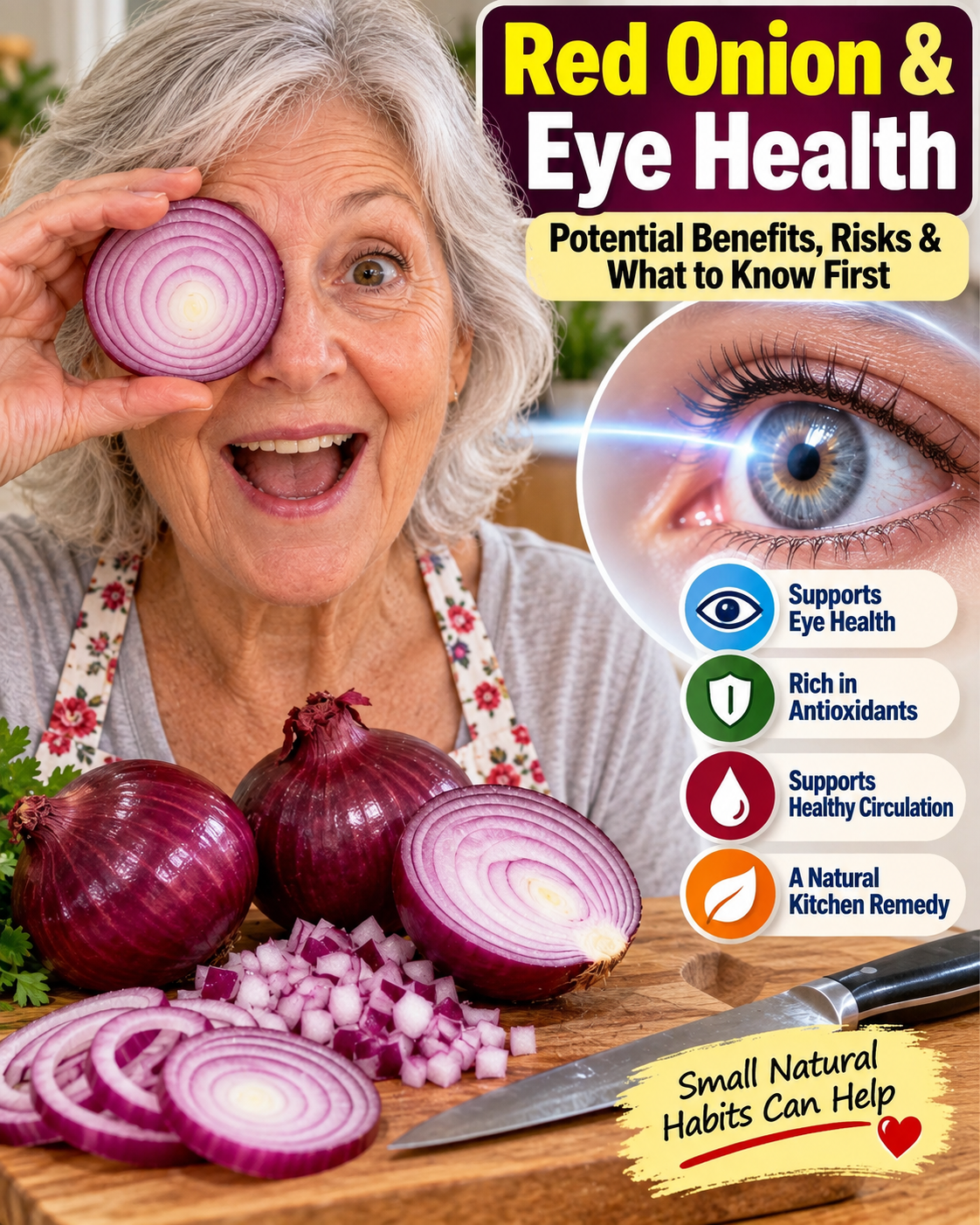
Red Onion & Eye Health: Potential Benefits, Risks & What to Know First
Red onion is often promoted online as a surprisingly powerful food for aging eyes.
You may have seen claims that red onion can:
Improve blurry vision.
Protect against cataracts.
Strengthen aging eyes.
Reduce inflammation.
Or even “clear” cloudy vision.
There is a reasonable nutritional idea underneath some of the hype: onions contain plant compounds, including flavonoids such as quercetin, and vegetables can absolutely be part of an eye-healthy diet.
But there is an important line between supporting general health through nutrition and treating an eye disease.
There is currently no good clinical evidence that eating red onion reverses cataracts, restores lost vision, treats glaucoma, or repairs retinal damage.
And putting raw onion or onion juice directly into the eyes is not recommended.
⚠️ Important Safety Note
This article is for general educational purposes only and is not a substitute for an eye examination, diagnosis, or medical treatment.
Red onion is a food—not a cure for cataracts, glaucoma, macular degeneration, diabetic eye disease, or unexplained blurry vision.
Never put onion juice, onion water, onion slices, or homemade herbal mixtures directly into your eyes.
If you have sudden vision loss, severe eye pain, new flashes or many new floaters, a dark curtain or shadow across your vision, or a sudden major change in vision, seek urgent medical care.
🧅 Why Red Onion Gets Attention
Red onions contain a variety of naturally occurring plant compounds.
One of the best known is quercetin, a flavonoid also found in foods such as:
Apples.
Berries.
Grapes.
Broccoli.
Tea.
And other fruits and vegetables.
These compounds are studied because of their antioxidant and biological properties.
That makes onions a perfectly reasonable part of a nutritious diet.
But laboratory antioxidant activity does not automatically translate into treatment for human eye disease.
A substance can produce interesting results in cells or animals without being proven to improve vision in people.
👁️ Can Eating Red Onion Improve Eyesight?
There is not strong evidence that eating red onion directly makes eyesight sharper.
If blurry vision comes from:
Nearsightedness.
Farsightedness.
Astigmatism.
Cataracts.
Glaucoma.
Retinal disease.
Or diabetic eye disease,
adding onion to meals will not correct the underlying problem.
The National Eye Institute emphasizes a broader approach to protecting vision: healthy eating, physical activity, avoiding smoking, UV protection, managing conditions such as diabetes and high blood pressure, and receiving appropriate eye examinations.
So think of red onion as one vegetable within a healthy diet, not as an eye treatment.
🌈 Why Colorful Vegetables Still Matter
Rejecting exaggerated onion claims does not mean nutrition is irrelevant.
Quite the opposite.
A diet containing a variety of vegetables, fruits, whole grains, nuts, legumes, fish, and other nutrient-rich foods supports overall health.
And overall health matters to your eyes.
For example, diabetes and high blood pressure can increase the risk of eye and vision problems. NEI recommends managing these long-term conditions as part of protecting vision.
Red onion can comfortably fit into that dietary pattern.
But it does not need to be eaten in unusually large quantities.
🥗 A Simple Eye-Healthy Red Onion Salad
Instead of making concentrated onion juice, use red onion as ordinary food.
Try:
¼ small red onion, thinly sliced
1 cup spinach or mixed leafy greens
½ tomato
½ cucumber
A small amount of olive oil
Fresh lemon juice
Optional:
A few walnuts or pumpkin seeds.
Serve it alongside salmon, sardines, beans, eggs, or another protein source.
This approach provides a variety of foods instead of relying on one “miracle” ingredient.
NEI specifically encourages dark leafy vegetables such as spinach, kale, and collard greens, along with fish rich in omega-3 fatty acids such as salmon, tuna, and halibut, as part of an eye-healthy diet.
🧅 Red Onion vs. the Viral Claims
| Claim | What to know |
| Red onion is a nutritious vegetable | Yes |
| Red onion contains plant compounds such as flavonoids | Yes |
| Eating vegetables supports overall health | Yes |
| Red onion restores blurry vision | Not established |
| Red onion removes cataracts | No evidence |
| Onion juice treats glaucoma | No |
| Onion juice should be placed in the eyes | No |
| Red onion replaces an eye examination | No |
| A balanced diet can support long-term eye health | Yes |
🌫️ Can Red Onion Remove Cataracts?
No evidence establishes red onion as a treatment that removes an existing cataract.
A cataract develops when the normally clear lens inside the eye becomes cloudy.
NEI explains that proteins in the lens begin breaking down and clumping together, creating cloudy areas that can progressively affect vision.
Symptoms can include:
Cloudy or blurry vision.
Colors looking faded.
Difficulty seeing at night.
Sensitivity to light.
Halos around lights.
Frequent changes in eyeglass prescription.
Or double vision in one eye.
Red onion cannot dissolve those cloudy proteins.
When a cataract becomes troublesome enough to interfere with daily life, the established treatment is cataract surgery, in which the cloudy lens is removed and replaced with an artificial lens. NEI reports that about 9 in 10 people who undergo cataract surgery see better afterward.
🚫 Don’t Put Onion Juice in Your Eyes
This is the most important safety message in this article.
Some online remedies suggest cutting an onion and squeezing the liquid directly into the eye.
Do not do this.
The intense burning and tearing caused by onion are not evidence that the eye is being “cleansed.”
Pain is not proof that a treatment is working.
The eye’s surface is delicate, and homemade preparations are not sterile ophthalmic medications.
They may cause substantial irritation and potentially introduce contaminants.
🚿 What If Onion Juice Accidentally Gets Into the Eye?
If a significant irritating substance gets into an eye, prompt rinsing is important.
Guidance on ocular chemical exposures emphasizes immediate irrigation rather than trying to neutralize the substance with another homemade chemical mixture.
If significant pain, redness, light sensitivity, or blurred vision persists after rinsing, seek professional eye care.
Do not add lemon juice, vinegar, baking soda, herbs, oils, or another substance in an attempt to “neutralize” the onion.
🍯 What About Onion and Honey Eye Drops?
This is another homemade remedy to avoid.
Honey may be a food, but mixing kitchen honey with onion does not create a sterile eye medication.
There is no reason to risk irritating or contaminating the eye to test a viral recipe.
If your eyes require medication or lubrication, use a product specifically intended for ophthalmic use and follow professional advice when needed.
🌿 What About Onion Water?
Drinking onion-infused water is unlikely to offer some unique eye benefit that cannot be obtained by simply eating a balanced diet.
More importantly, onion water should not be used as an eye wash.
Homemade food preparations are not equivalent to sterile eye products.
👓 Blurry Vision Needs a Cause
Blurry vision is a symptom—not a diagnosis.
Possible explanations include:
An outdated glasses prescription.
Dry eye.
Cataracts.
Diabetes-related changes.
Glaucoma.
Macular degeneration.
Corneal problems.
Retinal disease.
And many other conditions.
This is why an eye examination can be far more valuable than experimenting with food remedies.
NEI describes a comprehensive dilated eye exam as the best way to detect many eye diseases early, including problems that may initially cause few or no symptoms.
🧓 Eye Exams Become Especially Important After 60
Some eye diseases become increasingly common with age.
NEI recommends a dilated eye examination every 1 to 2 years for people over 60, while individual needs can differ depending on health and risk factors.
A dilated exam allows the eye doctor to examine structures inside the eye and look for conditions including:
Glaucoma.
Age-related macular degeneration.
Diabetic retinopathy.
And other eye problems.
That is a much more powerful vision-protection strategy than waiting for symptoms and trying an onion remedy.
🥬 What Foods Have Better Support for an Eye-Healthy Diet?
Rather than focusing exclusively on red onion, build variety.
NEI specifically highlights:
Spinach
Kale
Collard greens
Salmon
Tuna
Halibut
as examples of foods that fit an eye-healthy eating pattern.
Other nutritious foods can include:
Eggs.
Beans.
Nuts.
Whole grains.
Colorful vegetables.
Whole fruits.
And appropriate sources of healthy fats.
You do not need to eat all of them every day.
The overall dietary pattern matters.
🐟 Don’t Forget Fish
Fish rich in omega-3 fatty acids is one of the food groups specifically highlighted by NEI in its healthy-vision guidance.
Try including fish such as salmon in meals when appropriate for your diet.
For example:
Grilled salmon.
Spinach.
Tomatoes.
A little red onion.
Olive oil.
And a whole grain.
That makes much more nutritional sense than drinking a concentrated glass of raw onion juice.
☀️ Sunglasses May Do More for Long-Term Protection Than an Onion Remedy
Protecting the eyes from ultraviolet radiation is another evidence-based habit.
NEI recommends sunglasses that block 99% to 100% of UVA and UVB radiation.
This is particularly relevant to cataract prevention.
NEI specifically lists protecting the eyes from the sun, avoiding smoking, protecting against eye injury, and making healthy food choices among ways to help reduce cataract risk.
🚭 Smoking Matters to Eye Health
If you’re worried about protecting aging eyes, smoking is a much bigger issue than whether your onion is red or white.
NEI reports that smoking increases the risk of conditions including:
Cataracts.
Age-related macular degeneration.
And optic nerve damage.
Quitting smoking therefore has meaningful benefits for eye health as well as the rest of the body.
🩸 Blood Sugar Matters Too
Diabetes can damage the eyes.
That means someone worried about worsening vision should pay attention to blood glucose management rather than relying on antioxidant drinks.
NEI emphasizes managing diabetes and high blood pressure because both can increase the risk of eye problems and vision loss.
If you have diabetes and notice new blurry vision, arrange an eye examination.
❤️ Don’t Ignore Blood Pressure
High blood pressure can also affect eye health.
Keeping blood pressure controlled supports blood vessels throughout the body—including those serving the eyes.
Again, this illustrates why protecting eyesight is usually about the whole health pattern, not one special vegetable.
👁️ What About Macular Degeneration?
Age-related macular degeneration, or AMD, affects central vision and becomes more important with age.
NEI identifies smoking, family history, and age among important risk factors and recommends healthy behaviors such as regular physical activity, maintaining healthy blood pressure and cholesterol, avoiding smoking, and eating foods including leafy green vegetables and fish.
Red onion can be included in meals.
But it is not an established AMD treatment.
💊 What About Eye Vitamins?
Eye supplements deserve similar caution.
Certain specialized vitamin and mineral combinations can be appropriate for some people with specific stages of AMD.
That does not mean everyone with blurry vision should buy an “eye vitamin.”
The appropriate supplement depends on the diagnosis.
More is not automatically better.
📱 Give Your Eyes Screen Breaks
If your eyes become tired after hours on a phone or computer, another onion serving is unlikely to solve the problem.
NEI recommends taking regular screen breaks as one of several simple healthy-eye habits.
Blink regularly.
Take short visual breaks.
Adjust text size if you are constantly squinting.
Reduce glare.
And make sure your glasses prescription is current.
📅 A Simple 14-Day Eye-Health Routine
For the next two weeks, keep things simple.
At breakfast:
Choose a balanced meal rather than relying on a supplement.
At lunch or dinner:
Include vegetables. Red onion can be one of them.
Several times per week:
Include leafy greens and, if appropriate for your diet, omega-3-rich fish.
Outdoors:
Wear sunglasses that block 99–100% of UVA and UVB.
During screen use:
Take regular breaks and blink frequently.
Every day:
Stay physically active and follow your treatment plan for blood pressure or diabetes if you have those conditions.
Never:
Put onion juice or another homemade food mixture directly into your eyes.
Regularly:
Keep up with appropriate eye examinations.
NEI emphasizes this combination of healthy eating, physical activity, eye protection, and regular eye care rather than relying on a single food.
🚫 Common Mistakes to Avoid
1. Believing antioxidant means “cures eye disease.”
Red onion contains interesting plant compounds, but that does not establish it as medicine.
2. Putting onion juice directly into the eyes.
Do not do this.
3. Assuming burning means the remedy is working.
Irritation is not evidence of healing.
4. Trying onion water for cataracts.
An established cataract cannot be washed away with food.
5. Delaying an eye examination because you’re trying a home remedy.
Some eye diseases cause little or no warning before vision damage occurs.
6. Assuming blurry vision is just aging.
It needs a cause.
7. Ignoring diabetes and blood pressure.
Both can increase eye-disease risk.
8. Taking random eye supplements without knowing your diagnosis.
Supplement needs differ.
9. Ignoring UV exposure.
UV-blocking sunglasses are an important protective habit.
10. Waiting when vision suddenly changes.
Some sudden vision changes are emergencies.
🚨 When to Get Urgent Eye Care
Do not wait for onion, vitamins, or another dietary change to work if you experience:
Sudden vision loss.
A sudden major increase in blurry vision.
A dark curtain or shadow moving across your vision.
New flashes of light.
A sudden shower of new floaters.
Severe eye pain.
A very red, painful eye.
A significant eye injury or chemical exposure.
Sudden vision changes accompanied by weakness, facial drooping, confusion, severe dizziness, or difficulty speaking.
These symptoms require prompt medical evaluation.
❓ Frequently Asked Questions
Is red onion good for eye health?
Red onion is a nutritious vegetable and can be part of a healthy diet. However, there is not good clinical evidence that red onion itself restores vision or treats eye disease.
Does red onion contain antioxidants?
Yes. Onions contain plant compounds including flavonoids such as quercetin. That does not mean they function as an eye medication.
Can red onion improve blurry vision?
It has not been proven to correct blurry vision. Persistent or unexplained blur should be evaluated because many different conditions can cause it.
Can onion cure cataracts?
No clinical evidence establishes onion as a cataract treatment. Cataracts involve clouding of the eye’s natural lens.
Can I put onion juice in my eyes?
No. Do not use raw onion juice as homemade eye drops.
What if onion accidentally gets into my eye?
Rinse the eye promptly with plenty of clean water. Significant chemical or irritant exposures should be irrigated quickly, and persistent pain, redness, or vision changes warrant medical attention.
Is onion-and-honey eye medicine safe?
Homemade onion-and-honey preparations should not be put into the eye. Food ingredients are not automatically sterile ophthalmic medications.
What foods does NEI recommend for healthy eyes?
NEI highlights dark leafy vegetables such as spinach, kale, and collard greens and fish rich in omega-3 fatty acids such as salmon, tuna, and halibut.
How can I protect aging eyes?
Maintain a balanced diet, stay physically active, manage diabetes and blood pressure, avoid smoking, protect your eyes from UV exposure, and receive appropriate eye examinations.
Do people over 60 need regular eye exams?
NEI recommends a dilated eye exam every 1–2 years for adults over 60, although individual risk factors can change how often examinations are needed.
⭐ The Bottom Line
Red onion is a healthy vegetable.
It provides plant compounds and can be included in a balanced diet alongside leafy greens, whole fruits, fish, nuts, legumes, and other nutrient-rich foods.
But red onion has not been proven to:
restore blurry vision,
remove cataracts,
treat glaucoma,
reverse macular degeneration,
or repair damaged retinal tissue.
And raw onion juice should never be used as homemade eye drops.
For long-term eye health, the evidence supports a broader approach: eat a healthy diet, remain physically active, manage diabetes and blood pressure, avoid smoking, wear UV-protective sunglasses, and receive regular eye examinations.
NEI calls the dilated eye exam the best way to identify many eye diseases early, including problems that may develop before you notice vision loss.
Enjoy red onion as food—not as eye medicine.
Not a cure • Never put raw onion juice in the eyes • Persistent or sudden vision changes need professional evaluation.