
Going upstairs used to be automatic.
Then somewhere after 50, the knees begin announcing every step.
You feel stiffness when standing.
A dull ache after walking.
Grinding or crackling.
Pain going downstairs.
And sometimes that unpleasant moment when the knee feels weak or unstable.
A cheap kitchen pot is often promoted as the solution:
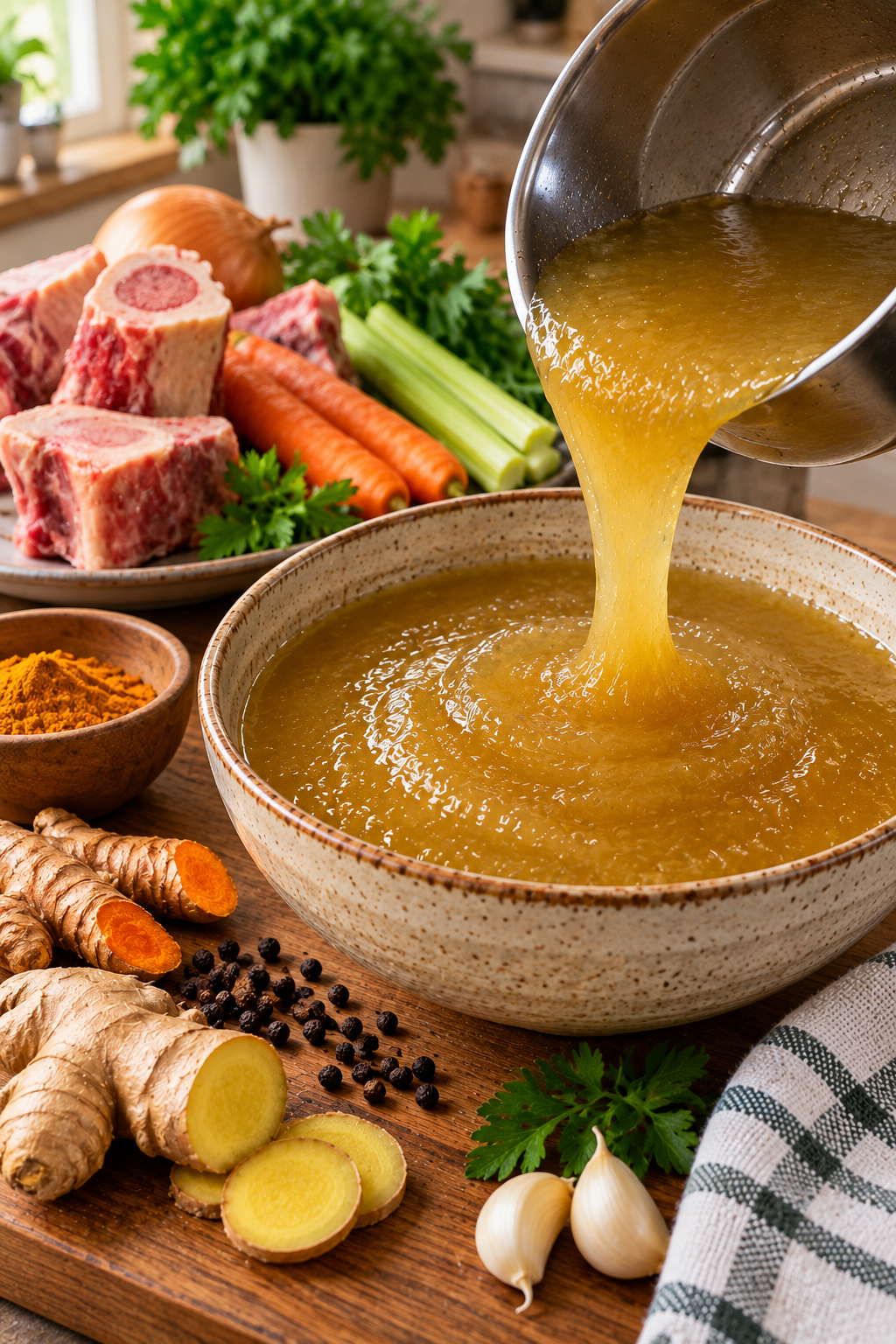
a pot of slow-simmered bone broth or gelatin-rich broth.
The idea sounds convincing because cartilage contains collagen and other structural proteins, while broth made from connective tissue can contain gelatin, amino acids, and collagen-derived compounds.
But there is a major distinction that viral posts rarely make:
Drinking bone broth does not pour new cartilage directly into an arthritic knee.
Osteoarthritis is not simply a case of the body “running out of collagen.”
It is a whole-joint disease involving cartilage, bone, the joint lining, ligaments, tendons, and sometimes the meniscus. NIAMS explains that these tissues gradually change and break down over time, contributing to pain, stiffness, swelling, reduced motion, and difficulty with activities such as climbing stairs. (NIAMS)
That said, collagen nutrition is not completely imaginary.
Research on standardized collagen supplements suggests modest improvements in knee osteoarthritis pain and function in some people.
That makes the science interesting.
It just does not justify calling homemade broth a cartilage-regrowing treatment.
🍲 What Is the “Cheap Kitchen Pot”?
The simplest version is a gelatin-rich broth made with:
Chicken bones or carcass.
Beef bones with connective tissue.
Water.
Onion.
Carrot.
Celery.
Garlic.
Herbs.
A modest amount of salt—or no added salt if sodium needs to be limited.
Simmering connective tissue for several hours can release gelatin into the liquid.
When properly chilled, a collagen-rich broth may become slightly jelly-like.
That texture comes largely from gelatin.
And gelatin is derived from collagen.
🧬 Why Collagen Gets Connected to Knee Cartilage
Cartilage contains a complex extracellular matrix.
Collagen is one major structural component.
So it seems logical to say:
“Eat collagen and your knee will rebuild cartilage.”
But digestion does not work like installing replacement parts.
Collagen and gelatin are broken down into amino acids and smaller peptides during digestion.
Those compounds enter the body’s general nutrient pool.
The body can then use amino acids for many tissues and processes.
It does not send a spoonful of broth directly to the damaged spot in your knee.
That is why “bone broth rebuilds cartilage” goes far beyond the evidence.
🔬 The Collagen Research Is More Interesting Than the Broth Hype
Clinical studies have examined standardized collagen hydrolysates and collagen peptides rather than an ordinary kitchen stockpot.
A 2024 meta-analysis of 35 randomized trials involving 3,165 people with osteoarthritis concluded that collagen derivatives produced small-to-moderate improvements in pain and function compared with control treatments. (PubMed)
A separate systematic review focused specifically on knee osteoarthritis included 11 randomized trials and 870 participants. It also found improvements in pain and function with collagen-based supplementation, although there was substantial variability between studies. (PubMed)
That is meaningful evidence.
But it needs to be interpreted correctly.
The studies generally used:
Measured doses.
Standardized collagen products.
Weeks or months of treatment.
Defined osteoarthritis populations.
They did not show that one bowl of homemade bone broth regenerates worn knee cartilage.
⏳ Collagen Research Works in Months, Not Minutes
One randomized trial gave 250 people with knee osteoarthritis 10 grams of collagen hydrolysate daily for six months.
The researchers reported improvements in measures of knee discomfort. (PubMed)
Another newer randomized trial also used 10 grams of hydrolyzed collagen daily for six months and reported improvements in pain and function compared with placebo. (PubMed)
Notice the timeline:
Six months.
Not:
One dinner.
One weekend.
Or one “miracle broth” before bed.
🦵 Can Collagen Actually Regrow Knee Cartilage?
This is where the evidence becomes much weaker.
A small pilot randomized trial involving 30 participants looked at MRI-based cartilage measurements after collagen hydrolysate.
Researchers found changes in certain MRI cartilage parameters after 24 weeks. (PubMed)
Interesting?
Yes.
Proof that collagen supplements rebuild worn-out knees?
No.
The study was small and exploratory.
Clinical improvements in pain do not automatically mean new cartilage has been created.
And even if standardized collagen products eventually prove to influence cartilage biology, ordinary homemade broth still cannot be assumed to produce the same effect.
📊 Bone Broth vs. Collagen Supplements vs. Proven Knee Care
| Approach | What we can reasonably say |
| Homemade bone broth | Nutritious food; may provide gelatin/protein |
| Gelatin | Provides collagen-derived amino acids |
| Standardized collagen peptides | May modestly improve OA pain/function |
| One bowl of broth | Does not rebuild cartilage overnight |
| Glucosamine/chondroitin | Evidence remains inconsistent |
| Strengthening exercise | Strongly supported for knee OA |
| Weight management when needed | Can reduce knee symptoms |
| Topical/oral pain treatments | Established symptom-management options |
| Knee replacement | Effective option for severe end-stage disease when appropriate |
🥣 A Simple Homemade Gelatin-Rich Broth
For a basic pot, use:
2–3 pounds chicken bones, wings, feet, or a carcass
8–10 cups water
1 onion
2 carrots
2 celery stalks
2 garlic cloves
Bay leaf or herbs
Pepper
Optional:
A small amount of salt.
Place everything in a large pot.
Bring it to a gentle boil.
Reduce to a simmer.
Cook slowly for several hours.
Strain.
Cool safely.
Refrigerate.
If the broth gels when cold, that generally indicates a substantial amount of gelatin.
You can use it as:
Soup base.
Cooking liquid.
A warm savory drink.
Or part of a normal meal.
But don’t treat it as medication.
⚠️ More Salt Can Defeat the Point
Many commercial broths contain a lot of sodium.
That matters especially for adults with:
High blood pressure.
Heart disease.
Kidney disease.
Or fluid retention.
If you’re making broth for general health, there is little reason to turn it into a salt bomb.
Flavor it with:
Garlic.
Onion.
Pepper.
Parsley.
Thyme.
Rosemary.
Bay leaf.
Lemon.
Or other herbs and spices.
The joint benefit of a healthy meal pattern should not be undermined by excessive sodium.
🍗 Protein Matters More Than the “Magic Bone”
One reason broth gets overhyped is that people focus on collagen while ignoring total protein intake.
Muscle supports the knee.
Weak quadriceps can make everyday movement more difficult and increase stress around the joint.
NIAMS emphasizes strengthening exercise because improving the muscles supporting an arthritic joint can reduce pain and improve function. (NIAMS)
So if someone consumes a tiny cup of broth but eats very little protein overall and avoids exercise, they may be missing the bigger picture.
Good protein options can include:
Eggs.
Fish.
Chicken.
Greek yogurt.
Beans.
Lentils.
Tofu.
Lean meat.
And other foods appropriate for individual health needs.
🏋️ The “Building Block” Knees Often Need Most Is Muscle Strength
This is one of the most important points.
Many people assume stairs hurt because:
“My cartilage is gone.”
But stair climbing requires substantial work from the quadriceps and hip muscles.
When those muscles become weaker, every stair can feel harder.
NIAMS recommends exercises that improve strength, flexibility, endurance, and range of motion as core osteoarthritis treatment. (NIAMS)
That means a bowl of broth cannot replace:
Leg strengthening.
Appropriate walking.
Cycling.
Swimming.
Water exercise.
Or physical therapy.
Food provides nutrients.
Movement provides the stimulus that helps muscles remain strong.
🚶 Motion Is Usually Better Than Complete Rest
Pain often makes people afraid to move.
That can create a cycle:
Knee hurts.
You move less.
Muscles weaken.
The joint feels less stable.
Activity becomes even harder.
Pain increases.
NIAMS explains that reduced activity can contribute to muscle weakness, which can place additional stress on the joint. (NIAMS)
That doesn’t mean exercising through severe pain.
It means appropriate, progressive movement is generally part of treatment rather than something to avoid completely.
🪜 Why Stairs Hurt So Much
Going upstairs and especially downstairs increases the forces handled by the knee.
If the joint is already irritated, those movements can expose weaknesses quickly.
Common complaints include:
Pain behind or around the kneecap.
Pain along the inner knee.
Grinding.
Stiffness.
A feeling that the knee may give way.
Difficulty rising from chairs.
NIAMS notes that osteoarthritis symptoms can make stepping up, standing from a chair, and other everyday movements increasingly difficult. (NIAMS)
⚖️ Weight Loss Can Produce Real Knee Benefits
For someone who is overweight or has obesity, modest weight loss can improve knee symptoms.
The American College of Rheumatology/Arthritis Foundation guideline strongly recommends weight loss for people with knee or hip osteoarthritis who are overweight or obese.
The guideline notes that losing 5% or more of body weight can produce meaningful symptom and functional improvement, with larger losses generally associated with greater benefits. (PMC)
That does not mean everyone with knee pain needs to lose weight.
It means that when excess body weight is part of the picture, it is one of the better-supported interventions.
🧃 What About Glucosamine and Chondroitin?
These are often marketed as “cartilage builders.”
But the evidence remains inconsistent.
NCCIH states that despite extensive research, it is still uncertain whether glucosamine and chondroitin provide meaningful benefits for osteoarthritis symptoms or joint structure. (NCCIH)
So don’t assume:
Collagen supplement = proven cartilage regrowth.
Glucosamine = proven cartilage regrowth.
Bone broth = proven cartilage regrowth.
The evidence is much more modest.
💊 Collagen Supplements Are Not the Same as Bone Broth
This distinction is crucial.
A clinical study may use:
10 grams of hydrolyzed collagen.
A standardized type-II collagen preparation.
A specific molecular weight.
A defined daily dose.
A controlled formulation.
Homemade broth varies dramatically depending on:
Which bones are used.
How much connective tissue is present.
How much water is added.
Cooking duration.
Temperature.
Straining.
Serving size.
So you cannot look at a 10-gram collagen-peptide trial and say:
“One bowl of Grandma’s chicken broth gives the same treatment.”
We simply do not know that.
🧪 Does the Body Need Vitamin C to Make Collagen?
Vitamin C is required for normal collagen synthesis.
That is one reason a balanced diet matters.
Foods rich in vitamin C include:
Bell peppers.
Citrus fruit.
Strawberries.
Kiwi.
Broccoli.
And tomatoes.
But once again, more is not automatically better.
Eating huge doses of vitamin C does not force worn knee cartilage to regenerate.
The body needs adequate nutrients.
Not megadoses.
🥕 Turn the Pot Into a Real Meal
Instead of treating bone broth like a medicinal shot, turn it into a nourishing soup.
Add:
Chicken or beans for protein.
Carrots.
Celery.
Onions.
Leafy vegetables.
Barley or another whole grain if appropriate.
Herbs.
This gives you something much more useful:
A balanced meal.
That supports muscle, energy, and overall health better than drinking collagen water by itself.
🌿 What About Turmeric?
Turmeric is commonly added to joint broths.
Some research has examined concentrated curcumin preparations for osteoarthritis symptoms, but kitchen turmeric is not equivalent to a standardized supplement.
Adding turmeric to food is fine if you enjoy it.
Just don’t describe turmeric broth as:
“Rebuilding cartilage.”
“Replacing joint fluid.”
Or:
“Curing arthritis.”
Food can support overall health without needing miracle language.
🫚 Ginger Can Be Useful for Flavor Too
A few slices of fresh ginger can make broth taste excellent.
And using herbs and spices may help reduce the need for excess sodium.
But ginger should not be presented as a cartilage-regenerating drug.
The same rule applies to:
Garlic.
Rosemary.
Black pepper.
Bay leaf.
Onion.
They can make a healthy meal more enjoyable.
That is already valuable.
♨️ Warmth Itself Can Feel Good on Stiff Joints
Sometimes people drink a warm broth and say:
“My knees feel looser afterward.”
Part of the experience may simply be comfort and warmth.
NIAMS notes that heat therapy can increase blood flow, improve flexibility, and help reduce osteoarthritis pain for some people. (NIAMS)
A warm meal can feel soothing.
But temporary comfort should not be mistaken for new cartilage formation.
🧊 Cold Can Help Too
If the knee becomes swollen or irritated after activity, cold therapy may help reduce pain.
NIAMS notes that cold can numb nerves around the joint and may help relieve inflammation and discomfort. (NIAMS)
So the practical approach may be:
Warmth for stiffness.
Cold for a hot, swollen flare.
Appropriate activity.
Strengthening.
And medical treatment when needed.
💊 Proven Treatments Shouldn’t Be Delayed
Some people become so focused on supplements and broth that they avoid treatments with stronger evidence.
Depending on the person, knee osteoarthritis management may include:
Exercise.
Weight management.
Physical therapy.
Bracing.
Topical treatments.
Oral pain medicines.
Anti-inflammatory medicines.
Joint injections.
And surgery when disease becomes severe.
NIAMS lists these among established approaches to osteoarthritis care. (NIAMS)
There is nothing wrong with having broth alongside that plan.
The problem begins when broth replaces the plan.
🦿 Knee Replacement Is Not “Giving Up”
For severe osteoarthritis, some people eventually reach a point where:
Pain occurs every day.
Walking becomes severely limited.
Sleep is disrupted.
Stairs are nearly impossible.
Other treatments no longer provide enough relief.
NIAMS explains that partial or total joint replacement may be considered when extensive joint damage causes major disability and other treatments have not helped sufficiently. (NIAMS)
At that stage, another supplement is not necessarily the answer.
🚨 Not Every Painful Knee Is Osteoarthritis
A painful knee after 50 can also result from:
Meniscus injury.
Tendon injury.
Ligament problems.
Bursitis.
Gout.
Inflammatory arthritis.
Infection.
Fracture.
Or other conditions.
NIAMS notes that blood tests, imaging, and sometimes joint-fluid testing are used when doctors need to distinguish osteoarthritis from problems such as infection or gout. (NIAMS)
That’s why sudden severe knee pain deserves more than a soup recipe.
⚠️ A Hot, Red, Swollen Knee Needs Attention
Suppose your knee was mildly stiff yesterday.
Then today it becomes:
Extremely painful.
Hot.
Red.
Very swollen.
And difficult to move.
Especially if you also have a fever.
That is not typical “worn cartilage until the broth works.”
A hot swollen joint can sometimes signal:
Infection.
Gout.
Or another acute inflammatory problem.
Seek medical evaluation promptly.
🦵 What If the Knee Suddenly Locks?
If the knee repeatedly:
Locks.
Catches.
Gives way.
Or becomes mechanically stuck,
tell a healthcare professional.
NIAMS notes that MRI may sometimes be useful when a joint is locking or giving out because it can show soft-tissue problems around the knee. (NIAMS)
Mechanical symptoms aren’t something collagen powder can diagnose.
📅 A Better 6-Week Knee Plan
Instead of judging your knees after one bowl of broth, give yourself a realistic timeframe.
Week 1
Track:
Pain on stairs.
Morning stiffness.
Walking tolerance.
Chair-rise difficulty.
Swelling.
Weeks 1–2
Begin gentle movement appropriate for your ability.
Consider:
Short walks.
Stationary cycling.
Water exercise.
Range-of-motion exercises.
Weeks 2–6
Add progressive strengthening when medically appropriate.
Focus particularly on:
Quadriceps.
Hamstrings.
Glutes.
Calves.
Food
Use broth or collagen-containing foods if you enjoy them.
But also prioritize adequate overall protein and a balanced diet.
If overweight
Discuss gradual weight loss.
Reassess
Ask:
Can I climb stairs more comfortably?
Do I rise from chairs more easily?
Can I walk farther?
Is morning stiffness shorter?
Those are meaningful outcomes.
📊 The Bigger Picture
| Strategy | Main goal |
| Bone broth | Nutritious food, hydration, protein/gelatin |
| Collagen peptides | Possible modest symptom support |
| Strength training | Improve joint support |
| Walking/cycling/swimming | Maintain function and endurance |
| Weight management | Reduce knee loading when appropriate |
| Heat/cold | Short-term symptom relief |
| Bracing/physical therapy | Improve stability/function |
| Medication | Pain/inflammation management |
| Surgery | Severe structural disease when other options fail |
🚫 10 Knee Mistakes After 50
1. Assuming every painful knee means the cartilage is completely gone.
Osteoarthritis affects the whole joint, not cartilage alone. (NIAMS)
2. Believing bone broth sends collagen directly into the knee.
3. Expecting cartilage to regrow after a few bowls.
4. Staying completely inactive because movement hurts.
Appropriate exercise can reduce pain and stiffness and improve strength and function. (NIAMS)
5. Ignoring weak thigh muscles.
6. Buying expensive “cartilage rebuilding” supplements without checking the evidence.
NCCIH says evidence for many osteoarthritis supplements remains limited or inconsistent. (NCCIH)
7. Using salty commercial broth every day despite high blood pressure.
8. Treating a red, hot, swollen knee as ordinary arthritis.
9. Ignoring repeated locking or giving way.
10. Waiting until walking is nearly impossible before getting the knee evaluated.
❓ Frequently Asked Questions
What is the cheap kitchen pot for stiff knees?
Usually people mean bone broth or gelatin-rich chicken or beef broth.
Does bone broth rebuild knee cartilage?
There is no good clinical evidence that ordinary homemade bone broth regenerates damaged knee cartilage.
Why do people say broth contains the “building blocks” of cartilage?
Gelatin and collagen provide amino acids such as glycine and proline that the body can use in protein synthesis. But those nutrients are distributed throughout the body rather than being delivered directly to the knee.
Do collagen supplements help knee osteoarthritis?
Possibly. Meta-analyses of randomized trials suggest small-to-moderate improvements in pain and function with certain collagen derivatives. (PubMed)
Do collagen supplements regrow cartilage?
That has not been established. Small studies have investigated cartilage-related MRI changes, but this is not proof that oral collagen rebuilds a worn knee. (PubMed)
How long did collagen studies last?
Many studies lasted weeks to months. Several randomized trials used around six months of supplementation—not a single serving. (PubMed)
Is bone broth the same as collagen peptides?
No. Standardized collagen products used in clinical trials have measured doses and compositions. Homemade broth varies considerably.
What helps knee osteoarthritis the most?
Exercise and strengthening are core treatments. Weight management can also meaningfully improve symptoms when someone is overweight or obese. (NIAMS)
Should I stop exercising if stairs hurt?
Not necessarily. The activity may need modification, and a physical therapist can help identify a safer progression. Complete inactivity can contribute to muscle weakness. (NIAMS)
When should knee pain be evaluated?
Get medical advice if pain is persistent, progressively worsening, significantly limiting walking or sleep, or accompanied by repeated locking, instability, substantial swelling, or other concerning symptoms.
⭐ The Bottom Line
A cheap pot of gelatin-rich chicken or beef broth can be a perfectly reasonable addition to a healthy diet.
It supplies:
Protein.
Gelatin.
Amino acids.
Fluid.
And, when vegetables are added, a range of nutrients.
There is also legitimate evidence that standardized collagen derivatives may modestly reduce knee osteoarthritis pain and improve function in some people. A 2024 meta-analysis of 35 randomized trials involving more than 3,000 patients found small-to-moderate improvements in pain and function. (PubMed)
But don’t turn that finding into something it does not say.
Bone broth has not been shown to:
Regrow worn knee cartilage.
Replace joint tissue.
Reverse osteoarthritis.
Restore a “bone-on-bone” knee.
Or make painful stairs normal overnight.
Osteoarthritis affects multiple structures within the joint, and NIAMS emphasizes exercise, strengthening, weight management when appropriate, symptom treatment, and medical care as the foundation of management. (NIAMS)
So keep the broth if you enjoy it.
But give your knees something even more important:
stronger supporting muscles, regular appropriate movement, healthy body weight when relevant, and a treatment plan matched to the actual condition of the joint.
The pot can provide nutrients.
It cannot rebuild the staircase inside your knee.