
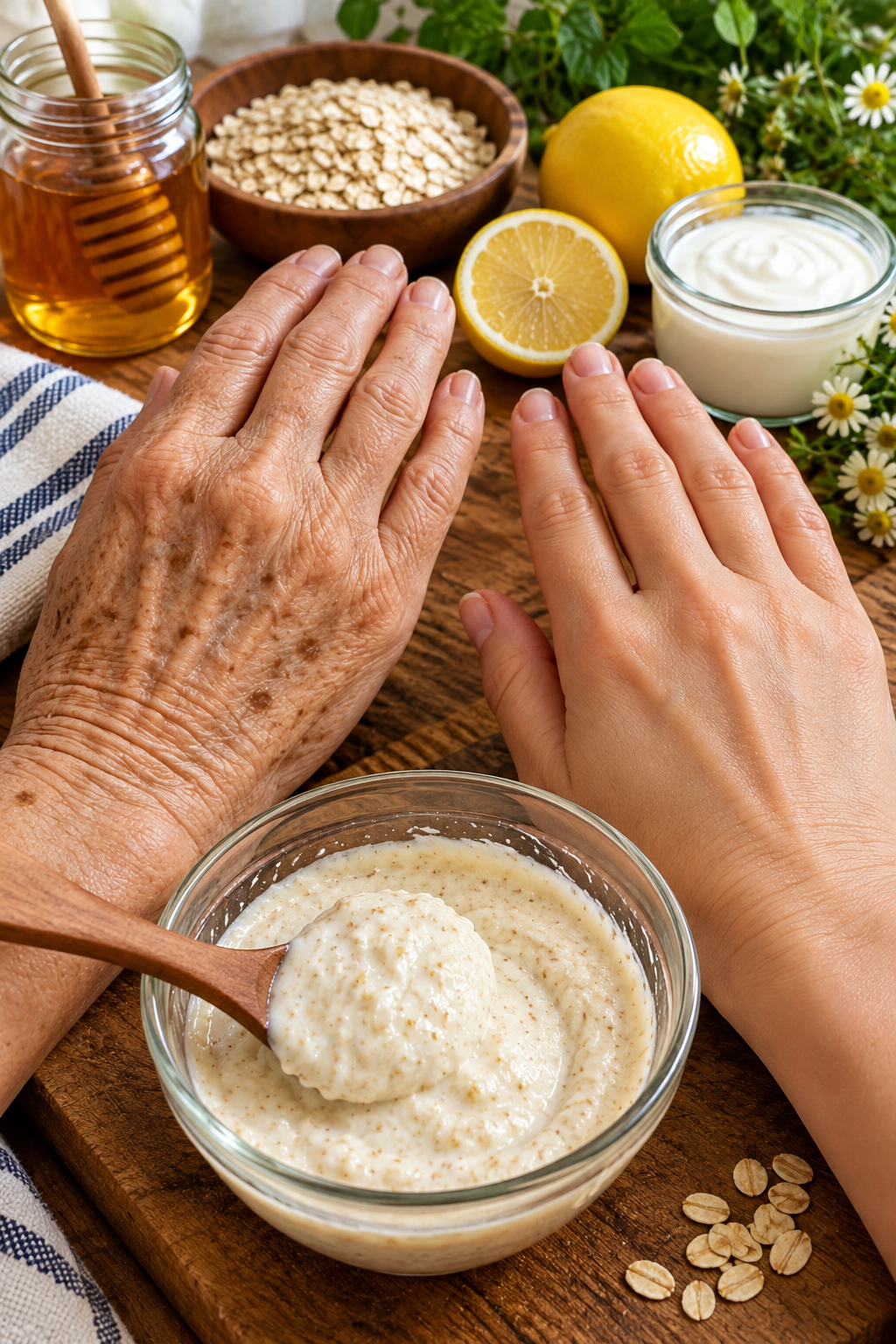
Hands often reveal age faster than the face.
After 60, the skin on the backs of the hands may look:
Thinner.
Drier.
More crepey.
Rougher.
More lined.
And less plump.
That can make the hands look years older even when the rest of the skin is well cared for.
A simple creamy treatment can sometimes make a noticeable difference in the surface appearance:
a thick, fragrance-free moisturizer or ointment applied to slightly damp hands—especially one containing ingredients such as glycerin, petrolatum, mineral oil, ceramides, or hyaluronic acid.
Dermatologists explain that skin in the 60s and 70s tends to become thinner and lose water more easily, which contributes to dryness and a rougher appearance. Applying a creamy moisturizer can help restore the skin barrier and improve how the skin feels and looks.
But there is an important limitation.
A moisturizing paste can temporarily soften, smooth, and plump dry surface lines. It cannot permanently rebuild lost collagen, replace lost hand volume, erase deep wrinkles, or reverse decades of sun damage overnight.
So the goal is not “age reversal.”
The goal is better hydration, better barrier function, and a smoother surface look.
🧴 The Simple Creamy Hand Treatment
You do not need a complicated recipe.
A practical version is:
1 teaspoon of a thick fragrance-free cream
plus
a very thin layer of plain petroleum jelly on top if your hands are extremely dry.
Apply it to hands that are still slightly damp after washing.
Massage it over:
The backs of the hands.
Knuckles.
Cuticles.
Fingers.
And dry areas between the fingers.
For nighttime use, apply a slightly thicker layer before bed.
If you like, wear clean soft cotton gloves for a short period afterward to reduce rubbing onto bedding.
This is not a wrinkle-removal treatment.
It is an occlusive moisturizing routine designed to hold water in the outer layer of skin.
💧 Why Wrinkled Hands Can Look Better After Moisturizing
Dry skin exaggerates texture.
Tiny surface lines become more visible.
The skin looks duller.
Creases stand out.
And rough patches reflect light unevenly.
Moisturizers work partly by reducing water loss and supporting the outer skin barrier. A review of moisturizers notes that ingredients such as glycerin, petrolatum, and dimethicone can improve skin hydration and make fine lines appear smoother and softer.
That explains why hands can look noticeably better after a rich cream even though the deeper aging process has not changed.
Think of a dry sponge.
When it loses water, it looks shriveled.
After it absorbs moisture, the surface looks fuller.
Skin is far more complex than a sponge, but the visual principle helps explain the temporary plumping effect.
🧬 What Actually Happens to Hands With Age?
Several changes occur at the same time.
The skin becomes thinner.
It holds less water.
Collagen and elastin decrease.
Fat and soft tissue beneath the skin can diminish.
Veins and tendons become more visible.
And years of ultraviolet exposure contribute to wrinkles and age spots.
The American Academy of Dermatology notes that aging hands may develop crepey skin, roughness, loose skin, visible veins, and age spots. Moisturizer can help roughness and temporarily plump dry skin, while deeper concerns may require treatments such as retinoids, chemical peels, lasers, fillers, or other dermatologic procedures.
That is why one cream may improve the surface dramatically without making the hands biologically younger.
🧴 Why Thick Creams Usually Beat Thin Lotions
Lotions contain more water and often feel light.
Creams are thicker and contain more oil.
Ointments are thicker still and are usually the most effective at reducing water loss.
AAD explains that creams and ointments are generally better choices when skin becomes drier with age, and ointments are especially effective when dryness is severe.
For hands over 60, that means:
A thin scented lotion may feel pleasant.
But a fragrance-free cream or ointment usually does more for rough, wrinkled-looking dryness.
🧪 Ingredients Worth Looking For
You do not need every trendy ingredient.
A good hand moisturizer may contain one or more of these:
Glycerin — draws water into the outer skin.
Hyaluronic acid — helps bind water.
Ceramides — support the skin barrier.
Petrolatum — reduces water loss.
Mineral oil — provides an occlusive protective layer.
AAD recommends these types of ingredients for dry hands and aging skin.
What matters most is consistent use.
A modest cream used after every hand wash often does more than an expensive jar used twice a month.
🚿 The Timing Trick Makes a Difference
One of the easiest improvements is when you moisturize.
Do not wait until the hands are completely dry.
After washing:
Pat them gently.
Leave a little moisture on the skin.
Then apply cream immediately.
AAD specifically recommends applying hand cream or ointment while skin is still slightly damp because this helps trap water in the skin.
This takes less than a minute.
And over time, it can make the skin look much less rough.
🌙 Why Nighttime Is Useful
At night, your hands are not being washed repeatedly.
They are not exposed to cleaning products.
And moisturizer has more time to remain in contact with the skin.
A simple nighttime routine can be:
Wash gently with lukewarm water.
Pat dry.
Apply thick fragrance-free cream.
Seal extremely dry areas with a tiny amount of petroleum jelly.
Leave it overnight.
Repeat regularly.
There is no need to add lemon, baking soda, vinegar, or another harsh kitchen ingredient.
🍯 What About DIY Kitchen Pastes?
Many social-media recipes use ingredients such as:
Honey.
Yogurt.
Oatmeal.
Olive oil.
Coconut oil.
Milk.
Rice flour.
Or mashed fruit.
Some may temporarily make the skin feel softer.
But the most predictable benefit usually comes from basic moisturizing and reducing water loss—not from a magical anti-aging reaction.
A homemade mixture also lacks the stability, preservation, and standardized formulation of a properly made moisturizer.
That doesn’t mean every kitchen ingredient is dangerous.
It means a professionally formulated fragrance-free moisturizer is usually a more reliable default for mature, dry hands.
🚫 Skip Lemon Juice on Wrinkled Hands
Lemon is often promoted as a natural “age spot eraser.”
But acidic juice can irritate dry or cracked skin.
Irritation can make hands:
Redder.
More sensitive.
More inflamed.
And rougher.
If your goal is smoother-looking mature skin, deliberately irritating the skin works against that goal.
🧂 Baking Soda Is Not a Hand Rejuvenator
Baking soda is another viral ingredient.
It may leave skin temporarily feeling unusual because it changes the surface environment, but it can also disrupt the skin barrier and worsen irritation.
Dry mature skin already has a weaker barrier.
It does not need aggressive scrubbing or alkaline treatments.
Use gentle cleansing and moisturizer instead.
☀️ The Biggest Long-Term Anti-Aging Step Is Sunscreen
Moisturizer improves dryness.
Sunscreen helps prevent additional photoaging.
AAD recommends a broad-spectrum, water-resistant SPF 30 or higher on exposed hands every day.
This is especially important when driving because hands may receive years of cumulative sun exposure.
If you moisturize every night but leave your hands unprotected from UV exposure every day, you are only addressing half the problem.
🚗 Driving Can Age the Hands Too
The backs of the hands are often exposed while driving.
AAD notes that sun protection is essential for maintaining the appearance of aging hands and even suggests sun-protective gloves for driving in some cases.
That does not mean you need to become obsessive.
A practical routine is enough:
SPF 30+ on the backs of the hands in the morning.
Reapply when needed.
Use gloves for prolonged sun exposure.
🧼 Handwashing Can Make Wrinkles Look Deeper
Frequent washing is necessary for hygiene.
But repeated exposure to water and cleansers can strip oils and worsen dryness.
AAD recommends continuing proper handwashing while applying moisturizer afterward to repair dryness.
So the answer is not:
“Wash less no matter what.”
It is:
Wash properly, use gentle products, then moisturize.
🌡️ Hot Water Makes Dry Hands Worse
Very hot water may feel comforting.
But it strips natural oils and can increase dryness.
AAD recommends warm rather than hot water for mature dry skin.
If your hands look especially wrinkled immediately after washing, try reducing the temperature for a week.
You may notice less tightness and roughness.
🧤 Cleaning Products Matter
Dish soap.
Bleach.
Degreasers.
Household cleaners.
And prolonged wet work can all aggravate hand dryness.
AAD recommends wearing gloves while cleaning and gardening to help protect aging hands.
This is simple but powerful.
A hand cream cannot fully compensate for repeated daily irritation.
🧴 Fragrance-Free Is Often Better
“Unscented” and “fragrance-free” do not always mean the same thing.
AAD explains that unscented products may still contain fragrance-masking ingredients, while fragrance-free products avoid added fragrance that may irritate sensitive dry skin.
If your hands:
Burn.
Itch.
Crack.
Or turn red after cream,
try switching to a fragrance-free formula.
📊 Surface Improvement vs. True Structural Change
| Claim | What is realistic |
| Thick moisturizer softens rough hands | Yes |
| Petrolatum reduces water loss | Yes |
| Moisturizing can temporarily plump fine lines | Yes |
| One paste rebuilds lost collagen | No |
| Moisturizer restores lost hand volume | No |
| A kitchen cream permanently erases wrinkles | No |
| Sunscreen helps prevent further photoaging | Yes |
| Retinol may improve wrinkly hand skin over time | Possible |
| Fillers can restore lost volume | Dermatologic option |
| Laser/peels can target texture or spots | Dermatologic option |
🧪 What About Retinol?
For someone who wants more than moisturization, retinol may be worth discussing.
AAD notes that dermatologists may recommend a lotion containing retinol or glycolic acid for wrinkly, crepey hand skin.
These treatments work differently from moisturizer.
Moisturizer changes hydration quickly.
Retinoids and exfoliating acids are used over longer periods to influence skin turnover and texture.
But mature skin can be sensitive.
Starting too aggressively can cause:
Redness.
Peeling.
Burning.
Dryness.
So introduce active ingredients slowly and moisturize well.
☀️ Retinol Makes Sun Protection Even More Important
If you use retinol or exfoliating acids, sunscreen becomes even more important.
The goal is not to improve texture at night while allowing more UV damage during the day.
A simple approach is:
Night: moisturizer, with retinol if tolerated.
Day: moisturizer plus SPF 30+.
Consistency beats complexity.
✋ Why Veins Suddenly Look More Obvious
Visible hand veins are not simply caused by dry skin.
As skin and underlying soft tissue become thinner, veins and tendons can become easier to see.
Cream cannot refill that missing volume.
AAD notes that fillers or fat transfer may be used to restore youthful fullness in appropriate candidates, while larger veins can sometimes be treated directly.
So if your main concern is:
“My hands look skeletal,”
a moisturizer can improve the skin surface but will not fully solve loss of volume.
🟤 What About Age Spots?
Brown spots on the backs of the hands often reflect years of sun exposure.
Moisturizer may make the skin look healthier overall, but it does not reliably erase pigmentation.
Dermatologic options can include:
Topical treatments.
Chemical peels.
Laser treatment.
And other procedures depending on the type of pigmentation.
But don’t buy random “whitening” creams online.
⚠️ Be Careful With Skin-Lightening Products
FDA recently reiterated warnings about over-the-counter skin-lightening products containing mercury or hydroquinone. The agency says there are no FDA-approved or legally marketed OTC skin-lightening products containing these ingredients and warns that some imported or illegally sold products may cause serious skin, kidney, or neurological harm.
So if the issue is age spots rather than wrinkles, avoid mystery creams promising overnight bleaching.
Ask a dermatologist about safer options.
🩹 When Dry Hands May Actually Be Eczema
Not every rough, cracked hand is simply “old skin.”
Hand eczema can cause:
Redness.
Itching.
Burning.
Cracking.
Scaling.
Pain.
And recurrent irritation.
AAD recommends fragrance-free creams or ointments and avoiding irritants, but persistent symptoms may need medical treatment.
If your hands continue cracking despite good moisturizing, do not just keep adding thicker paste.
You may need a diagnosis.
🩸 When to Get a Skin Change Checked
After 50, skin-cancer risk rises.
AAD recommends examining aging skin for suspicious growths and changes.
A moisturizer should not be used to cover up a spot that is:
Growing.
Bleeding.
Crusting repeatedly.
Changing color.
Irregular.
Or refusing to heal.
Those changes deserve professional evaluation.
🌙 A Simple 7-Day Hand-Smoothing Routine
For one week, keep the routine very simple.
Morning
Apply a fragrance-free hand cream.
Apply SPF 30+ to exposed hands.
After Every Hand Wash
Pat hands partly dry.
Apply cream while slightly damp.
Cleaning or Gardening
Wear protective gloves.
Evening
Wash with lukewarm water.
Apply thick cream.
Add a thin layer of petroleum jelly to very dry areas.
Before Bed
Reapply if needed.
After seven days, evaluate:
Dryness.
Roughness.
Tightness.
Flaking.
And how visible the fine surface lines appear.
Do not judge the treatment by whether your deepest wrinkles disappear.
Judge it by whether the skin looks and feels healthier.
🚫 10 Mistakes That Make Aging Hands Look Older
1. Using hot water repeatedly.
It can worsen dryness.
2. Skipping moisturizer after handwashing.
AAD recommends applying it while skin is still damp.
3. Using thin scented lotion on severely dry hands.
4. Scrubbing with baking soda or coarse sugar.
5. Applying lemon juice to cracked or sensitive skin.
6. Forgetting sunscreen on the backs of the hands.
Sun protection helps prevent additional wrinkling and photoaging.
7. Cleaning without gloves.
8. Expecting cream to replace lost fat or collagen.
9. Buying unregulated skin-lightening products.
Some have contained harmful mercury or hydroquinone.
10. Ignoring persistent cracking, bleeding, or changing skin lesions.
❓ Frequently Asked Questions
What creamy paste makes wrinkled hands look smoother?
A thick fragrance-free moisturizer or ointment is the safest, most evidence-supported option. Ingredients such as glycerin, petrolatum, ceramides, mineral oil, and hyaluronic acid can help reduce dryness and improve surface smoothness.
Can petroleum jelly remove wrinkles?
No. It reduces water loss and can make dry fine lines appear less obvious, but it does not permanently erase wrinkles or rebuild collagen.
Why do my hands look more wrinkled after 60?
Aging skin becomes thinner, holds less water, loses collagen and elastin, and may lose underlying volume. Years of sun exposure can add wrinkles and age spots.
How often should I moisturize my hands?
AAD recommends applying moisturizer several times daily, especially after handwashing and whenever the skin feels dry.
Is cream better than lotion for older hands?
Often, yes. Creams contain more oil and are generally more hydrating, while ointments are the most occlusive option for very dry skin.
Should I use moisturizer on wet hands?
Slightly damp is ideal. Applying cream after washing while a little water remains on the skin helps trap moisture.
Can coconut oil help?
It may soften some people’s skin, but a fragrance-free moisturizer containing proven humectants and occlusives is generally more predictable. Coconut oil can also irritate certain sensitive skin types.
Can lemon remove hand wrinkles or age spots?
It is not a proven wrinkle treatment and can irritate mature or damaged skin.
What actually helps wrinkled hand skin beyond moisturizer?
AAD notes that retinol or glycolic-acid lotions, light chemical peels, lasers, fillers, and other dermatologic treatments may be considered depending on whether the issue is wrinkles, age spots, loose skin, or lost volume.
When should I see a dermatologist?
Consider evaluation if the skin remains severely dry despite proper moisturizing, becomes painful or cracked, develops persistent eczema-like symptoms, or you notice a new or changing growth.
⭐ The Bottom Line
Wrinkled hands after 60 often look older partly because mature skin becomes drier, thinner, and less able to hold water.
That means a simple creamy routine can create a real cosmetic improvement.
Apply a thick fragrance-free cream to slightly damp hands, especially after washing.
For very dry skin, add a thin layer of petroleum jelly or another ointment to help lock in moisture.
Dermatology research supports moisturizers for restoring the skin barrier, reducing water loss, and making fine surface lines appear smoother and softer.
But the cream does not:
Rebuild all lost collagen.
Restore lost hand fat.
Erase deep wrinkles overnight.
Or permanently reverse skin aging.
For long-term appearance, the highest-value combination is surprisingly simple:
Moisturize consistently.
Use gentle cleansing.
Protect hands from detergents and hot water.
Wear SPF 30+ on exposed hands.
And if deeper wrinkles, lost volume, or age spots are the main concern, dermatologic treatments can go beyond what a homemade paste can realistically achieve.
The surface can look softer within days.
Just don’t confuse smoother-looking skin with turning the clock backward.