
Your socks suddenly leave deep marks around your ankles.
Your shoes feel tighter by evening.
Your feet look puffy.
Or you wake up and notice swelling around your eyes.
For adults over 55 or 60, these changes shouldn’t automatically be dismissed as “just getting older.”
Swelling—medically called edema—can occur when the body retains excess fluid. In chronic kidney disease (CKD), this can happen when damaged kidneys have difficulty removing extra sodium and fluid. NIDDK notes that kidney-related edema may appear in the feet, ankles, legs, hands, or face, particularly in more advanced disease or when substantial protein is leaking into the urine.
That makes swelling worth paying attention to.
But there’s another viral claim that needs correcting:
No fruit can directly “flush” damaged kidneys, pull edema out of the legs, lower creatinine overnight, or repair kidney filters.
What certain fruits can do is help replace highly processed, sodium-heavy foods with naturally low-sodium whole foods.
For some people with CKD who need lower-potassium choices, fruits such as apples, berries, grapes, peaches, and pineapple may also fit more easily into an individualized eating plan.
The important word is:
Individualized.
Because with kidney disease, the “healthiest fruit” for one person isn’t necessarily the right choice for another.
🍎 Fruit #1: Apples
Apples are one of the simplest fruits to keep around.
They provide:
Fiber.
Vitamin C.
Plant compounds.
Natural sweetness.
And very little sodium.
For someone replacing packaged desserts, salty snacks, or heavily processed breakfast foods, an apple can be a practical choice.
NIDDK specifically lists apples among fruits that may be substituted for higher-potassium choices when someone with advanced CKD has been told to limit potassium.
But notice the wording:
When potassium restriction is necessary.
You don’t need to start eating apples because they “clean the kidneys.”
They don’t.
Their advantage is that they can fit into a nutritious, minimally processed diet.
A simple serving
Try one small apple or roughly half a large apple.
Eat the peel if you tolerate it because that’s where some of the fiber is found.
You don’t need to turn it into juice.
Whole fruit usually provides more fiber and is more filling.
🫐 Fruit #2: Berries
Blueberries, strawberries, raspberries, and blackberries can be excellent ways to add fruit without reaching for sweetened packaged foods.
Berries provide:
Fiber.
Vitamin C.
Anthocyanins and other polyphenols.
Natural sweetness.
And relatively little sodium.
NIDDK includes berries among fruit options that may be suitable when people with advanced CKD need to substitute away from certain higher-potassium fruits.
Again, that does not mean:
“Blueberries lower creatinine.”
Or:
“Strawberries regenerate kidneys.”
The more defensible benefit is that berries can be part of a heart-healthy, plant-rich diet.
And that matters because kidney and cardiovascular health are closely connected.
Easy breakfast idea
Try:
½ cup berries
with
plain oatmeal
or another breakfast appropriate for your individual kidney plan.
No detox powder required.
🍇 Fruit #3: Grapes
Grapes are another convenient whole-fruit option.
They provide water, natural carbohydrates, and various plant compounds.
NIDDK lists grapes among alternatives that may be used when advanced CKD requires a lower-potassium eating pattern.
A small bowl can also replace:
Cookies.
Candy.
Pastries.
Or heavily salted snacks.
That’s where the benefit becomes practical.
The grape isn’t “scrubbing” your kidneys.
You’re simply replacing a highly processed food with a minimally processed fruit.
Portion still matters
A reasonable portion might be approximately:
½–1 cup of grapes
depending on your nutritional needs.
Don’t assume:
“Fruit is healthy, so unlimited amounts are better.”
With CKD, portion size can matter—especially when potassium, carbohydrate, or fluid intake needs monitoring.
🍑 Fruit #4: Peaches
A fresh peach is naturally low in sodium and provides fiber and vitamin C.
NIDDK also lists peaches among lower-potassium alternatives that may be appropriate for certain people with advanced CKD.
Fresh peaches are especially simple.
But canned peaches deserve a label check.
Look for varieties packed in:
Water.
Their own juice.
Or without large amounts of added sugar.
If potassium restriction applies, NIDDK notes that draining canned fruits and discarding the liquid can help with potassium management.
The goal isn’t to find a magical peach preparation.
It’s to keep the overall eating pattern simple.
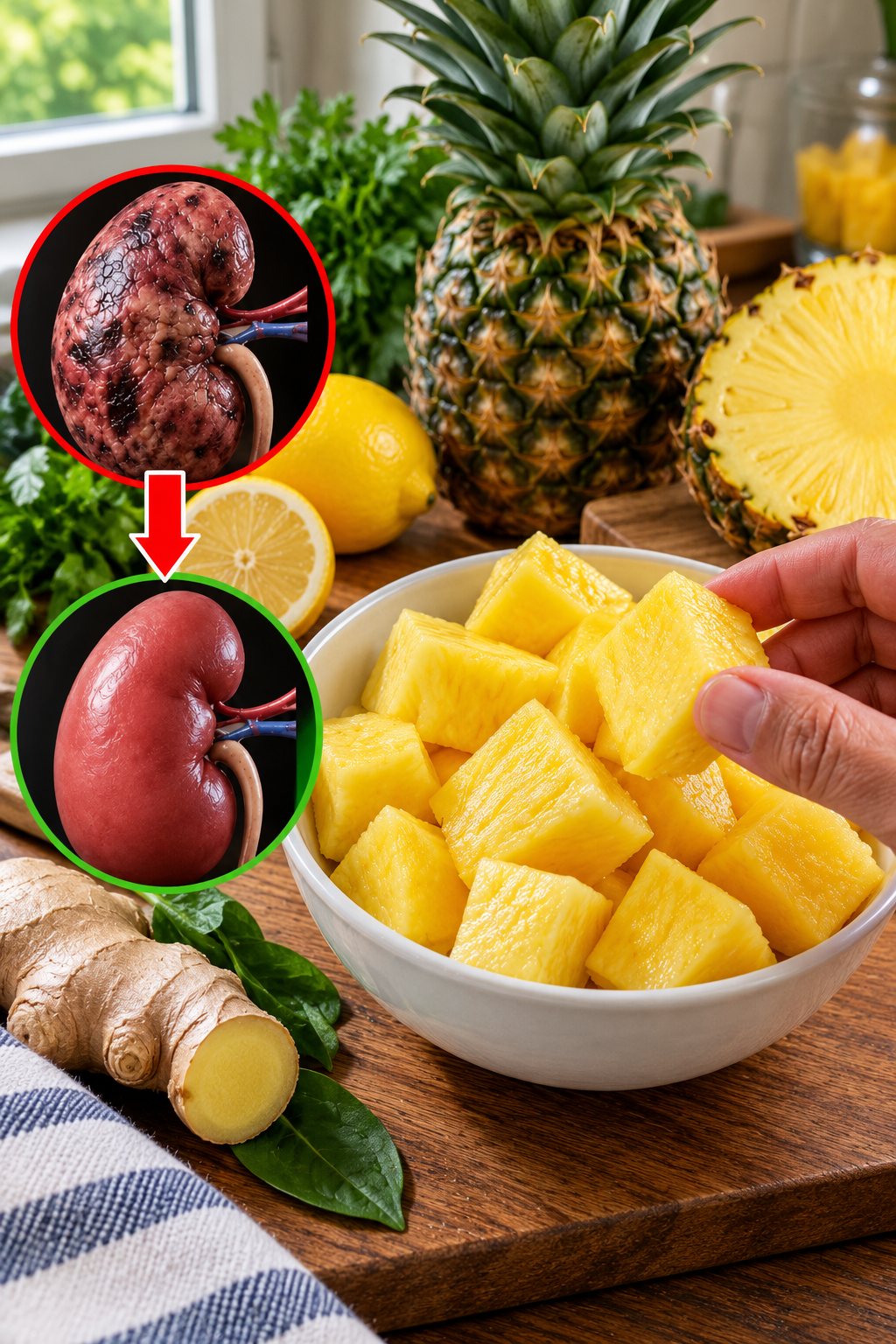
🍍 Fruit #5: Pineapple
Pineapple can provide a sweet flavor without adding sodium-heavy processed foods to the diet.
Fresh or frozen unsweetened pineapple can be used in modest portions.
It works well:
With breakfast.
As a snack.
Or as a dessert replacement.
But pineapple needs the same reality check as every other fruit on this list.
It has not been proven to:
Repair kidney filters.
Remove protein from urine.
Reverse CKD.
Or drain edema from the ankles.
Think of it as food—not medicine.
📊 What These Fruits Can—and Cannot—Do
| Claim | Evidence-based reality |
| Apples flush creatinine | No |
| Berries repair damaged kidneys | No |
| Grapes remove protein from urine | No |
| Peaches cure CKD | No |
| Pineapple drains kidney swelling | No |
| Whole fruits can fit a heart-healthy diet | Yes |
| Some fruits may fit lower-potassium CKD diets | Yes |
| Fruit is naturally low in sodium | Generally yes |
| Everyone with CKD needs low-potassium fruit | No |
| Sodium reduction can help with fluid retention | Yes |
| Kidney diets should be individualized | Yes |
🧂 The Real “Swelling Food” Issue Is Often Sodium
If someone has kidney-related fluid retention, spending all day searching for a special fruit can distract from something far more important:
Sodium.
NIDDK explains that excessive sodium causes the body to retain fluid. This can contribute to:
Swelling.
Higher blood pressure.
And additional stress on the heart and kidneys.
The National Kidney Foundation similarly notes that when kidneys aren’t functioning normally, excess sodium and fluid can accumulate, contributing to swollen ankles, puffiness, high blood pressure, and even shortness of breath.
So consider two different afternoon snacks:
Snack A
Apple slices.
Snack B
Processed meat.
Cheese crackers.
Chips.
And a salty dip.
The apple isn’t pulling fluid out of your legs.
But replacing Snack B with Snack A can dramatically change how much sodium enters the diet.
That’s the meaningful difference.
🧂 Where Sodium Hides
Most people don’t consume all their sodium from a salt shaker.
NIDDK notes that much of Americans’ sodium intake comes from packaged, prepared, and restaurant foods.
Common sources include:
Processed meats.
Fast food.
Canned soups.
Frozen meals.
Chips.
Crackers.
Sauces.
Restaurant foods.
Prepared sandwiches.
Packaged snacks.
Even foods that don’t taste extremely salty can contain substantial sodium.
That’s why a person can stop adding table salt and still eat a high-sodium diet.
🏷️ The Label Trick Worth Learning
Check the Nutrition Facts label.
NIDDK notes that a food containing:
20% Daily Value or more sodium per serving = high sodium
while:
5% Daily Value or less = low sodium.
Then check serving size.
A package may say:
300 mg sodium
but contain three servings.
If you eat the entire package:
That’s 900 mg.
Reading one number without checking the serving size is a common mistake.
🍌 Wait—Why Isn’t Banana on the List?
Bananas are nutritious.
They aren’t “bad for kidneys.”
But bananas are relatively high in potassium.
If kidney function becomes significantly impaired, some people have difficulty removing enough potassium from the blood.
NIDDK explains that CKD can cause potassium to become either too high or too low, both of which can create heart and muscle problems.
For people who genuinely need potassium restriction, NIDDK lists foods such as bananas and oranges among choices that may need limiting, while apples, berries, grapes, and peaches may sometimes be used instead.
But here’s the critical point:
Do not stop eating bananas simply because you are over 60.
⚠️ Not Every Kidney Patient Needs Low Potassium
This is one of the most important kidney-nutrition rules.
CKD is not one uniform condition.
In early stages, someone may have very few dietary restrictions.
As kidney function declines, nutritional needs may change substantially.
NIDDK specifically states that there is no single meal plan for everyone with CKD.
Potassium recommendations depend on:
Kidney function.
Blood potassium.
Medications.
Dialysis status.
And other medical conditions.
The National Kidney Foundation likewise emphasizes that potassium needs depend on kidney function and medication use.
So don’t create a restrictive “kidney diet” from social-media lists.
Use your laboratory results.
🧂 Be Careful With Salt Substitutes
This is an easy mistake.
Someone learns:
“Salt is bad for my swelling.”
So they buy a “low-sodium salt.”
But many salt substitutes contain potassium chloride.
That may be a problem for someone whose kidneys cannot remove potassium efficiently.
NIDDK advises people who need potassium restriction to check labels for potassium chloride and notes that salt substitutes may contain significant potassium.
Use herbs, spices, garlic, lemon, and other appropriate seasonings instead if advised.
💧 Should You Drink More Water to Flush Out the Swelling?
Not automatically.
This is where generic wellness advice can become dangerous.
Healthy people need adequate fluid.
But damaged kidneys may eventually become unable to remove excess water effectively.
NIDDK explains that some people with CKD need to limit liquids because damaged kidneys cannot remove extra fluid adequately.
In kidney failure, excessive water can contribute to:
Swelling.
Higher blood pressure.
And greater workload on the heart.
So if someone has obvious fluid retention, telling them:
“Drink a gallon of water to flush your kidneys”
may be exactly the wrong advice.
🍉 Fruit Contains Fluid Too
This becomes relevant for people who have been prescribed a fluid restriction.
Fluid isn’t only:
Water.
Coffee.
Tea.
Or juice.
Foods can contribute water as well.
NIDDK notes that fruits and vegetables are among foods that contribute to total water intake for people with kidney failure who need to monitor fluids.
That does not mean fruit should automatically be avoided.
It means someone with a medically prescribed fluid limit needs to count intake according to their care plan.
🚫 Fruit Juice Is Not Automatically Better
Suppose someone hears:
“Grapes are kidney-friendly.”
They decide:
“I’ll drink three huge glasses of grape juice.”
That is not equivalent to eating a modest serving of whole grapes.
Juice removes or substantially reduces the intact fiber structure and makes it easy to consume large quantities quickly.
It also provides more concentrated carbohydrate per drinking occasion.
For most people, whole fruit is the more sensible default unless there is a specific reason for juice.
And NIDDK notes that if someone with diabetes and CKD needs to treat low blood sugar while also limiting potassium, apple, grape, or cranberry juice may be chosen instead of higher-potassium juices such as orange juice.
That’s a specific clinical situation—not an instruction to drink juice all day.
🩸 What About Creatinine?
This is where viral kidney-fruit claims become especially misleading.
Creatinine is a waste product associated largely with normal muscle metabolism.
Blood creatinine contributes to calculating eGFR, an estimate of kidney filtration.
Eating apples or berries does not act like pushing a “creatinine flush” button.
If creatinine is elevated, the important questions include:
What is the eGFR?
Has the value changed?
Is there albumin in the urine?
Could dehydration or another acute illness be contributing?
Are medications involved?
Is there known CKD?
The goal isn’t simply to manipulate a laboratory number with fruit.
It’s to determine why kidney filtration may be abnormal.
🧪 Protein in the Urine Matters Too
Someone can have significant kidney damage even when they feel relatively normal.
Protein—especially albumin—leaking into urine can indicate damage to the kidney’s filtering structures.
NIDDK notes that substantial protein leakage can be associated with edema.
No fruit reliably stops that leakage.
If you repeatedly notice:
Very foamy urine.
Swelling.
High blood pressure.
Or abnormal kidney tests,
ask about appropriate urine and blood testing.
Don’t simply add another fruit smoothie.
🫧 Does Foamy Urine Always Mean Kidney Disease?
No.
Urine can foam temporarily because of:
A forceful urine stream.
Concentrated urine.
Cleaning chemicals in the toilet.
Or other harmless reasons.
But persistent excessive foam can sometimes reflect proteinuria.
NIDDK notes that excess protein in urine can produce bubbles or foam and may accompany glomerular kidney disease.
Persistent foam plus swelling deserves more attention than either symptom alone.
❤️ Blood Pressure Is More Important Than a “Kidney Fruit”
High blood pressure and kidney disease can reinforce one another.
Elevated pressure can damage kidney blood vessels.
Damaged kidneys can make blood-pressure control harder.
For people with kidney disease and edema, NIDDK notes that a lower-sodium diet can help reduce edema and lower blood pressure.
So if your goal is genuinely reducing stress on the kidneys, don’t focus exclusively on fruit.
Pay attention to:
Blood pressure.
Sodium.
Diabetes.
Medication adherence.
Smoking.
Physical activity when appropriate.
And laboratory monitoring.
🍬 Diabetes Changes the Fruit Conversation
Diabetes is a major CKD risk factor. NIDDK specifically identifies diabetes, high blood pressure, heart disease, and family history of kidney failure as major risk factors for kidney disease.
That doesn’t mean people with diabetes cannot eat fruit.
It means portions and total carbohydrate intake matter.
Whole fruit is very different from:
Fruit syrup.
Sweetened canned fruit.
Fruit-flavored beverages.
Large smoothies.
Or juice with added sugar.
The word “fruit” on the package does not automatically make a product kidney- or diabetes-friendly.
🍎 A Simple Fruit Rotation
For someone who has been told that these fruits fit their potassium and carbohydrate needs, a simple week might include:
Monday: Small apple
Tuesday: ½ cup berries
Wednesday: Small serving of grapes
Thursday: Fresh peach
Friday: Pineapple
Saturday: Berries
Sunday: Apple
This isn’t a medical prescription.
And there is no reason the kidneys need five different fruits in five days.
It’s simply a practical way to add variety without turning fruit into a complicated “detox protocol.”
🥗 What Actually Reduces the Dietary Burden?
The phrase “lighten the kidney filter load” sounds appealing, but kidney nutrition is more nuanced.
NIDDK explains that nutritional management in CKD may involve appropriate amounts of:
Sodium.
Protein.
Potassium.
Phosphorus.
And fluids.
For example, protein produces waste products that the kidneys remove.
Some people with CKD may therefore need moderate protein intake.
But too little protein can cause malnutrition.
So even “eat less protein to rest your kidneys” can become harmful when taken too far.
Kidney diets need balance—not extremes.
🚫 10 Fruit Mistakes to Avoid With Kidney Disease
1. Calling fruit a kidney detox.
Fruit does not detox damaged kidneys.
2. Expecting apples to lower creatinine overnight.
3. Drinking huge fruit smoothies because they’re “natural.”
4. Avoiding every potassium-containing food.
Potassium restriction should be individualized.
5. Eating unlimited lower-potassium fruit.
Portions still matter.
6. Ignoring sodium while obsessing over fruit.
Excess sodium can contribute directly to fluid retention and swelling.
7. Using potassium-based salt substitutes without checking the label.
8. Drinking excessive water to “flush” edema.
Some people with advanced CKD require fluid restriction.
9. Assuming every swollen ankle is kidney disease.
10. Delaying medical evaluation while experimenting with home remedies.
🦶 Swollen Ankles Don’t Automatically Mean Kidney Disease
Kidney disease is one possible cause of edema.
But swelling can also occur with:
Heart problems.
Vein disease.
Liver disease.
Blood clots.
Certain medications.
Lymphatic problems.
Pregnancy.
Prolonged sitting or standing.
And other conditions.
That means you cannot diagnose kidney disease by pressing a finger into your ankle.
Blood and urine tests are much more informative.
🚨 One Swollen Leg Is Particularly Important
Kidney-related fluid retention more commonly produces broader or bilateral swelling.
A leg that suddenly becomes:
Much more swollen than the other.
Painful.
Warm.
Red.
Or tender
can raise concern for a blood clot or another acute problem.
That needs prompt medical evaluation.
Don’t try to “drain” it with pineapple, parsley tea, lemon water, or another home remedy.
🫁 Swelling Plus Shortness of Breath
This combination also deserves prompt attention.
Fluid retention can occur with serious heart or kidney problems.
The National Kidney Foundation notes that excess sodium and fluid in kidney disease may contribute not only to swelling but also to shortness of breath and fluid around the heart and lungs.
If swelling is rapidly worsening or accompanied by significant breathing difficulty, chest symptoms, or severe weakness, seek urgent medical care.
🧪 Two Kidney Numbers Worth Knowing
If you’re concerned about kidney health, ask about:
eGFR
This estimates how effectively the kidneys are filtering blood.
UACR
The urine albumin-to-creatinine ratio helps detect abnormal albumin leakage into urine.
Early CKD can be silent.
NIDDK notes that many people have no symptoms during early kidney disease and may only discover it through blood and urine testing.
That’s why testing beats guessing.
👴 Why This Matters After 60
Age itself isn’t a diagnosis of kidney disease.
But adults over 60 are more likely to live with conditions that influence kidney health, particularly:
High blood pressure.
Diabetes.
Heart disease.
And multiple medication use.
If those risk factors are present, don’t wait for dramatic symptoms.
NIDDK recommends kidney testing for people at increased risk and emphasizes management of conditions such as diabetes and hypertension to help protect kidney function.
❓ Frequently Asked Questions
Which five fruits can fit a kidney-conscious diet?
Apples, berries, grapes, peaches, and pineapple can be useful options for many people. Apples, berries, grapes, and peaches are specifically mentioned by NIDDK as alternatives for some people with advanced CKD who need to limit higher-potassium foods.
Do these fruits repair kidneys?
No. They can contribute to a nutritious eating pattern but have not been shown to regenerate damaged kidney tissue.
Can fruit lower creatinine?
No specific fruit reliably “flushes” creatinine. Elevated creatinine should be interpreted alongside eGFR, urine testing, medical history, and other factors.
Are bananas bad for kidney disease?
Not automatically. Bananas contain substantial potassium, so some people with advanced CKD and elevated potassium may need to limit them. Potassium needs should be individualized.
Are oranges bad for kidneys?
Not inherently. Like bananas, oranges and orange juice can be higher in potassium, which may matter for some people with advanced CKD. NIDDK advises against unnecessary restriction when potassium control isn’t required.
Does pineapple remove swelling?
No. Pineapple does not function as a medical diuretic treatment for kidney-related edema.
Can apples remove protein from urine?
No. Persistent albuminuria reflects an underlying kidney or medical issue that requires evaluation and appropriate management.
Should I drink more water if my ankles are swollen?
Don’t automatically increase fluid. Some people with advanced kidney disease need to limit fluid because damaged kidneys cannot remove excess water effectively.
What’s more important than choosing the perfect fruit?
Managing sodium, blood pressure, diabetes, medications, protein intake when appropriate, and monitoring kidney function generally matters much more.
When should swelling worry me?
New, persistent, or worsening swelling should be discussed with a healthcare professional, especially when accompanied by foamy urine, changes in urination, high blood pressure, or known kidney disease. Sudden one-sided painful swelling or swelling with significant shortness of breath needs prompt medical attention.
⭐ The Bottom Line
Apples, berries, grapes, peaches, and pineapple can all fit into a kidney-conscious eating pattern for many people.
Several of these fruits may also be useful alternatives when someone with advanced CKD has specifically been told to reduce potassium.
But none of them has been proven to:
Flush creatinine.
Repair kidney filters.
Reverse CKD.
Remove protein from urine.
Or rapidly drain swollen legs.
If swelling really is related to kidney disease, sodium and fluid balance may be much more important than finding a special fruit. Excess sodium promotes fluid retention and can worsen swelling and blood pressure.
And remember: there is no universal “kidney diet.”
As CKD progresses, potassium, phosphorus, protein, sodium, and fluid requirements can change, which is why NIDDK recommends individualized guidance from a healthcare professional or kidney dietitian.
So eat fruit because it helps build a healthier overall diet—not because someone promised it would wash your kidneys clean.
And if your ankles, legs, hands, or face are becoming noticeably swollen, don’t hide the alarm with another detox recipe. Find out why the swelling is happening.