
Cold feet.
Heavy calves.
Legs that seem to tire much sooner than they used to.
For adults over 55 or 60, these symptoms can make a simple walk through the grocery store feel surprisingly difficult.
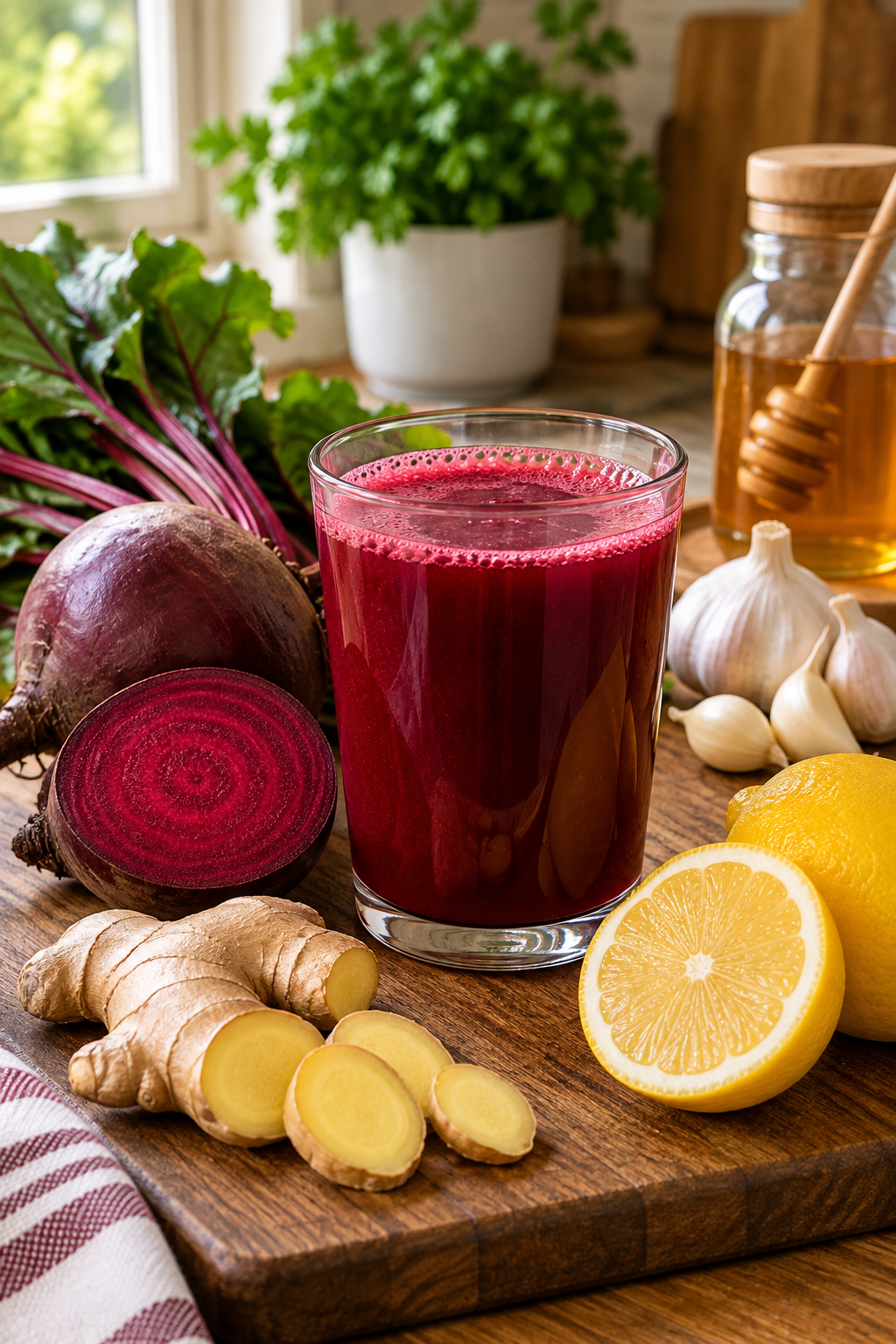
And online, one deep-red drink is repeatedly promoted as the answer:
Beetroot juice.
Unlike many viral circulation remedies, beetroot actually has an interesting scientific mechanism behind it.
Beets are naturally rich in dietary nitrate, which the body can convert through the nitrate–nitrite pathway into nitric oxide. Nitric oxide participates in blood-vessel relaxation and vascular function. Clinical research has found that nitrate-rich beetroot juice can modestly lower blood pressure and may improve some measures of vascular function.
But this needs an important reality check.
Beetroot juice has not been proven to instantly “blast open” blocked arteries, remove plaque, permanently restore circulation, or cure cold feet.
And persistently cold or painful feet can sometimes be a sign of a circulation problem that deserves medical attention.
So what can this red drink realistically do?
❤️ Why Beetroot Gets So Much Attention
The story starts with nitrate.
After nitrate-rich foods are consumed, some dietary nitrate is converted to nitrite and ultimately nitric oxide through several biological pathways.
Nitric oxide can influence the smooth muscle surrounding blood vessels, helping regulate vascular tone.
This is why researchers have investigated beetroot juice for:
Blood pressure.
Endothelial function.
Exercise performance.
Walking ability.
And peripheral artery disease.
That is considerably more scientifically plausible than saying beet juice simply “cleans the arteries.”
🥤 A Simple Beetroot Drink
You don’t need a complicated ten-ingredient circulation tonic.
A simple homemade version can use:
½ small raw or cooked beet
½–1 cup water
A squeeze of fresh lemon, optional
Blend until smooth.
You can strain it if you prefer juice, although leaving the pulp provides more of the whole-food fiber.
Start with a modest portion rather than an enormous glass.
Commercial beetroot juice is another option, but check the label for added sugars and serving size.
This is a food—not an emergency treatment.
⏱️ Does Beetroot Really Work “Suddenly”?
Some physiological effects of dietary nitrate can occur relatively soon after ingestion.
But that doesn’t mean a person with poor circulation will suddenly feel warm blood rushing through previously blocked arteries.
Research on beetroot juice has looked at interventions ranging from acute doses to weeks of supplementation.
A meta-analysis involving seven trials and 218 adults with hypertension found that nitrate-rich beetroot juice consumed in amounts ranging from about 70–250 mL per day for 3–60 days reduced systolic blood pressure by an average of roughly 5 mmHg compared with controls. The effect on diastolic pressure was not statistically significant.
That’s interesting.
But a five-point blood-pressure change is very different from:
“Your circulation explodes back to life in 20 minutes.”
🩸 Why Blood Pressure and Circulation Aren’t the Same Thing
This distinction matters.
A food can influence vascular tone without removing an obstruction.
Imagine a garden hose.
Relaxing the hose slightly is different from removing a solid blockage inside it.
Peripheral artery disease, or PAD, involves atherosclerotic plaque affecting arteries supplying the limbs.
Beetroot nitrate may influence nitric-oxide biology.
It does not dissolve atherosclerotic plaque.
So someone with PAD should not replace established treatment with beetroot juice simply because their blood pressure improves after drinking it.
🚶 The Most Interesting Research: Walking With PAD
This is where beetroot becomes particularly interesting.
Peripheral artery disease reduces blood flow to the legs and can cause pain, aching, heaviness, or cramping during walking.
A 2025 systematic review examined beetroot juice in people with confirmed PAD.
Only five randomized trials involving 64 patients met the review criteria.
Some studies reported improvements in walking outcomes and blood pressure, while others showed no significant difference or improvements in both treatment and control groups.
The researchers concluded that beetroot juice may have potential benefits for exercise capacity and blood pressure—but emphasized that the evidence remains preliminary because the studies were small and heterogeneous.
That’s the responsible interpretation.
Promising? Yes.
Proven treatment? No.
🚶♂️ One Small Study Produced an Interesting Walking Result
One randomized crossover trial studied 11 people with PAD.
After dietary nitrate from beetroot juice, researchers reported improvements in endothelial function and reductions in systolic blood pressure.
Participants also increased their maximal walking distance by approximately 93 meters and walking time by about 56 seconds compared with their baseline response.
However, the study was extremely small, and claudication onset itself did not significantly change.
So this shouldn’t become:
“Beet juice cures poor circulation.”
A better conclusion is:
Dietary nitrate may influence vascular function and exercise capacity in some people with PAD, but larger trials are needed.
🦵 What Does PAD Actually Feel Like?
One classic symptom is intermittent claudication.
That usually means:
Pain.
Aching.
Heaviness.
Tightness.
Or cramping
in the calf, thigh, buttock, or foot that appears during walking or climbing stairs and improves after rest.
The National Heart, Lung, and Blood Institute identifies this pattern as the most common PAD symptom.
But here’s the tricky part:
Not everyone with PAD experiences classic symptoms.
NHLBI reports that only about one-quarter of people with PAD experience the classic symptoms, while many have atypical symptoms or none at all.
That’s why “my legs don’t hurt” doesn’t necessarily rule it out.
🧊 What About Cold Feet?
Cold feet are extremely common and don’t automatically mean blocked arteries.
Your feet may feel cold because of:
A cold environment.
Normal changes in temperature regulation.
Nerve problems.
Certain medications.
Thyroid problems.
Anemia.
Diabetes-related neuropathy.
Or circulation problems.
But one foot being noticeably colder than the other deserves more attention.
NHLBI lists a foot that feels colder than the other as one possible PAD symptom. Other warning signs can include pale, discolored, or blue skin; weakness or numbness; reduced hair or toenail growth; and slow-healing wounds.
Beet juice should not be used to cover up those signs.
⚠️ One Cold Foot Is Different From Two Cold Feet
Suppose both feet feel cold every winter.
That’s one situation.
Now suppose:
Your right foot suddenly feels much colder than your left.
It becomes pale.
Pain increases.
The foot becomes numb.
That is very different.
A sudden major change in circulation can require urgent evaluation.
Don’t spend hours waiting for beetroot juice, ginger tea, or another home remedy to “kick in.”
🫀 Beetroot Doesn’t Unclog Arteries
This is probably the most important myth to eliminate.
Atherosclerosis involves plaque buildup within arterial walls.
Beetroot juice does not act like drain cleaner.
It does not travel through the bloodstream scraping cholesterol from arteries.
The nitrate → nitrite → nitric oxide pathway may influence blood-vessel function.
That’s useful biology.
But it is not plaque removal.
📊 Viral Claims vs. What Research Actually Supports
| Claim | Evidence-based view |
| Beetroot causes an instant circulation surge | Exaggerated |
| Beetroot contains dietary nitrate | Yes |
| Nitrate can contribute to nitric oxide production | Yes |
| Beetroot may modestly reduce blood pressure | Yes |
| Beetroot instantly warms cold feet | Not established |
| Beetroot dissolves artery plaque | No |
| Beetroot may improve some vascular measures | Some evidence |
| Small PAD trials suggest possible walking benefits | Yes, preliminary |
| Beetroot replaces PAD medication | No |
| A persistently cold/discolored foot should be evaluated | Yes |
❤️ Beetroot and Blood Pressure
The blood-pressure evidence is stronger than the “cold feet cure” evidence.
A systematic review and meta-analysis of randomized trials in people with hypertension found an average systolic reduction of approximately 4.95 mmHg from nitrate-rich beetroot juice compared with control treatment.
Another broader meta-analysis found that beetroot juice supplementation was associated with reductions in both systolic and diastolic blood pressure, although results varied across trials.
This means beetroot may have a legitimate place in a heart-healthy diet.
But it also creates an important caution.
💊 If You Already Take Blood-Pressure Medicine
Don’t assume that because beetroot is a vegetable it cannot affect you.
If you already have:
Low blood pressure.
Dizziness when standing.
A history of falls.
Or several blood-pressure medications,
regular concentrated beetroot juice deserves more caution.
Because nitrate-rich beetroot can lower blood pressure in some people, combining it with an already effective treatment plan could potentially make dizziness or lightheadedness more noticeable.
That doesn’t mean everyone taking hypertension medication must avoid beets.
It means food-level intake and concentrated daily juice aren’t always the same thing.
Talk with your clinician if you plan to use concentrated beetroot juice regularly and you already struggle with low readings or dizziness.
👴 Why This Matters More After 60
Falls become more consequential as we age.
A circulation drink isn’t useful if it leaves you lightheaded when you stand up.
If you’re experimenting with beetroot juice and already take blood-pressure medication, pay attention to:
Dizziness.
Weakness.
Feeling faint.
Unsteadiness.
Unusually low blood-pressure readings.
The goal isn’t to push blood pressure as low as possible.
The goal is healthy cardiovascular function.
🥬 Beetroot Isn’t the Only Nitrate-Rich Food
This is another important point.
You do not need beetroot juice to obtain dietary nitrate.
Other nitrate-rich vegetables include leafy greens such as:
Arugula.
Spinach.
Lettuce.
Celery.
And other leafy vegetables.
That means the bigger lesson isn’t:
“Everyone needs a beet shot.”
It’s:
“Vegetable-rich dietary patterns provide compounds that support cardiovascular health.”
👄 Your Mouth Is Part of the Nitrate Pathway
This surprises many people.
Oral bacteria participate in converting nitrate into nitrite, which contributes to the nitrate–nitrite–nitric oxide pathway.
So the mouth isn’t merely a passageway for beet juice.
It participates in the chemistry.
This has led researchers to investigate whether strong antibacterial mouthwash can alter nitrate metabolism.
That doesn’t mean you should stop normal dental hygiene.
It simply shows how much more complicated the biology is than:
“Drink red juice → arteries open.”
🥤 Juice or Whole Beet?
Both have advantages.
Whole Beet
Provides fiber.
More filling.
Slower to consume.
Fits naturally into meals.
Beetroot Juice
Provides a concentrated dose.
Easy to consume.
Commonly used in nitrate research.
But it is easy to drink a much larger quantity of beet than you would normally eat.
If your goal is simply healthy eating rather than reproducing a clinical experiment, roasted, steamed, or grated beet is perfectly reasonable.
🍋 Do You Need Lemon?
No.
Lemon can improve flavor.
That’s enough.
You don’t need to pretend that lemon “activates” beetroot or strips plaque from arteries.
A squeeze of lemon can simply make the drink taste fresher.
Sometimes the simplest explanation is the correct one.
🫚 What About Adding Ginger?
Ginger is another reasonable culinary ingredient.
If you enjoy it, adding a small slice to beetroot juice is fine for many people.
But combining two healthy foods doesn’t suddenly create a vascular medication.
“Beet + ginger” should not become:
“Natural angioplasty.”
That’s not how arterial disease works.
🧄 What About Garlic?
Garlic can also fit into a heart-conscious diet.
But again, the best use is often culinary:
Use garlic, herbs, lemon, pepper, and spices to make minimally processed foods flavorful without relying heavily on sodium.
Don’t expect garlic to dissolve an obstruction in your leg.
🚶 Walking Is More Powerful Than Many People Realize
If someone has PAD, structured exercise isn’t just generic wellness advice.
Walking is an important part of PAD management.
Beetroot research itself often focuses on walking performance, which tells you something important:
The goal isn’t merely to make feet temporarily feel warm.
It’s to improve functional mobility while properly managing the underlying cardiovascular disease.
A drink can complement healthy habits.
It should not replace them.
🚬 Smoking Changes the Circulation Conversation Completely
For someone concerned about leg circulation, smoking is a far more important target than finding the perfect juice.
PAD is an atherosclerotic cardiovascular disease.
That means managing the major cardiovascular risks matters:
Smoking.
Blood pressure.
Cholesterol.
Diabetes.
Physical activity.
Weight when appropriate.
And prescribed medication.
Beetroot juice is a side character in that story.
Not the main treatment.
🍬 Diabetes and Cold Feet
Diabetes complicates the picture because cold, numb, tingling, or painful feet can involve nerve damage as well as circulation.
Someone may say:
“My feet are cold, so blood isn’t reaching them.”
But the sensation can also be neurological.
That’s why persistent foot symptoms in someone with diabetes deserve proper evaluation rather than self-diagnosis.
And diabetic feet should be checked regularly for:
Cuts.
Blisters.
Color changes.
Pressure injuries.
And wounds that aren’t healing.
🦶 A Wound That Won’t Heal Is a Warning
This is one symptom that should never be dismissed.
NHLBI lists sores on the toes, feet, or legs that heal slowly—or don’t heal—as a possible sign of PAD.
A nonhealing foot wound isn’t a signal to double the beetroot dose.
It is a signal to get medical care.
🚨 When Cold Feet Become an Urgent Problem
Seek prompt medical evaluation if you develop:
A foot suddenly becoming much colder than the other.
Significant color change.
New numbness or weakness.
Severe foot or leg pain at rest.
A wound that isn’t healing.
Increasing redness or infection around a wound.
NHLBI notes that severe PAD can cause pain even at rest and can lead to sores, infection, and potentially limb loss when untreated.
Those symptoms require more than nutritional experimentation.
🚫 10 Beetroot Mistakes to Avoid
1. Calling beetroot an artery cleaner.
It does not dissolve atherosclerotic plaque.
2. Expecting an immediate circulation explosion.
Nitric-oxide biology is real, but the viral description is exaggerated.
3. Assuming warm feet prove arteries have opened.
Skin temperature isn’t a reliable test of arterial health.
4. Ignoring one foot being colder than the other.
That can be a PAD warning sign.
5. Replacing prescribed cardiovascular treatment with beetroot juice.
6. Drinking huge concentrated servings.
Clinical studies use controlled preparations and doses.
7. Ignoring low blood pressure or dizziness.
Beetroot nitrate can reduce blood pressure in some people.
8. Assuming every case of tired legs is poor circulation.
Muscle, joint, nerve, medication, and other medical problems can cause similar symptoms.
9. Ignoring nonhealing foot wounds.
10. Using beetroot instead of getting persistent symptoms evaluated.
🩺 How Doctors Check Leg Circulation
If symptoms suggest PAD, healthcare professionals don’t diagnose it by asking whether beet juice makes your feet warmer.
They can assess symptoms, pulses, medical history, and cardiovascular risk factors.
One commonly used test is the ankle-brachial index (ABI).
It compares blood pressure measured at the ankle with blood pressure measured in the arm.
Depending on the situation, additional vascular testing may be needed.
This is far more informative than guessing based on foot temperature.
📅 A Better 7-Day Experiment
If you’re otherwise medically able to consume beetroot and simply want to see whether it fits your diet, use the week to collect information instead of promising yourself a cure.
Record:
Morning blood pressure if you normally monitor it.
Whether you experience dizziness.
How far you comfortably walk.
When leg discomfort starts.
Whether rest relieves it.
Whether both feet feel equally warm.
Any numbness or tingling.
Any skin-color changes.
Any wounds.
If you repeatedly develop calf discomfort at roughly the same walking distance and it improves after resting, tell your healthcare professional.
That pattern is much more important than whether beetroot made you feel temporarily warmer.
❓ Frequently Asked Questions
What is the deep-red circulation drink?
Beetroot juice is the most likely candidate. Beets contain dietary nitrate, which participates in the body’s nitrate–nitrite–nitric oxide pathway.
Does beetroot juice increase circulation?
Research suggests dietary nitrate can influence vascular function, and some studies have demonstrated improved endothelial function. However, saying it causes a dramatic “circulation surge” exaggerates the evidence.
Can beetroot juice help tired legs?
Possibly in certain contexts. Small studies involving people with PAD have reported improvements in walking performance, but a 2025 systematic review found the overall evidence preliminary and based on only 64 participants across five randomized trials.
Does beetroot juice unclog arteries?
No. It has not been shown to remove atherosclerotic plaque.
Can beetroot lower blood pressure?
Yes, modestly in some people. A meta-analysis in hypertension found an average reduction of approximately 5 mmHg in systolic pressure with nitrate-rich beetroot juice.
Will beetroot make cold feet warm?
It isn’t established as a treatment for chronically cold feet. Cold feet have multiple possible causes.
Why is one foot colder than the other?
Differences in arterial circulation are one possibility. NHLBI lists one foot being colder than the other among possible PAD symptoms.
Is calf pain while walking a circulation problem?
It can be. Pain, aching, heaviness, or cramping that occurs with walking and improves after rest is called intermittent claudication and is a classic PAD symptom.
Can people taking blood-pressure medicine drink beetroot juice?
Many can consume beets as food, but concentrated nitrate-rich juice can lower blood pressure. Someone taking antihypertensive medication—especially with low readings, dizziness, or falls—should discuss regular concentrated use with their clinician.
What’s more important than beetroot for poor leg circulation?
Identifying the cause and treating cardiovascular risk factors. Persistent walking-related leg pain, major temperature differences between feet, discoloration, rest pain, or slow-healing wounds deserve medical evaluation.
⭐ The Bottom Line
Beetroot juice is one of the rare viral “circulation drinks” with a genuinely interesting scientific basis.
Its dietary nitrate can participate in nitric-oxide production, and randomized research suggests beetroot may modestly reduce blood pressure and improve certain measures of vascular function.
Small studies in people with peripheral artery disease have also reported improvements in walking ability and vascular measures.
But the newest systematic review found only five randomized trials totaling 64 patients, with inconsistent results and important limitations. Researchers therefore consider the evidence promising but preliminary.
So beetroot juice may deserve a place in a healthy diet.
It does not:
Blast blocked arteries open.
Melt plaque.
Guarantee warm feet.
Cure peripheral artery disease.
Or replace cardiovascular treatment.
And if tired legs appear predictably when walking, one foot is consistently colder than the other, your foot changes color, or a wound refuses to heal, don’t simply increase the beetroot.
Those can be warning signs of impaired leg circulation.
Use the red drink as food—not as a substitute for finding out why your feet are cold.