
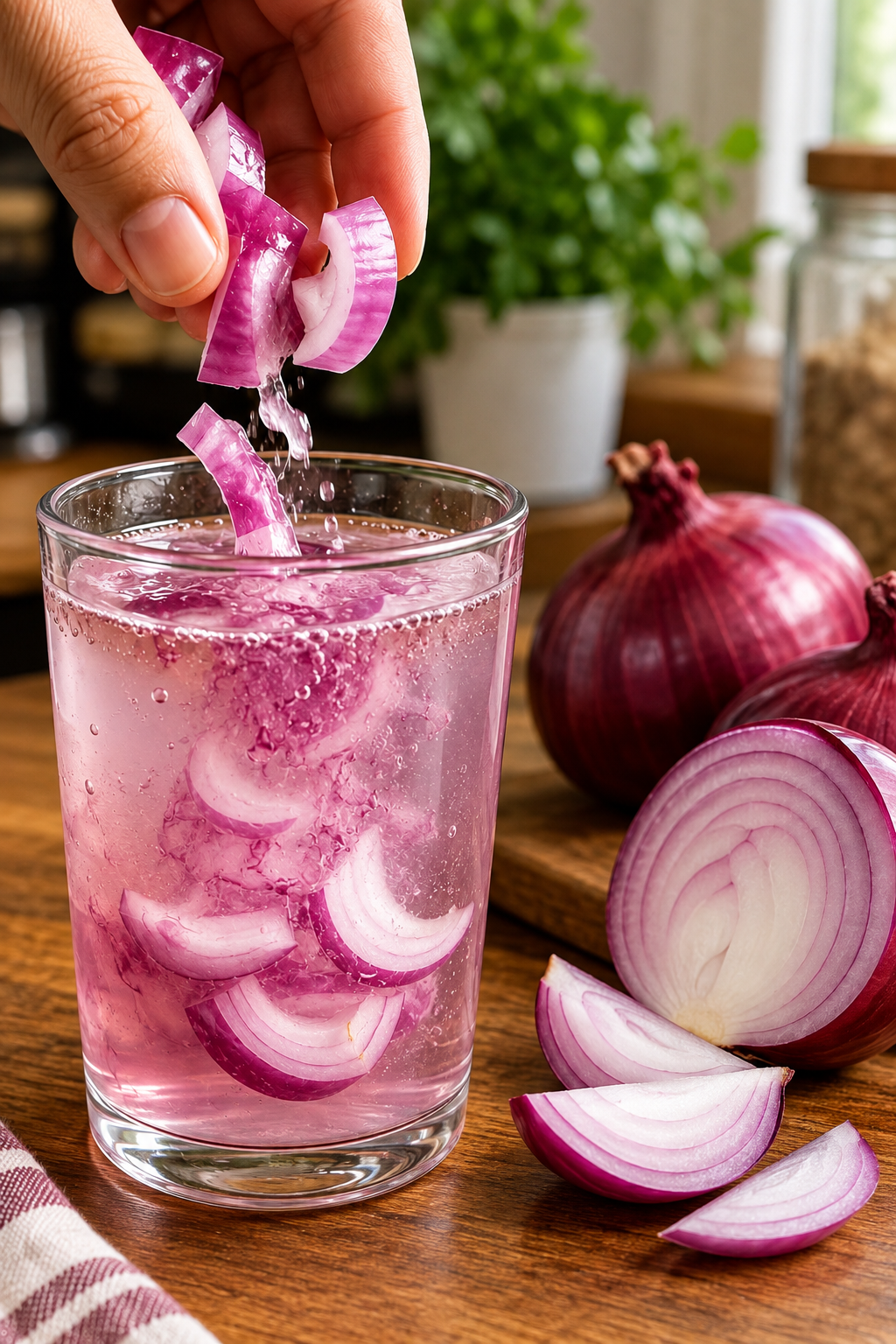
“Eat onion for five days and blurry vision resets.”
It is the kind of promise that spreads quickly because onions contain plant compounds such as quercetin, an antioxidant flavonoid that has attracted legitimate eye-health research.
But the headline goes much further than the evidence.
There is no good clinical evidence that eating onions for five days can reverse blurry vision, remove cataracts, restore damaged retinas, cure glaucoma, or “reset” aging eyes.
Blurry vision is a symptom, not a diagnosis. It can come from something as simple as dry eye or an outdated glasses prescription—or from conditions such as cataracts, glaucoma, diabetic eye disease, retinal problems, or other disorders that need treatment. The National Eye Institute notes that several major causes of low vision in older adults include age-related macular degeneration, cataracts, diabetic retinopathy, and glaucoma.
So onions can stay on the plate.
They just should not replace an eye exam.
🧅 Where the Onion-Vision Idea Comes From
Onions contain several plant compounds, including quercetin.
Quercetin has antioxidant and anti-inflammatory properties, and researchers have studied it in relation to eye tissues.
That scientific connection is real.
The leap to “five days restores vision” is not.
Recent research on quercetin and cataracts has included animal and laboratory models. For example, a 2025 study found protective effects of quercetin in a mouse cataract model and cultured lens cells. That is interesting mechanistic research, but it does not show that eating onions reverses cataracts in humans.
Another review of quercetin and age-related eye disease notes that most evidence remains preclinical and that clinical application is still limited.
That’s the key distinction:
Promising molecule ≠ proven onion treatment.
👁️ Why Blurry Vision Needs a Cause, Not a “Reset”
Imagine two people both saying:
“My vision is blurry.”
One has dry eye.
The other has diabetic macular edema.
Those problems need completely different management.
The National Eye Institute explains that macular edema can cause blurry or wavy central vision and may result from conditions such as diabetic retinopathy or age-related macular degeneration.
Other causes of blurred vision can involve the cornea. NEI notes that dry eye and corneal disorders can affect vision, and it recommends prompt evaluation for significant changes in vision, blurry vision, intense eye pain, or very red and watery eyes.
No kitchen ingredient can tell you which condition you have.
🧅 What Can Onions Realistically Offer?
Onions are nutritious vegetables.
They can provide:
Fiber.
Vitamin C.
Flavonoids such as quercetin.
Sulfur-containing compounds.
And flavor that may help make vegetable-rich meals more enjoyable.
Human research confirms that compounds derived from onion can be absorbed. One controlled study found measurable quercetin exposure after participants consumed onion-skin extract, although the dose and preparation were very different from eating an ordinary onion with dinner.
That supports onions as an interesting dietary source of quercetin.
It does not establish them as a treatment for blurred vision.
📊 Viral Claim vs. What the Evidence Shows
| Claim | What we actually know |
| Onion restores blurry vision in 5 days | Not established |
| Onion contains quercetin | Yes |
| Quercetin has antioxidant activity | Yes |
| Quercetin has shown eye effects in lab/animal studies | Yes |
| Eating onion reverses cataracts | Not established |
| Onion treats glaucoma | No established evidence |
| Onion repairs diabetic retinal damage | No established evidence |
| Sudden blurry vision can require urgent care | Yes |
| A dilated eye exam can help identify the cause | Yes |
🔬 What Does Quercetin Research Actually Show?
Quercetin is scientifically interesting.
Laboratory research has shown that it can influence oxidative-stress pathways in lens cells. An older experimental study found quercetin reduced oxidative damage in cultured human lens epithelial cells.
Other animal research has suggested potential protection against lens opacification.
A broader ophthalmology review discusses possible applications involving cataracts, glaucoma, retinal disorders, and other eye diseases. But much of this work involves cells, animals, pharmacologic preparations, or specialized delivery methods rather than ordinary dietary onion.
That means a scientifically responsible conclusion is:
Quercetin deserves research.
Not:
“One onion fixes blurry vision.”
🥗 Food-Level Onion vs. Quercetin Treatment
This distinction is often missing from viral health videos.
Eating:
A few slices of onion in a salad
is not equivalent to:
A purified quercetin dose.
And neither is equivalent to:
A drug delivered directly to eye tissue.
Concentration matters.
Absorption matters.
Dose matters.
Delivery method matters.
Disease matters.
A substance working in lens cells in a laboratory dish does not mean enough of it reaches an older adult’s eye after eating onions to reverse an eye disease.
👴 Why Blurry Vision Becomes More Important After 55
Age doesn’t automatically cause serious vision loss.
But many eye conditions become more common with age.
NEI notes that low vision is more common among older adults because diseases that cause vision loss—including AMD, cataracts, diabetic retinopathy, and glaucoma—become more common. Aging by itself is not the same as disease.
That makes persistent blurry vision after 55 something worth checking instead of dismissing as:
“I’m just getting old.”
🌫️ Could It Simply Be Cataracts?
Cataracts can gradually make vision:
Cloudy.
Hazy.
Less sharp.
Sensitive to glare.
Difficult at night.
But an onion diet has not been shown to dissolve an established cataract.
Experimental quercetin research should not be confused with clinically proven treatment in humans.
If cataracts are interfering significantly with daily life, an eye doctor can determine whether cataract treatment is appropriate.
💧 Could Dry Eye Be Causing the Blur?
Yes.
Dry eye can cause fluctuating vision.
Someone may notice that vision temporarily clears after blinking and then becomes hazy again.
NEI identifies dry eye as a corneal condition that can cause vision problems.
Interestingly, one small pilot study examined quercetin from onion intake and tear-related measures. Researchers detected quercetin-related compounds in tears after onion consumption, but that does not establish onion as a treatment for chronic blurry vision or dry-eye disease.
This is another good example of a preliminary finding becoming exaggerated online.
🍬 Could Blood Sugar Be Behind Blurry Vision?
Yes.
Changes in blood glucose can affect vision.
More importantly, long-term diabetes can damage retinal blood vessels and contribute to diabetic retinopathy or diabetic macular edema.
NEI identifies diabetic retinopathy as a major cause of low vision and notes that diabetic macular edema can produce blurry vision.
If someone with diabetes experiences changing vision, controlling blood sugar and getting regular dilated eye exams matters far more than beginning a five-day onion routine.
🚫 Onion Cannot Replace Glaucoma Treatment
Glaucoma is especially dangerous because some types can damage vision without obvious early symptoms.
Onion is not a glaucoma treatment.
NEI explains that treatments that lower eye pressure help slow glaucoma and that people at increased risk need comprehensive dilated eye exams on a regular schedule.
And one specific form—acute angle-closure glaucoma—is a medical emergency.
🚨 Blurry Vision + Eye Pain Can Be an Emergency
If blurry vision suddenly appears with:
Severe eye pain.
A red eye.
Nausea.
Vomiting.
or significant headache,
seek urgent medical care.
NEI states that angle-closure glaucoma can present with intense eye pain, nausea, a red eye, and blurry vision, and recommends immediate medical attention.
That is not a situation for:
Onion water.
Carrot juice.
Herbal drops.
Or waiting five days.
⚡ Flashes, Floaters or a Curtain Over Vision
Another emergency pattern is:
A sudden shower of new floaters.
Flashing lights.
A dark curtain or shadow crossing part of your vision.
These are warning signs of possible retinal detachment.
NEI advises immediate eye care because retinal detachment can cause permanent vision loss, while prompt treatment can help protect sight.
Again:
Do not wait for a food remedy to work.
🩸 Sudden Blurring in One Eye Also Matters
A retinal blood-vessel problem can cause sudden blurry vision or vision loss.
For example, central retinal vein occlusion usually affects one eye and can produce blurred vision or sudden vision loss. NEI notes that early treatment may reduce the risk of further vision loss.
Any sudden unexplained vision change deserves prompt attention.
🧅 Should You Eat Raw Onion Every Morning?
You can eat onions as part of your diet if you tolerate them.
But there is no evidence-based requirement to:
Eat them raw.
Eat them before breakfast.
Eat them on an empty stomach.
Eat them for exactly five days.
Or combine them with honey, lemon, garlic, or another ingredient for eyesight.
Cooked onion still remains a nutritious vegetable.
The dramatic ritual is marketing—not ophthalmology.
🔥 Raw Onion Can Have Downsides
Raw onion may trigger gastrointestinal symptoms in some people, particularly:
Heartburn.
Gas.
Bloating.
Abdominal discomfort.
People with sensitive digestion do not need to force raw onion because a video promises vision improvement.
Food should not hurt to prove it is “working.”
👁️ Never Put Onion Juice in Your Eyes
This deserves special emphasis.
Do not drip onion juice, onion water, garlic juice, lemon juice, honey mixtures, or homemade herbal liquids directly into your eyes.
The eye surface is delicate.
Unsterile homemade solutions can cause:
Severe irritation.
Chemical injury.
Inflammation.
Contamination.
Or infection.
Eating onions is one thing.
Putting onion liquid directly into an eye is entirely different.
🥕 What About Carrots?
Carrots provide beta-carotene, which the body can convert to vitamin A.
Vitamin A is important for normal vision.
But in a well-nourished person without deficiency, eating massive amounts of carrots does not create super-vision or reverse ordinary age-related eye disease.
The same principle applies to onions:
Nutrient-rich foods support health.
They are not instant repairs.
🥬 A Better Food Pattern for Aging Eyes
Rather than betting everything on one onion, build meals around a variety of nutrient-rich foods.
Think:
Leafy green vegetables.
Colorful vegetables.
Fruit.
Beans.
Whole grains.
Fish when appropriate.
Nuts and seeds.
Healthy fats.
Onions and garlic can absolutely be part of that pattern.
What matters is the overall diet over months and years—not a five-day challenge.
🕶️ Habits That Matter More Than an Onion Challenge
Eye health after 55 is supported by several practical habits:
Don’t smoke.
Protect eyes from excessive UV exposure.
Control diabetes.
Manage blood pressure.
Stay physically active.
Eat a balanced diet.
Use prescribed eye medication correctly.
Get regular eye examinations.
The exact exam schedule depends on age and individual risk. NEI notes, for example, that people at higher risk for glaucoma may need a comprehensive dilated eye exam every one to two years.
🧪 “But My Vision Improved After Eating Onion”
That can happen without proving the onion was responsible.
Blurry vision may fluctuate naturally.
Dry eye may improve temporarily.
Blood sugar may change.
Lighting may be different.
Your eyes may simply be less tired.
Or the blur may have resolved independently.
A personal experience can be meaningful to the individual but cannot establish that onion reversed the underlying condition.
🚫 10 Mistakes to Avoid With the “5-Day Onion Trick”
- Expecting blurry vision to disappear in five days. No clinical evidence establishes this.
- Assuming all blurry vision is caused by aging. Several eye diseases can produce blur.
- Putting onion juice directly into the eyes.
- Delaying an eye examination while testing the remedy.
- Assuming quercetin laboratory research proves onions cure cataracts. Much of the evidence remains experimental or preclinical.
- Ignoring diabetes. Diabetic eye disease can cause blurry vision.
- Ignoring sudden floaters or flashes. They can signal retinal detachment.
- Ignoring severe eye pain and redness. Acute glaucoma can threaten vision.
- Taking high-dose quercetin supplements because onions contain quercetin. Food and supplement doses are not equivalent.
- Believing that five days without improvement means you simply need a stronger recipe.
📅 A Better 5-Day Vision Check
If you like the “five-day” idea, use five days to observe, not to promise a cure.
Write down:
Whether one or both eyes are blurry.
Whether the blur is constant or comes and goes.
Whether blinking temporarily clears it.
Whether distance or near vision is worse.
Whether straight lines appear wavy.
Whether you see halos.
Whether you have new floaters or flashes.
Whether there’s pain or redness.
Whether you have diabetes.
Whether symptoms are changing.
That information can be far more useful during an eye examination than knowing how many onions you ate.
🧪 Eye Exams Can See What a Kitchen Remedy Cannot
A comprehensive eye examination can assess structures that you cannot evaluate at home.
Depending on symptoms, an eye professional may evaluate:
Vision.
Refraction.
Cornea.
Lens.
Eye pressure.
Optic nerve.
Retina.
Macula.
And blood vessels.
NEI notes that a dilated eye exam is an important way to identify causes of low vision and several retinal conditions.
❓ Frequently Asked Questions
Can onion improve blurry vision in five days?
There is no reliable clinical evidence showing that eating onion restores blurry vision within five days.
Is onion good for eye health?
Onion is a nutritious food and contains quercetin. Quercetin has shown interesting antioxidant and eye-related effects in laboratory and animal research, but clinical evidence for treating human eye disease remains limited.
Can onion remove cataracts?
No evidence shows that eating onion removes an established cataract.
Does quercetin prevent cataracts?
Experimental research is promising, including animal and cell studies, but this has not established dietary quercetin or onion as a proven cataract treatment in humans.
Should I put onion juice in my eyes?
No. Do not place homemade onion preparations directly into the eyes.
Can blurry vision come from dry eyes?
Yes. Dry eye can cause vision problems and fluctuating blur.
Can diabetes cause blurred vision?
Yes. Diabetes can contribute to retinal disease, including diabetic macular edema, which may cause blurry vision.
What if only one eye suddenly becomes blurry?
Sudden unexplained vision loss or blurring in one eye deserves prompt medical evaluation. Retinal vascular problems are one possible cause.
What if I see flashes and new floaters?
Seek urgent eye care, particularly if you also notice a curtain or shadow in your vision. These can be symptoms of retinal detachment.
What if my eye is painful, red, and blurry?
Seek urgent care. Acute angle-closure glaucoma can produce intense eye pain, redness, nausea, and blurred vision and can threaten sight.
⭐ The Bottom Line
Onions deserve a place in a healthy kitchen.
They contain quercetin and other plant compounds that researchers continue to investigate. Experimental research suggests quercetin may influence oxidative-stress and other pathways relevant to eye health.
But that does not mean a five-day onion routine can:
Reverse blurry vision.
Dissolve cataracts.
Repair the retina.
Lower glaucoma pressure.
Or restore age-related vision loss.
Blurry vision can come from numerous causes, including dry eye, cataracts, diabetic retinal disease, glaucoma, macular disease, corneal problems, and retinal vascular disorders.
So eat onion if you enjoy it.
Include colorful vegetables in your diet.
But if your vision remains blurry—especially after 55—find out why it is blurry rather than trying to overpower the symptom with a stronger home remedy.
And if vision changes suddenly, you develop severe eye pain or redness, or you notice flashes, new floaters, or a curtain-like shadow, seek urgent eye care rather than waiting five days.